Sunday, April 19, 2009

Japan's Finest: Monster Plagues

Dear readers I have failed you. Despite my promises of weekly anime and manga commentary, there was none to be had. I will endeavor to correct this error with an extra post this week, but the quarter is getting busier, and putting out two posts a week may be a tad over-optimistic. Now I shall address another oversight:

While I initially intended to discuss the difference between Shonen and Shoujo art styles, I realized my last post missed a rather important chapter of anime's assimilation into America's cultural consciousness: The Monster Plagues. From 1998 to around 2003, America was wracked by Japanese monster collecting franchises. Nobody knows advertising and merchandising like the 日本人, particularly because there is a social element to it. Popular fiction is designed with a sort of brand recognition in mind, blending consumerism and cultural consciousness in a way that would send George Lucas to the Sepuku Mat with shame. America's youth got a taste of this with the Power Ranger craze that came in the mid 90's, although the franchise was rebuilt from scratch in the USA for the USA, and merely based on the Japanese concept of Sentai. Even earlier than that, Transformers demonstrated the lucrative potential of using a cartoon to market toys.

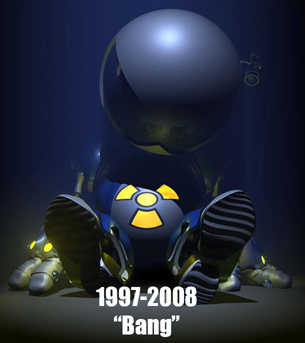
You used the Multimedia stone! What...!? Mickey is evolving!


Congratulations! Your Mickey evolved to Pikachu!

The monster plagues are significant because they represent the first time foreign fictional universes were marketed towards children across a broad spectrum of socially interactive media. Disney has been doing cross-marketting for years, threading Saturday morning cartoons through coloring books, breakfast cereals and happy meals, but they were completely out-classed by the monster collecting menaces which emphasized fan interactivity at every corner. The card and video games were set up to require trading while the manga and anime brought the world behind the games to life.

The First Plague

I first learned about 'Pocket Monsters', or pokemon (lower case refers to the critters, uppercase refers to the franchise.) through an advertising video which arrived on my doorstep. I'm not sure if it was connected to my Nintendo Power subscription, or dropped off by some shady division of the JSDF which had profiled me as an easy target, but the tape captivated me immediately, introducing a bright and friendly world populated with adorable, elementally powered creatures just waiting to be collected in shiny metal balls.

I faithfully watched the anime when it came out, which furthered my indoctrination with insidiously catchy marketing jingles that taught me to memorize each one of the 150 critters names. The Anime, which is apparently still running to my great astonishment and slight horror, follows the adventures of Ash Ketchum and series mascot pikachu as they casually foil the plans of incompetent villains known as team rocket, try to catch 'em all and aspire to be "the very best, like no one ever was," (Click at your own risk, there is more singing).

This was all a preamble to the video game of course, which I pre-ordered and devoured upon arrival, eager to show off all my cartoon gained knowledge. The true evil genius behind the pokemon marketing strategy is that a player couldn't catch all the monsters by playing just a single version of the game. Rather, all the games critters were divided between a two versions of the game, and players were required to trade in order to collect all the creatures. Fortunately, a friend in grade school picked out the blue version to my red version, and we slowly mannaged to fill out our entire pokedex.
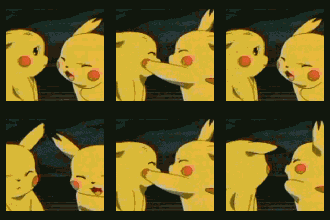

It was going to see the movie which really did in my parents' patience, prompting my father to point out "This is really sick." And so it is. Beneath the bright colors and adorable creature designs, Pokemon is really quite dark. You play the role of a pre-adolescent delinquent who wanders around assaulting, abducting and brainwashing animals that pose no apparent threat to society, all for the sake of casually pitting them against each other in gladiatorial combat. It was a truth I rejected when my parents first presented it to me, using dog fighting as the real world analogy. It seemed like hyperbolic comparison, but back then I could not articulate where they were crossing the line.

The trouble is, there is no real world reference for Pokemon, because it is a completely fabricated experience. In the real world, you can't transform something evil into something good or even something acceptable through presentation alone. In fact, trying to dress up the facts in a misleading way tends to compound its evil, especially in fields of Law (Hi Mom!) and Science (Hi Dad!). But video games are not reality.

Presentation establishes the laws of fictional universes. Series creator Satoshi Tajiri-Oniwa did not design Pokemon with animal duels in mind, but rather his hobby of collecting insects. Unfortunately, bug collecting is fairly uninteresting as a game because the only possible outcomes would be "You catch the bug!" and "The Bug got away!" In order to spice things up a bit, a rock-paper-scissors style combat system was implemented to add some depth to the creatures being collected, and the game play itself. The game is actually designed very specifically to punish excessive force (If you knock out the pokemon while trying to weaken it, you can't capture it), and to render violence inconsequential through healing items. It's not a formula which would work in real life, which is why its so pleasing as a game.

Fact vs. Fiction


The idea of inconsequential violence is alarming to a lot of people and for good reason: It's a concept which cannot exist in reality. The great fear is that players will start applying their experiences of these fictional places as if they were life lessons. It is not a baseless concern, though it is one that is frequently exaggerated when it can just as easily be overcome with some guidance and self restraint. My parent's realized this, so they let me keep playing but made sure I did other more necessary things at the same time.

My interest in Pokemon waned quickly however, mostly because I exhausted myself trying to navigate an untranslated import copy of Pokemon Gold after catching all 151 of the Red and Blue bastards, but also because I was bothered by the real world parallel that had been drawn between my favorite past-time and animal abuse. I knew bloodlust was not the driving force behind my monster collecting endeavors, but at the same time I didn't know what was. Looking back, I think the potential for discovery was another element in pokemon I found deeply appealing. Recess and afternoons playing in the back yard frequently meant pretending I was a pokemon trainer, though rather than imagining battles, I spent a great deal of time filling in the gaps of the game's world. How do Pokeballs work exactly? Are all animals in the Pokemon world pokemon? Are ghost-type pokemon born from dead people or dead pokemon? These are the sort of mundane details I am loathe to learn about reality, but utterly fascinated by when they pertain to a completely fabricated universe. Sadly, Pokemon simply walked away from all these questions.

Another huge element of appeal for Pokemon, and all the other monster combat collection series out there is the sense of having some secret knowledge. Considering how many things adults have mastery over, (Sex, Money, Cultural References, Professional knowledge) knowing about something parents have no hope of understanding is absolute bliss. It's even better when your friends don't know about it either. And for a good year or two, Pokemon was a fairly silent phenomenon. Once it was busted wide open, the appeal started to fade.

The Second Plague

Consequently, I shifted my focus toward Digimon, the next monster based anime card/video game property to hit the states. When I first heard of it, I was a rabid pokemaniac and I condemned it as a blatant ripoff based on the title, which is supposed to be short for 'Digital Monsters'. Apparently, most other kids drew the same conclusion and paid no further head to Bandai's take on monster collection. Digmon was never as popular as pokemon, which is sad, because its stories were a great deal more interesting.

I realized this when I actually watched the show and discovered it delved into many of Pokemon's disregarded questions. The story in the first season is still totally formulaic, but it actually bothers to explain how and why a bunch of brats are wandering through a dangerous world filled with monsters instead of attending school; a persistent logical blackhole in Pokemon's narrative. Another narrative boon is that the monsters are capable of human speech, unlike pokemon who can only say their names: a cute gimmick to begin with, but one that wears thin quickly. Furthermore, battles between digimon were generally necessary for survival as opposed to electively enslaving innocent creatures. Finally digital monsters had a much wider aesthetic range than psuedo-Sanrio appearance of pokemon, and occasionally managed to look somewhat bad ass.


Things really got interesting in the show's third season when it went all meta on itself, placing the story in the real world and referring to the events of the first two seasons as a TV show. Even though this shift was primarily intended to accommodate the new card game aspect of the franchise and advertise it to viewers, it was also a sound move narrative. The heroes had already saved the digital world (in the first season) and the real world (second season) so the change of pace was welcome. The question it posed to young viewers, "What if your favorite cartoon franchise became real?" invites an awesome story, though I honestly have no idea how it turned out. I had finally built up an immunity to all Mon-suffixed strains of monster plagues. It's worth mentioning that Digimon's video game properties, at least the ones I played, were inferior to the Pokemon franchise in terms of presentation and actual enjoyable game play.

The Third Plague

At some point, I was fascinated by YuGiOh! which was the first trend I ever predicted. When I inquired about an untranslated manga a thai classmate of mine was reading, he explained it was a "Card game comic book" and let me take a look. The monster designs alone told me it would be a hit: even more than Digimon, the monsters actually looked monstrous. About two years later, Kids WB brought the anime over, and the TCG (trading card game) started popping up on local shelves.

I dove into the card game excitedly, hoping to fill the card-game void within my heart that neither Magic: The Gathering, or The Pokemon TCG had been able to fill. It was then that I concluded card games are inherently evil. They are a bastion of hope for kids who can't afford to play video games, as a starter pack costs about half as much as a new top shelf console title, and the booster packs are just the right price for blowing one's allowance on, though ultimately, you end up spending about as much money on the cards as you would on a gaming system and a couple of titles. What's worse, the cards are next to useless unless you know somebody else who plays the game. If you do know somebody, it's even odds that he's an expert, or that they're just as clueless as you are. Even if you do get a feel for the game, and build a deck you're satisfied with, it will probably be rendered useless by the next batch of cards which come out. Then again, the cards do feature some very nice artwork, with creatures whose detail surpasses any pokemon or digimon I've ever seen.
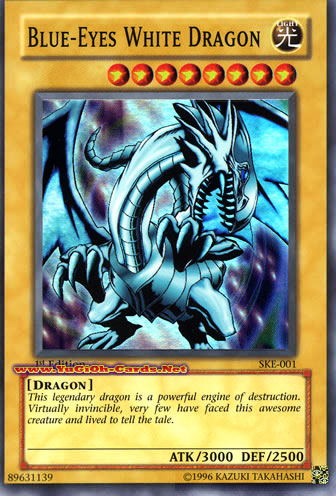

The narrative frame for YuGiOh! presents the card game as a modern take on an ancient game played by the Pharoahs of Egypt, though Wikipedia can probably tell you more than I can. I only caught the show a couple of times, and then only in it's first iteration. Like Dragon Ball, YuGiOh! has spawned an alphabet soup of other series set after it. From what I saw of the first version, the main character, Yugi, wears a magic puzzle around his neck which essentially puts him through puberty when he solves it, and has a ridiculously powerful five-carded monster that results in automatic victory if he draws it and...that's pretty much it. The character designs struck me as an awkward mix of too much style and not enough complexity, and even more than pokemon, the story is relentlessly faithful to the flow of the game battles.

When I concluded my last post, I mentioned that there was some debate about what constitutes anime, and whether it has gone mainstream as an art form. I have heard fellow anime fans argue, that series like Pokemon, YuGiOh and Digimon do not count as anime series at all, because they were series designed with globalization in mind from the start. It's an interesting position, but a weak one, since the shows all follow a decidedly Japanese aesthetic (picture below explains what I mean), and served as the gateway anime to many a young viewer. Not everybody was lucky enough to catch Toonami after all. The series may be heavily edited by localization, but there are occassionaly some good reasons for such cuts. (Again see below.)


Various strains and mutations of the Monster Plagues still exist to this day, and I suspect that they shall endure for many generations to come, as poxes tend to do.

Wednesday, April 15, 2009

You Sunk My Battlestar

A long time ago, a guy once wrote a play where a girl asks nobody in particular, "What's in a name?"

Most intelligent people figure out the correct answer is "Letters" and move on with their lives, but for some reason writers and philosophical types interpret the question as "How does language shape our definition of reality?" and spend the rest of their lives wrestling with it. Next thing they know, they're chasing shots of tequila with soy sauce instead of beer, practicing Iaido in the local park around midnight and... I'm talking about myself again.

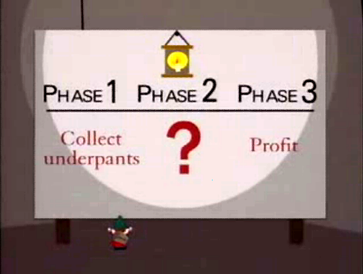
A similar, but much more manageable approach to such inquiries may be framed by the question: "What is a name trying to sell me?" It's a query I find myself pondering frequently in our modern world of advertising, most recently at word of SciFi Channel's decision to rename themselves Syfy. Evidently the goal is to shed their geeky image, but their explanation of how the name change will facilitate such a reinvention suggests a business strategy cribbed from the underwear gnomes of South Park. I can't see this turning out well for them, and it appears that I am not alone.

Then again, it wouldn't be the first time Science Fiction, or even Scifi Network managed to work with a bad name.

I honestly can't think of a television title which misrepresents the mood of its show more gravely than Battlestar Galactica: A compound noun that is nonsensical to those who don't know the context paired with a not-quite-made-up adjective is a concoction of such profound nerdiness that people who normally like Science Fiction find themselves derisively snickering and smirking at it. Of course, those who have seen the show realize it is The West Wing of Science Fiction.

For those who have no clue what I'm talking about, Battlestar Galactica is the title of several different TV shows where humanity searches the stars for a new home as they struggle to survive assaults from the Cylons: Robotic slaves turned Terminators. The specific series I'm referring to is the latest iteration of the franchise which recently concluded. The show was a 'reimagining' of its predecessors, which I have not seen, but based on what I've learned of chimpanzee cyborg dogs, I assume the title's..."whimsical" tone suited the original series better than the show in question.

"So what the frak is a reimagining?" you ask, only more politely because you are a better person than me? Aside from being a pretentious neologism, it's a narrative device that inhabits the curious space between a canonical Reboot, a la Batman Begins, and a good old fashion Remake, with a smattering of Pseudo-sequel thrown in for good measure. As one might guess, the intention is an overall image change. For BSG, the change was to be darker, more sophisticated and relevant in a post-9/11 world. It was a sizable hurdle, but armed with an impressive CGI budget (by SciFi's standards anyway) the series creators managed to clear it handsomely (below). Not everybody was pleased however.


The big change between this BSG and those of the past is that the Cylons have learned how to create synthetic people as opposed to just being robots. In some cases, these synthetic people think they are actual people, with feelings and memories and everything, until their Cylon overlords flip the kill-switch. Other times, these "skinjobs" are aware of their status from the start and serve as spies. Therefore, the war being fought in the show is as much about counter terror and counter intelligence as it is about big explosions and jumpin' through hyperspace (which ain't like dusting crops for all my farmboy readers out there). This emphasis on terror is established from the get-go, as the initial attack which destroys the human colonies is predicated on human incompetence and Cylon tactical espionage action.

The show also breaks new ground where politics are concerned. In fact, sociopolitical tensions within the fleet frequently present the Galactica with problems just as grave as Cylon attacks. Things like bigotry, working conditions, and freedom of press frequently come into play. The episode dealing with birth control and abortion within the fleet was particularly compelling, as it ends up pitting a woman's right to choose against humanity's need to procreate, in addition to the normal spiritual and ethical conundrums inherent to the debate. This practical stuff is a side of science fiction most series gloss over, following the rationale that practical considerations = boring. BSG manages to examine our everyday against another back drop and the results are compelling.

Religion is a much more common presence in Science Fiction, but BSG handles it in a timely and compelling manner. The viewer is led to examine the polytheistic humans and the monotheistic Cylons and determine who has the real god/belief system, as miracles grace both sides at various points in the show. [Broad Spoiler Warning] Eventually these two forces come to an uneasy truce and triumph over the remaining faction of atheistic Cylons, (but the arc of that last plot isn't nearly as long and trite as one would expect). Some of the spiritual issues are resolved in a muddled manner, or seem to drop off the radar altogether when the creators get bored with them, as I felt was the case with the 'Jesus Baltar' arc.

Then again, when you have characters who bounce between as many roles as the cast of Galactica it's almost inevitable that they'll end up feeling a bit cracked. Hell, a lot of the time the fissures are built in. Sometimes however, I got the sense that writers tried to achieve character depth by complexity. Gaius Baltar jumps back and fourth between scientific genius, traitor, scheming politician, charismatic spiritual leader, prisoner (and apparently soldier at the very end) according to the needs of the script. All the while, he remains the same lascivious, narcissistic prick who damned humanity at the beginning of the series, but you get the impression that the writer's have forgiven him, and that they would like you to consider him redeemed too. Apollo on the other hand, is a relentless golden boy, who juggles the hats of ace pilot, admiral, lawyer, and president without misplacing a hair from his part. It'd probably be better if I don't get started on the characters who have clones, but as you might expect, the plot can be difficult to follow at times.

It also suffers from some pacing issues periodically. Every season has at least a couple of episodes which feel like little more than scaffolding for future plot twists. Normally, this would be totally forgivable given the series' overall quality, but SciFi stretched the last season out over what felt like two years, but continued to pimp it as hard as they could. The marketing reached a new low with it's Last Supper promotion:


I'm no stranger to sacrilege, but I like to keep it funny and the series already takes itself too seriously. I realize the picture was the creators' ideas, and that there's a whole viral aspect of it that supposedly foreshadowed the identity of the final four Cylons, but it strikes me as the perfect example of why Science Fiction fandoms are condemned and ostracized: They literally make a religion out of their shows, and take the greatest pleasure from the most obscure details of their other world. It seems antithetical to BSG's socially relevant approach to Science Fiction, and it's a tendency which needs no encouragement.

In fact, this sort of seriousness is my chief complaint towards BSG. Don't get me wrong, it's incredibly refreshing to see an adult take on the space epic, but the show seems to regard any element of levity with terror, as if the narrative will somehow be consumed by the same sacharine cancer which ruined Star Wars, or the sort of self-deprecation cycle that rendered Stargate the Meg Griffin of Scifi TV. This is most apparent in the way that BSG addresses children. At best, they are portrayed as creepy giggling prophets utterly devoid of personality. More commonly, they are reduced to wailing burdens, or abstract score keeping objects. Hera's exchange between the two factions is similar to both a custody battle and a game of capture the flag: I had never felt less for a child in danger. I can't help but assume that this fear of dismissal stems from the series' title and pedigree.

All this buildup is largely responsible for my disappointment with the series' conclusion. Unlike many fans, who lament the show's relatively short run, I feel that the series may have marched on a season too far. There is at least half a season of red herring and filler-episodes that could be trimmed from the show, and during that time, many of my favorite characters (like Geda and Dualla) withered as the spotlight turned to other less interesting cast members (most of the final cylon models). Some of the promised revelations also felt woefully insubstantial given their build up (cough, the deal with Kara). That being said, the show managed to tie up it's myriad of loose ends which is commendable in itself.

The new Battlestar Galactica does live up to its impossible hype when taken as a whole, and it's the sort of infinitely quotable epic you should check out for the cultural references alone. The miniseries that spawned the show is a good place to start, but I believe the absolute best examples of the show come immediately after. Both "33" and "Water" are compelling stories that set the mood for the struggle that follows.

Once again, I've written too much to be considered polite by blogging standards, though honestly, I feel like I've left an awful lot unsaid about Galactica. It hurts to leave the rich vein of "gender studies" completely untouched, though that itch will get scratched plenty good in my upcoming commentary on Y: The Last Man. But first, check back around Friday for this week's edition of Japan's Finest!

Monday, April 13, 2009

Japan's Finest: An Introduction to Anime and Manga

Like many others in the cyberculture and gaming crowd, I am a great fan of Japanese animation and comics. My love for that flavor fiction is so great in fact, that it led me to believe I loved Japanese culture as a whole, and inspired an ill-advised attempt to learn the Japanese language from scratch during my junior year. The experience provided a very unique brand of enlightenment. The kind that usually entails a trauma ward. Nonetheless, my love for cartoons from the land of the rising sun remains undiminished. So for the next few weeks I'll be doing a weekly bit on Japan's finest fictional offerings.

By now, almost everybody has heard the terms anime and manga, and probably even been exposed to them in some fashion, so I won't waste text giving a TL;DR version of what wikipedia will tell you. In the interest of accessibility, I will attempt to provide a condensed introduction to the US culture of Japanese animation, starting with how it rose to prominence in the US. For those of you who are familiar with the subject matter, I'm sad to say there won't be much actual analysis in this installment, but it makes for a nice walk down memory lane and funny links abound.

Anime has been making it's way to American shores for decades, though alot of it has been lost in translation as well. Many early efforts were poorly dubbed and aggressively edited in accordance with the quaint notion that all cartoons should be suitable for Saturday morning audiences. Deaths and injuries deemed too grim for the kiddies were often cut, forcing American producers to come up with alternative explanations for character absences and replacements on the spot, resulting in plots that were all but unintelligible. Furthermore, early production values were extremely low, and Japanese animators frequently fell back on recycling lengthy transformation sequences every episode to cut costs. This motif still persists to this day out of nostalgia, as it's become something of a hallmark of Japanese style, and looped animations have recently come back into style. Needless to say, the appeal of early efforts was limited, and anime remained a niche market for a long time.


Though many early adopters have fond memories of Osamu Tezuka, Hayao Miyazaki is widely regarded as the man who managed to present the unique stylistic and narrative merits of Japanese animation to the rest of the world. After decimating Japanese theatrical attendance records, My Neighbor Totoro made its way to US shores through the narrow channel of imported VHS, garnering great praise but little attention. Princess Mononoke (below) provided the real breakthrough, making enough of an impact on the international market that Disney hastily went about securing the rights for a US theatrical release. Even though Miyazaki denied them the right to edit the film for the sake of marketing it to their typical demographic, Disney agreed to release the film and even paid for an impre$$ive voice acting cast. Despite a disappointing box office return on Mononoke, Disney continues to release, (and undermarket, and delay) studio Ghibli's films in the US. All the films discussed or linked in this paragraph deserve your attention, regardless of your experience with and feeling for Japanese cartoons.


While Miyazaki established a critical reputation for anime, the imported shows were ultimately responsible for building an actual fanbase in America. Cartoon Network's Toonami programming block played a major part in this process by putting classic Japanese franchises (like Dragon Ball Z, Sailor Moon, and Gundam Wing) on basic cable with minor meddling. I realize some of these shows were shown on other networks earlier, but Toonami is the name people remember, and for good reason: It had attitude. While most adolescent advertisers hilariously fail at achieving that lucrative blend of hipness and rebellion, Toonami succeeded by balancing its hyper-kinetic shows with a very cool 'frame' for the block. Bumps and promos suggested the shows were being broadcast to Earth from a spaceship piloted by robots. These commercial buffers alternated between sequences of almost Zen-like calm, which simply showed the ship humming through space, and action montages set against slick, beat heavy techno. Fan favorite android host Tom (pictured below) was so smooth he could even sound cool when he was being preachy.


I was sad to learn Toonami is a thing of the past, but unsurprised, seeing how it handed off the torch of improting anime to Adult Swim. The transition has been a mixed blessing, allowing more adult shows like Paranoia Agent and Cowboy Bebop to be displayed without compromise. At the same time, the translation in their most recent efforts (Bleach, Death Note) feel half-assed. I have no idea about how much of the localization they handle, but they have to do better than this, especially since other networks (IFC and G4) are starting to pick up Anime as well.

Though to be perfectly frank, there's no risk of one network loosing a hardcore fan's business to another network because the hardcore fans never really depend on them to begin with. The 'official translations' are merely appetizers. Those who claim to be anime fans based only on the offerings of American TV are ridiculed by true aficionados who know better and get their fix from the web. This elder breed does not only have access to a wider variety of anime than what has been licensed in the US, but access to comics that less informed viewers will spend months or even years waiting for.

As I implied earlier, there is a very healthy overlap between anime and cyberculture. The practice of Fan Subbing, or posting Japanese anime and manga with subtitles and translations done by fans, inhabits a very dark legal gray area, but endures: A) because the license holders can do very little to stop it and B) because the fan subs generally blow "Mr. I'll Take a Chip and Eat It" out of the water. The superior quality comes from a combination of love and economic freedom. These weekend translators don't treat series as a product which needs to be re-packaged so it will sell to a specific demographic because they aren't worried about turning a profit and fans are seeking it out anyway. The practice hasn't affected anime too adversely, though the manga market is feeling the hurt.

Manga has been around in the states just as long as anime, but it has come to prominance much more recently, and far more rapidly. At this point I should also point out that most anime series are based on manga series. In Japan, various manga series are compiled and released in weekly or monthly anthology magazines, or in collected volumes that come out on a semi-annual basis. For a long time, only the volumes would show up in the states, and then only in comic book stores.Recently though, manga publishers have started releasing their compilation mags in the US, and major bookstores are allocating increasingly large sections of their floorspace to manga. Of course, since most of the series they peddle are available online for free, they take a huge hit on their profit margins.


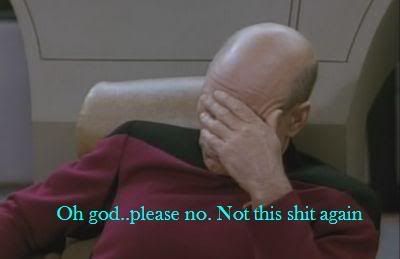
All the same, the manga industry continues to mature and expand, as evidence by the recent trend of the manga Makeover. Everything from Star Trek to Shakespeare (above) is being retooled according to the hip aesthetics of Japanese illustration. There is some debate amongst purists as to whether these adaptations (which are typically done by American artists) count as true manga, however. There are isolated pockets of fans who feel that the noble heritage of anime is being dissolved by 'Narutards' and Death Note emos, despite the fact that these 'unenlightened noobs' are the only ones supporting official U.S. releases. Of course the elders would argue that the licensing companies are part of the problem...and just like that, we're back at the same old dialectic of the casual fan vs. the dedicated fan, much to the continued exasperation of one Captain Jean Luc Picard.

In any event, the anime and manga market has grown much larger than a niche market, and there is a lot more to talk about. Future installments of Japan's Finest will further your anime and manga education by discussing the difference between specific art styles (what's Shoujo vs. Shonen?) and in depth analysis of favorite series both new and old.

Until next time... See You Space Cowboy.

Monday, April 6, 2009

Odd Omens

As promised, this post will bring some closure to my earlier discussion of Neil Gaiman. I realize the last entry was rather light on critical insight, and I have endeavored to compensate with this post, but I'm afraid there's still a fair bit about me in here as well.

Just as I was not initially taken with Sandman, Gaiman's status as literary idol is a far cry from my first impression of him, which was half-formed during my first attempt to read Good Omens.


I say half-formed because Gaiman was not the sole creator of Omens: It's a apocalyptic, comedic affair that was co-authored with Terry Pratchet of Disc World fame, and my fondness for that series was the angle I approached Omens from. For those unfamiliar with Disc World, I like to describe it as fantasy done Douglas Adams style. If you are unfamiliar with Adams and the Hichhiker series: Don't panic! Simply exit the blog in a calm yet expedient manner, read Hitchhiker's Guide to the Galaxy, and everything will remain mostly harmless. Otherwise I'll make with the Vogon poetry.

/End ADD.exe: Omen's was enjoyable enough to begin with, but it began to wear on me terribly. Comedy is much easier to digest intellectually than drama but it's also much easier to walk away from, especially when its presented in ~300 pages of text as opposed to a performance you can just watch. Even when the fate of the world is hanging in balance of plots outcome, as is the case with Good Omens, you still know everything will end in laughter. Without any kind of emotional risk, the novelty of the jokes are the only hook for readers. Admittedly, this is usually how comedy works, but considering how ripe religion is for ridicule, most of the gags used are 'easy' enough that they seem to write themselves.

So Gaiman and Pratchet try to keep things fresh by going absolutely nuts. It seems like they threw every absurd character and awkward scenario into the plot pot, producing a tangeled stew of tangential madness. I think it was all about the fun as opposed to the craft, which is actually a good way to approach craft. They knew that no editor on God's could stand a chance against their combined insanity. Reading the result is like trying to follow a conversation between school girls as it gets swept up by some verbal Speed Force and enters the realm of precognition, where one is already "Omigawding" at what the other is about to say. Anyone whose has participated in such an exchange knows they can be exhilarating just as well as everyone whose has tried to follow them from the outside knows they can be profoundly alienating. I trust that High School has provided most of us with both experiences.

I happened to read the book during those dark days of adolescence, where I was uniquely tormented and miserable just like everyone else, so finding that same cliquish atmosphere within the fiction was thoroughly frustrating. There is no clear evidence of such an exclusive agenda within the story, because it was not intentional. It was like the text was being haunted by some phantom in-crowd which existed beyond the margin. This reaction is as impressive as it is pathetic. Anyone can be ostracized by other people. Being rejected by your own imagination takes a rare gift.

The inside-joke I was missing is that Crowley the Demon is standing in for Gaiman, and Aziraphale the Angel is a proxy for Pratchet. An intelligent casual reader may guess that from the beginning, but actually appreciating the subtle interplay between the two needs requires one to have read enough of each author's work in order to be familiar with the people behind the prose. Once you've reached that level of understanding, the conversational nature is a boon to the story because you feel like you could participate in it if the opportunity presented itself. You're one of the cool kids. Such familiarity also provides the reader with additional incentive to see the story all the way through. Who care's if there's nothing at risk? You know the guys involved!

This "inside crowd" sort of fiction is always a double-edged sword, and from an analytical standpoint, it's a very interesting variation on the Casual vs. Dedicated reader dialectic. In earlier posts, I've expressed, or at least implied the opinion that keeping things casual and inclusive is generally the best course of action. I know that probably seems hypocritical in the context of a blog post riddled with links to obscure references, but you'll notice that I also link to many relevant wikipedia articles that will help clarify my ravings. Furthermore, I frequently indulge in such hypocrisy because it's the only way I can deal with the unique strain my gift exerts on my mind.

A blog also differs from a book in many important ways. Conceptually, the act of publishing a story can be considered an invitation of sorts. If you approach the book with that sort of expectation, only to be confronted with some sort of exclusion, it's supremely off-putting. Many genres of polemic fiction defeat themselves in such a way. The author intends to solve one of the world's great problems by inspiring people with their words...only to alienate readers by condemning them as the root of the problem.

I understand that Good Omens was very well received as books go, and I believe this was because it was entertaining on two different levels. As the Simpson's has proven from over a decade now, easy and plentiful is a safe and profitable approach to humor, and Good Omen's follows the formula to produce a comparable level of appeal. On the other end of the spectrum, diehard fans have the satisfaction of watching their favorite author's bicker as angel and demon, producing a buddy comedy that plays out like an extended good angel bad angel sketch. Since I skewed in the middle of these two intended audiences, I was left out in the cold.

Now that I am more familair with the creatores, lots of little gags have come back to me, and one scene in particular captures the spirit of their duality effectively well. At one point, the pair needs to cover some ground, so Crowley conjures a sleek looking sports car (an act of superficiality suitable for a preening demon and astheticist dreamlord alike), only to have Aziraphael adorn it with hideous tartan luggage straps; a representation of humble functionality befittingan angel that also hints at Pratchet's fetish for luggage.

The reason that I bring this up with regards to Gaiman is that all of his stories have this semi-metafictional mutlilayered quality to them. Sandman is particularly appealing to writers because it is a collection of stories about stories. An epic about epics. The same is true of American Gods and to a lesser extent, Stardust as well. The Graveyard Book is enjoyable by itself, but all the more richer when one realizes it's a variation on Kipling's Jungle Book. I haven't read or seen Coraline yet (both movie and book are on my fictional to-do list), but from what I hear, it's engaging to children and absolutely terrifying for parents.

Ultimately, story-tellers are Gaiman's intended in-crowd. According to the writing workshops I've had in college, neither critics nor audiences are supposed to enjoy stories about stories, though you wouldn't know it from the opulent introductions penned by respected authors that preface each volume of Sandman. I'm not sure if that says more about the teachers I've had, or Gaiman's writing, but one day, I hope to beat the same odds.

Mr. Sandman

Frequent readers have probably realized this already, and if not, now is as good a time as any to come clean: I am an arrogant bastard. I mean here I am, starting a post about somebody else with a paragraph about myself. Again. With respect to most things I am insecure, but I have tremendous confidence in my creative abilities. It is the very core of my ego, and it has given rise to a terrible involuntary tendency: I immediately deconstruct every story I encounter down to its base premise, and if I find its ingenuity wanting, I am dismissive of it. Even worse, when I encounter works of fiction that genuinely impress, the voices within shriek "If only we thought of this first so you could do it better!" rather than acknowledging obvious virtues and striving to learn from them. Such is the cost of conceit: arrogance preserving ignorance and pride crippling pursuits to realize potential.

The various works of Neil Gaiman have all profoundly invoked this latter response in me. One story in particular filled me with so much covetous energy that my pride finally collapsed under its weight, forcing the revelation that I could learn a lot by earnestly examining what he did differently than I would and why. In every respect, this has been my way with the world; arriving at the simplest solution after walking the weirdest road to get there. The work which led me to this non-epiphany was none other than Gaiman's comic masterpiece: Sandman. I found a phantom mentor in the details of Morpheus's dark odyssey and by the end of the epic, Gaiman had established himself as one of my literary idols. That's him to the right. Isn't he dreamy? Do, do you get it? Because Morpheus is lord of dreams and... God I really should be shot for that one.

My girlfriend Grace has a truly awe-inspiring gift. She can finding missing pieces of peoples' souls in stories they have not read yet. The first volume of Sandman was just one of many life-altering works of fiction she introduced me to.

Unlike most of the stories she showed me, I did not like Sandman at first. Despite forwards and prologues intended to ease readers into the experience, the plot felt disconcertingly vague. Though far from straightforward, the first story arc, where Morpheus Lord of Dreams (left) is freed from decades of imprisonment and attempts to recover his tools is conceptually simple enough, yet I found myself re-reading passages to make sure I got them 'right' as if I would be tested on them. With saintly patience, Grace urged me on to the second volume, and once I hit the 'cereal convention' I was hooked. I finished the remaining nine volumes in a month and a couple associated spin-offs since the summer as well.

Season of Mists (volume four) was where I really went rabid about the series. If you plan on reading the series, I'd suggest you skip this paragraph, because I consider the premise of this volume to be a tremendous spoiler, but if you're planning on giving the series a pass, hopefully the example will change your mind: Circumstances force Morpheus to ask Lucifer for a favor, even though the former had gravely insulted the latter earlier in the story. So Lucifer literally gives him Hell. He releases all the souls imprisoned, and relieves his demonic legions from duty, and leaves Morpehus to deal with a parade of deities and cosmic entities who all want to stake their claim on the underworld. Mythologies from all over the world intertwine at the afterlife, and they all make different case
s for ownership through threats, bribes and appeals for mercy.

The overarching narrative almost always features this sort of blending. Mortals cross into the realm of dreams, and dreams stride into reality. Morpheus frequently meets with his siblings; all personifications of universal constants like Death, Desire and Destiny, (there's a theme here) known as Endless. And these are all based on the primary plot-arc, which Gaiman frequently suspends to indulges his tangential whims. These little detours are exceedingly bizzaire, describing the death-wish of a forgotten DC Comic character who was obscure to begin with, or offering visions of what the world would be like if humans were ruled by cats. Usually these diversions are interesting and breif enough that they don't disturb the story line, though the arc in 'A Game of You' (volume five); where Gaiman tries to make a thoroughly uninteresting character more interesting through casual psychoanalysis and feminist mysticism; is pretty terrible. It's a crystalization of his worst qualities: pretention, thematic vagueness, and strangeness for the sake of strangeness. I know a few of the collected volumes are arranged differently than their publishing order, so that may be a factor.

Once again, the natural fractures of the comic form makes it the perfect media to convey long, complicated, and involving stories. The episodic release schedule makes the narrative breaks seem less arbitrary, and it also slows the pace, creating a greater sense of scale and allowing readers to consider each aspect of the plot more carefully. Even though I consumed the series all at once, my experience of it continues and grows richer
as I discover all the different aspects of folk lore it incorporated. For instance, I had no idea that Gaiman's Corinthian was based on an actual legend about a dream god's eating peoples eyes, but I learned as much through a folklore class the following quarter.


Comics also have pictures, and they play an important part in Sandman. For starters, a lot things which happen in the story simply translate better through visual channels. And while most graphic novels are drawn by a single artist, Morpheus and co. have been drawn by a number of different talents, each bringing their unique touch and art style to the experience. Volumes 9 & 10 display the most impressive range of variation, moving from sharp, almost cubist aesthetics, to detailed watercolor-like style, to traditional comic styles. You might think this would be visually exhausting, but the art remains consistent for a given chapter or story, so it's easy enough to follow. I frequently found myself wondering what interpretations from other artists might look like. All the change also serves to emphasize the elements which remain constant, like character specific speech bubbles. Dream always speaks in white text against a black bubble, fitting for a nocturnal figure, while Delirium's text is squigly and adorned with rainbows.

As much as I want to be the Daniel to Gaiman's Morpheus (alternate links I considered for that were "Psuedo-spoiler", and "Things That Sound Gay"), I can't say I love Gaiman's writing without saying I hate it as well. Part of it is that damn pride I began with. Part of it is that his approach to story telling seems so similar to that I wish to develop, that the difference which remains has been compressed to a needle sharp kernal of not-exactly rightness. It's like an OCD person being confronted with a row of pictures that are all perfectly straight save one, and then telling them they can't correct it. There's more to it than that, but I've left it for the next post. Look back for it soon.

Thursday, March 5, 2009

Watching the Watchmen

It has been forever and I apologize, but a new post has finally arrived, along with some general changes to the Sarcasmancy banner. I will strive to post more consistently in this coming quarter, even in the face of academic trials and personal crises. You also may notice a few more pictures in future posts, like this one here:


On March 5th, at the Steven Jay Ross theater I had the privilege of attending a preview for a little flick called Watchman. You probably don't believe me, and I can't blame you seeing how the movie's been out for weeks and I'm just talking about it now. The intermingling days have been a deluge of deadlines, examinations and group projects on WoW which required extensive study.

The production values at work in this film are flat-out amazing. Every major character, and most of the minor ones as well (like newstand guy and comic book kid), are attired according to the comic book's odd orange, purple, green color scheme down to their last button. Some people have groused over the changes to Night Owl II and Silk Spectre II costumes, but they both look sexier and more practical on screen than they did in the ink.

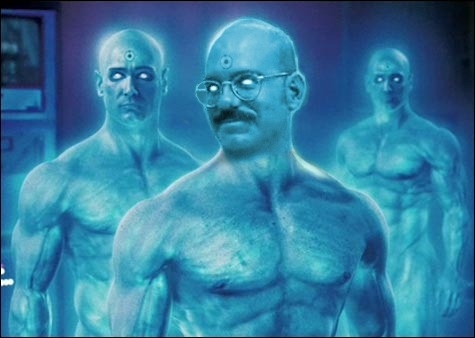
The casting is mostly strong. Edward Blake is amazing as The Comedian, and Carla Gugino displayed an impressive range as Sally Jupiter. Malin Ackerman was stretched more than a little too thin playing Laurie Jupiter, though the character sort of begs for over-acting, and she looks great naked, (though the sex scene is still ridiculously awkward). I personally loved Billy Crudup's take on Doc Manhattan. His soft spoken nature made him far more impressive than the deep, cold monotone the comic led everyone to expect. I can see how some people might feel that it made him too sympathetic, or even too vulnerable for the role, but honestly things could have been much worse:


I find it kinda funny, that lots of critics are criticizing Synder's adaptation for being too faithful to the graphic novel even though many of them backed up Alan Moore's claims of it being 'unfilmable'. Their complaints do not prescribe stylistic adjustments either, but outright objections about the source material. Some complain that politics are adolescent and tediously exaggerated. Others feel the plot is pretentious and needlessly convoluted. Guess what folks? Allan Moore has done this before. Snyder could have afforded to be a little bolder here and there, but the idea of a domesticated, mass-marketable Watchmen is a frightening prospect to a lot of people, and for good reason.

I think William Hoy and Zack Snyder recieved too little credit where editting is concerned. They mannaged to trim most of the fluff from the story and tremendously simplified its ending, which involved a green, tencacled, vagina-eyed monstrousity; a device I always suspected Moore implemented just to poke fun at the way comics escalate. In each volume, plots tend to become more convoluted, bizaire in correspondence with their broadening scale. At first you're saving banks from thugs, then nations from nazis, then planets from aliens, then universes from trans-dimensional disasters that encroach upon the metafictional.

Anyway, instead of whining about how each scene copies those in the comic, or tittering at how much screen time Doctor Manhattan's big blue dong has, it would be nice to see more critics addressing the absurd amount of superfluous violence Snyder injects into the presentation.

Much as I hate to admit it, The Batman may be to blame for this one. Dark Knight was violent. Where PG-13 ratings are concerned it pushed some serious boundaries, and I walked out of the theater predicting a parental backlash. I was relieved to be wrong, because everything between Ledger's pencil trick and Glasgow Smile served a purpose; developing Nollan's darker and more realistic take on Bats. It was also done with intelligence and decency, honoring one of the oldest traditions in the comic industry: It left the blood in the gutter. This practice exiles gruesome acts to the spaces between the pictures, allowing audiences to come up with their own explanations and interpretations of the macabre. I learned all this from Scott McCloud, and you can too if you pick up his excellent book, Understanding Comics, which is one of the few works of contemporary comic-theory available, and the best I have read to date.

Funny thing is, while Watchman is also all about making superhero vigilantism realistic, the spectacular and explicit presentation of it's violence (rife with slick slow-mo and over the top sound effects) serves to establish the exact opposite effect. The ridiculously violent fights feel more like those found in Marvel's flicks and that surreality distances audiences from the heavy themes at work in the script, despite it's relentlessly dark posturing.

Once again, it's a matter of fracture. The tendency in film, by design, is to present audiences with an experience that is as fluid and streamlined as possible, while comics bombard audiences with fractures; from issue, to page, to pannel, to text box or speach bubble, few media are as inherently fragmented as comics. This gives artists a number of channels to choose from when engaging their audience. Watchman was celebrated as a graphic novel, and is favorably compared to it's cinema counterpart for it's ability to pair grim suggestion with stark images of violence. And just as rain water renders war memorials unintelligible by filling in their inscriptions, Snyder wipes away the visual subtlety of Watchman's story by smearing Gibbon's carefully drawn lines with extra blood. Great, now I sound like a page out of Rorschach's journal. And possibly an alarmist to boot.

Understand, that I am a hotblooded young man who likes his steaks bloody, his entertainment violent and his freedom of speech loud. The mantel of Schoolmarm is not one I am eager to adopt. It's rather at odds with the rebellious artist persona I'm trying to cultivate here. Though in all honestly, the movie is too fucking violent. It's like Snyder found the laziest possible way to make the movie as 'challenging' to watch as the comic was to read, except one's stomach is tried as opposed to his intellect. Just a few cuts here (Buzzsaw. Prison Cell.) and there (Rorschach. Pedophile. Cleaver.) would have made it much easier to watch and nobody would have gone wanting for blood at the end of the day.

In closing, I would like to mention I have joined the ranks of the Biased Video Gamer Blog, an up-and-coming site featuring all sorts of gaming goodness, including links to amusing game videos and reviews including a piece on FEAR 2 written by yours-truly. There will be more where that came from as well! I will also continue to cover games here at Sarcasmancy on a fairly regular basis. The next post will be sooner coming than this one was, I promise you.

Thursday, February 26, 2009

A New Challenger Approaches!

Throughout the past couple of posts, I've been going on and on about the immersive potential of structurally fractured narratives, yet I haven't directly discussed any serialized media. As much as I love me some irony, this is an oversight which cannot stand. The next few posts are going to be about comics, television (including manga and anime respectively), and maybe some web series' as well. Lots of exciting things happening in these regions, and they need to be talked about.

Before we venture to these new and exciting regions, I'd like to offer my thoughts on Street Fighter IV, as it provides us with a topical opportunity to discuss the most serialized genre of video games: The 2D fighter. I haven't talked much about the potential pitfalls of narrative fractures and I can't think of a better example to prove my point. Let's begin with a personal history.

I became a serious gamer a bit later than most of my millenial contemporaries, (about 9 or 10 as opposed to 5 or 6) on account of good parenting. You see, I still hadn't figured out the whole "how to read" thing, and Mom and Dad didn't see how sitting in front of a television screen for hours on end would help matters. They already had to limit my time with the Gameboy Grandma gave me when I was 7. Ironically, I really began to blossom as a reader around the same time they caved and got me a Super Nintendo for Christmas. Whether there's a correlation is a matter for another post. Seriously. Remind me.

Anyway, my delay came with one grave cost: I missed the early-to-mid 90's fighting game boom, and I started too late to develop the insane hand eye coordination necessary to be competitive in the genre. Somehow I've managed to live on. This was part of my parent's plan of course. The media was rife with the horrors of Mortal Kombat; GTA of its day, though I never found it that appealing to begin with. My reading skills were still too feeble to appreciate the edginess of spelling 'Combat' with a 'K'.

I was always firmly in the Street Fighter II camp, allured by its anime-aesthetic, and the most iconic videogame attack of all time. I'd always beg for a turn at friends' houses, only to be laid to waste in a matter of seconds. By the time I had a SNES of my own, the entire 2-d fighting game scene was dwindling with the emergence of consoles with 3D capabilities, and Street Fighter II had lost most of it's mainstream appeal since Capcom saturated the market with a host of different editions of the game. They tried to revive interest in the series by introducing a new roster of characters in Street Fighter 3, but this pissed off players who had spent years training with the original characters, the vast majority of which were inexplicably cut. Capcom attempted to make amends by returning some of the cut characters with two more editions of SFIII. It didn't really work. The Street Fighter Alpha series found a small but dedicated following, though most mainstream fighter's got their fix with Capcom's cross over games, which really are incredible.

The age of street fighter seemed to have ended. Then this emerged.

I recognized it for what it is, but I still can't remember the last time I had been more excited about a sequel. Oh wait, yeah I can. Anyway, as much as I hoped the game would have the trailer's painted look I was afraid they would try to take the series to 3D again like they did with SF EX (which isn't even worth linking). Fortunately, Capcom decided to stick with 2D gameplay, while giving the characters and backgrounds detailed 3D characters models. The result is pretty, but it also looks a lot like SF2 updated with modern animation and HD graphics, which is funny because that already happened.

So how does it play? The phrase "returning the series to its roots" was thrown around a lot during the previews, and it's consistent with my experiences, right down to the old school throw-your-controller-against-the-wall difficulty. The CPU routinely kicks my ass on "Easy." Granted, I was trained in the weakest style of arcade kung fu, and just recently graduated to a style which is only slightly less embarassing. Still, there may be hope for me yet in the form of Focus Attacks; one of the two new mechanics Capcom introduced to the gameplay. Simply explained, Focus Attacks are easy to use all-purpose counter attacks. The other feature, known as the Revenge Gauge, seems to be a more technical version of the Special Attack Gauge (which is also still present), but I have yet to make heads or tails of it.

"But what of the story!?" you ask? I give you a flat stare and reply dryly, "What indeed."

Like every other game in the series, (hell pretty much every game in the genre), Street Fighter IV is centered around an international fighting tournament. Chronologically, I believe it occurs after SFII and before SFIII but I'm not sure. When I combed wikipedia for answers, I got a headache. The former's story has been told so many times, I don't know which one to go on. Normally I'd go with what's in the game, but to my knowledge, the only story telling that occurs in game are the quips your character makes to defeated opponents. Yet I know there is all this stuff about some evil organization with, and fighters harnessing dark energy floating somewhere in the periphery. Maybe it was in the game's manual somewhere? SFIV is slightly better. Each run through arcade mode begins and ends with these really nicely drawn anime scenes, but out of context, they make no damn sense. The scene that begins Abel's 'campaign' is a perfect example. This guy is brand new to the game, and not only does he have a huge amount of history, he's found a way to forget all of it! Are we supposed to have some idea who he is? How does he know Chun Li?

Even if there weren't so many different versions of the over-arching story, Street Fighter IV would still have to make sense of the fighting game's fundamental fracture: The Character Select Screen. Like all fractures, there's a lot of potential there, and Capcom even realizes some of it. Each character has a different reason for entering in the tournament, and a specific rival to take out. But for some reason, every character ends up in the same final boute against a semi-nude genetic monstrosity with a ying yang orb for an abdomen in a secret lab. Um. What? Is this still part of the tournament? Are the judges there with the evil scientists? I mean, SFII had the same nonsensically bottle-necked final fight, but at least M. Bison looked human. By the way, why is nobody surprised to find him back from the dead?

Look, I know it's a video game where people throw fire balls with their bare hands, and Yoga teaches you how to stretch your arms like Mr. Fantastic, but that doesn't mean you can't be coherent. I can suspend disbelief and ignore logic only so much, and Street Fighter IV crosses that line left and right. But if you're looking for a hardcore fighting game, you won't walk away disappointed.