Showing posts with label Authors. Show all posts

Friday, May 7, 2010

Mythologies of Violence in The Modern Video Game

As I mentioned on twitter, I recently started reading Roland Barthes' Mythologies for a class I'm taking on Popular Culture, and it's a text after my own heart. Rather than droning on about his ideas through pages and pages of recondite abstraction, Barthes approached philosophy by analyzing various elements of French bourgeois society (covering everything from soap to striptease) and discussing their associated cultural connotations, or Mythologies. Essentially, he did what I do here, only with more class, sophistication and academic merit. He was French after all.


While I pretty much leave you to draw your own conclusions about my analyses, Barthes' concludes his book with a comprehensive essay called "Myth Today," where he makes the case that myth is a language. A language of languages in fact. Using Saussure's semiological concepts of the signified, signifier and the sign, Barthes presents myth as a system where the sign of language becomes a signifier in and of itself. Honestly, it's a hell of a lot easier to understand if you look at the picture:


The nifty thing about myth and it's recursive structure is that it allows for an infinite chain of self-reference. Objects can exist simultaneously as objects and discourse on themselves. A similar sort of recursion; this 'object existing as an action' phenomena, is present in video games. Games exist as a composite of predefined computer programming, graphical design and computer hardware, but they also exist as dynamic processes; realized through dynamic exchanges between player and computer. Games and myth share this capacity for metaphorical recursion. Given this similarity, I thought it would be particularly fascinating to briefly analyze the mythologies and myth-making processes associated with modern videogames.

Most of the Mythologies surrounding video games pertain to violence, which is unsurprising as the vast majority of video games are essentially platforms for virtual violence. Like Barthes, I am generalizing. In fact, I am speaking even more broadly, as I am describing the trends of an entire medium. That said, I believe the chief mythology of modern videogames is the presentation of violence as an acceptable solution to almost every problem. This is particularly prevalent in fighting and shooting games, where players' abilities to interact with the virtual world are exclusively limited to movement and acts of violence.  

More mythical videogame lessons, linked from Movieposter.com. I also consulted IGN's list of 101 things we've learned from videogames

Even when the player's control over his avatar is suspended, violence dominates the narrative.I can't think of a better scene to illustrate my point than this scene from Gears of War 2. After spending years searching for his wife, Maria, Dom finds her a broken, tortured husk of a human. He looks to his comrade in arms, Marcus, who tells him gravely, "It's okay" and just as little Travis squeezes the trigger on Old Yeller, Dom kills his ruined wife. Now, I realize that some wounds never heal, and that mercy comes in many harsh forms, but I think the phrase "It's okay" and the action "shooting your tortured wife dead" should never co-habit, even on the battlefield. But that's most video games for you. Could you turn Maria's tedious psychiatric evaluation into a game? If you could, would it sell better than blasting aliens with assault rifles?

Even titles from studios like Bioware that emphasize diplomacy and negotiation regularly throw players into situations where violence is the only recourse. Violence is a means of wish fulfillment. It's a simple, and for my part, tremendously gratifying solution to a lot of problems. But in real life, violence is rarely so clean and convenient. There is a myriad of lesser mythologies that support the central myth of violence as a solution. When you kill or destroy things in a games, they disappear or transform into something useful. Many games are arranged to ensure that a fair fight is in order; balancing your avatar's might with an onslaught of weaker foes just waiting to be brought to justice. Perhaps most important of all, life and death are things of little consequence in video games. Life is a thing which is not only objectively quantifiable, through gauges and extra lives, but a thing that is commoditized.



Consequently, I would argue that the modern video game promotes a visually-idealized abstraction of violence rather than real violence. The virtual cruelty they present is endlessly creative (if brutal), but it is also sanitized and inconsequential. In games like World of Warcraft that force players to kill X amount of Y enemies to receive rewards, mass murder becomes mundane, and indeed, even tiring. Competitive Multiplayer games are a step closer to actual combat, but even in those virtual death matches, the goal is abstracted to a numerical goal; players must gain more points than their opponent. Just as Barthes asserts that French striptease is more a sport than an actual sexual act, I would argue that games are more sporting than they are violent. In a certain sense, they co-opt the imagery violence as a convenient and compelling short-hand for adversity.  Somebody would have to be an absolute maniac to take the bombastic mythologies of video game violence seriously; not that I think it hasn't happened before or that it isn't impossible.

Unlike the socially accepted mythologies Barthes discusses, many videogamers are well aware of the mythologies they are buying into. One does not attempt to double jump after playing Mario. Or if they do, they spend a couple weeks recovering from their injuries and never attempt to do it again. By and large, I would assert that gamers are consciously aware of the mythologies they buy into while playing games. Some of the subtler mythologies, like the hyper-masculinization of protagonists, or the sexual-objectification of female characters, or the commodifying habit of trying to accrue more points will inevitably rub-off on players' behavior, though those myths are pervasive in modern society as well. The myths of violence and behavior however are generally appreciated as part of the game's rules and not rules of reality. As a result, these violent mythologies occupy an even deeper semiological rank than the one Barthes' presents: They are myths that are conscious of their own mythological context.

Tuesday, September 8, 2009

Lost Among the Dunes

Despite my love for science fiction, I am not really all that well-read in the genre, especially where the classical authors are concerned. This is not due to deliberate omission as much as culture diffusion and osmotic pressure. The ideas put fourth by Asimov, Wells and Heinlein, concepts like time travel and interstellar empires, have already seeped into the cultural conscious and attained a familiarity which I cannot help but take for granted, so I feel little compulsion to read the original source material. I realize this historical indifference is the mark of a foolish young man, but I'm wise enough to be in no hurry to grow older. Fortunately, I have friends and family who are wise and insistent enough to get me to read classic sci-fi.


Such was the case with Frank Herbert's Dune, a novel I now refer to as The Lord of the Rings of science fiction. Like many off-the-cuff descriptions, my comparison serves as a point of reference more than anything else: Both works share the same staggering scale; epics which establish fictional universes whose detailed histories exert genuine gravity on readers. Yet the actual structure of Dune's mythology bears a greater resemblance to Middle-Earth than to that of Asimov's Foundation, though now that I write it, Dune might be better summed up as the middle ground between those two novels.

The most impressive thing about Dune, the thing which elevates it above Tolkien in my opinion, is that it is as dense as it is broad and deep. Yes, Herbert gives you rich detailed lore, and poems, but rather than forcing it into long chapters about walking, riding or hiking, he presents them as footnotes before each chapter so they don't become insuferable tangents which swallow the story's momentum. The first novel Dune novel feels like a complete trilogy in and of itself, as it follows young Paul Atreides journey from prince of Caladan, to rebel leader, to religious figure and emperor of the intergalactic Empirium. Over the course of that journey, Herbert delves into heady topics of ecology, religion, sociology to develop the distinctive culture of intriguing factions like the semi-nomadic, religiously fantic, worm-riding Fremen warriors and the scheming Bene Gesserit, who resemble ruler-cracking mother superiors schooled in Jedi mind tricks and yoga, mixed with a dash of dominatrix for good measure. Among these colorful factions we find unforgetable characters such as Stilgar, the wise warrior-priest cheiftan, the treacherous yet sympathetic Wellington Yueh, and my personal favorite, Gurney Halleck the silver-tongued bardic assassin. All these disparate elements blend against the amazing backdrop of the desert planet Arrakis whose unique ecology is the sole producer of the life-prolonging precience enhancing spice, Melange. Also, gaint god-worms of death.


The sci-fi concepts which guide Dune's story are as intriguing and densely presented as the story itself. Classic sci-fi tropes like laser weapons, force fields, and faster than light travel are all present and accounted for, and they are accompanied by other fantastic technology such as Ornithropters (aircrafts that fly by flapping their wings like birds) and water-recycling suits. These are mere set pieces however. The details of such technology pales in comparison to Herbert's exploration of concepts like hypnotic suggestion, evolution and presience; things which literally change the dynamic of what it means to be human. He takes a mystical approach to these concepts, much like how somebody from the eighteenth century might address cellphones, rather than a highschool science teacher trying to establish hard rules.

Herbert's books aren't any poorer for the omissions. On the contrary, they remain readable. Trying to sort through that sort of intellectual detritus in addition to navigating all the disparate philosophies and politics at work would merely exhaust readers: an important lesson I repeatedly fail to remember when working on my own fiction. Whenever the plot particulars points in a story get difficult (a character is being difficult, I forget where I'm going with something, etc.) I preoccupy myself with the grand questions of the fictional universe said story takes place in. Last week this led to wikipedia binge on quantum physics that led me to look at the universe as a perpetually splintering thread of possibility. Interestingly, I was reading Children of Dune at the time (the inspiration for this post), and I found both my thread concept, and the mind numbing confusion surrounding it reflected in Leto II's struggle with pressience and past lives. I'm still not sure if my life was imitating art or merely being fucked up by it.

Anyway, I think this is a suitable stopping point for today. I'll continue with Dune Messiah and Children of Dune next time. Expect more in the way of actual lit criticism.

Monday, April 6, 2009

Odd Omens

As promised, this post will bring some closure to my earlier discussion of Neil Gaiman. I realize the last entry was rather light on critical insight, and I have endeavored to compensate with this post, but I'm afraid there's still a fair bit about me in here as well.

Just as I was not initially taken with Sandman, Gaiman's status as literary idol is a far cry from my first impression of him, which was half-formed during my first attempt to read Good Omens.


I say half-formed because Gaiman was not the sole creator of Omens: It's a apocalyptic, comedic affair that was co-authored with Terry Pratchet of Disc World fame, and my fondness for that series was the angle I approached Omens from. For those unfamiliar with Disc World, I like to describe it as fantasy done Douglas Adams style. If you are unfamiliar with Adams and the Hichhiker series: Don't panic! Simply exit the blog in a calm yet expedient manner, read Hitchhiker's Guide to the Galaxy, and everything will remain mostly harmless. Otherwise I'll make with the Vogon poetry.

/End ADD.exe: Omen's was enjoyable enough to begin with, but it began to wear on me terribly. Comedy is much easier to digest intellectually than drama but it's also much easier to walk away from, especially when its presented in ~300 pages of text as opposed to a performance you can just watch. Even when the fate of the world is hanging in balance of plots outcome, as is the case with Good Omens, you still know everything will end in laughter. Without any kind of emotional risk, the novelty of the jokes are the only hook for readers. Admittedly, this is usually how comedy works, but considering how ripe religion is for ridicule, most of the gags used are 'easy' enough that they seem to write themselves.

So Gaiman and Pratchet try to keep things fresh by going absolutely nuts. It seems like they threw every absurd character and awkward scenario into the plot pot, producing a tangeled stew of tangential madness. I think it was all about the fun as opposed to the craft, which is actually a good way to approach craft. They knew that no editor on God's could stand a chance against their combined insanity. Reading the result is like trying to follow a conversation between school girls as it gets swept up by some verbal Speed Force and enters the realm of precognition, where one is already "Omigawding" at what the other is about to say. Anyone whose has participated in such an exchange knows they can be exhilarating just as well as everyone whose has tried to follow them from the outside knows they can be profoundly alienating. I trust that High School has provided most of us with both experiences.

I happened to read the book during those dark days of adolescence, where I was uniquely tormented and miserable just like everyone else, so finding that same cliquish atmosphere within the fiction was thoroughly frustrating. There is no clear evidence of such an exclusive agenda within the story, because it was not intentional. It was like the text was being haunted by some phantom in-crowd which existed beyond the margin. This reaction is as impressive as it is pathetic. Anyone can be ostracized by other people. Being rejected by your own imagination takes a rare gift.

The inside-joke I was missing is that Crowley the Demon is standing in for Gaiman, and Aziraphale the Angel is a proxy for Pratchet. An intelligent casual reader may guess that from the beginning, but actually appreciating the subtle interplay between the two needs requires one to have read enough of each author's work in order to be familiar with the people behind the prose. Once you've reached that level of understanding, the conversational nature is a boon to the story because you feel like you could participate in it if the opportunity presented itself. You're one of the cool kids. Such familiarity also provides the reader with additional incentive to see the story all the way through. Who care's if there's nothing at risk? You know the guys involved!

This "inside crowd" sort of fiction is always a double-edged sword, and from an analytical standpoint, it's a very interesting variation on the Casual vs. Dedicated reader dialectic. In earlier posts, I've expressed, or at least implied the opinion that keeping things casual and inclusive is generally the best course of action. I know that probably seems hypocritical in the context of a blog post riddled with links to obscure references, but you'll notice that I also link to many relevant wikipedia articles that will help clarify my ravings. Furthermore, I frequently indulge in such hypocrisy because it's the only way I can deal with the unique strain my gift exerts on my mind.

A blog also differs from a book in many important ways. Conceptually, the act of publishing a story can be considered an invitation of sorts. If you approach the book with that sort of expectation, only to be confronted with some sort of exclusion, it's supremely off-putting. Many genres of polemic fiction defeat themselves in such a way. The author intends to solve one of the world's great problems by inspiring people with their words...only to alienate readers by condemning them as the root of the problem.

I understand that Good Omens was very well received as books go, and I believe this was because it was entertaining on two different levels. As the Simpson's has proven from over a decade now, easy and plentiful is a safe and profitable approach to humor, and Good Omen's follows the formula to produce a comparable level of appeal. On the other end of the spectrum, diehard fans have the satisfaction of watching their favorite author's bicker as angel and demon, producing a buddy comedy that plays out like an extended good angel bad angel sketch. Since I skewed in the middle of these two intended audiences, I was left out in the cold.

Now that I am more familair with the creatores, lots of little gags have come back to me, and one scene in particular captures the spirit of their duality effectively well. At one point, the pair needs to cover some ground, so Crowley conjures a sleek looking sports car (an act of superficiality suitable for a preening demon and astheticist dreamlord alike), only to have Aziraphael adorn it with hideous tartan luggage straps; a representation of humble functionality befittingan angel that also hints at Pratchet's fetish for luggage.

The reason that I bring this up with regards to Gaiman is that all of his stories have this semi-metafictional mutlilayered quality to them. Sandman is particularly appealing to writers because it is a collection of stories about stories. An epic about epics. The same is true of American Gods and to a lesser extent, Stardust as well. The Graveyard Book is enjoyable by itself, but all the more richer when one realizes it's a variation on Kipling's Jungle Book. I haven't read or seen Coraline yet (both movie and book are on my fictional to-do list), but from what I hear, it's engaging to children and absolutely terrifying for parents.

Ultimately, story-tellers are Gaiman's intended in-crowd. According to the writing workshops I've had in college, neither critics nor audiences are supposed to enjoy stories about stories, though you wouldn't know it from the opulent introductions penned by respected authors that preface each volume of Sandman. I'm not sure if that says more about the teachers I've had, or Gaiman's writing, but one day, I hope to beat the same odds.

Mr. Sandman

Frequent readers have probably realized this already, and if not, now is as good a time as any to come clean: I am an arrogant bastard. I mean here I am, starting a post about somebody else with a paragraph about myself. Again. With respect to most things I am insecure, but I have tremendous confidence in my creative abilities. It is the very core of my ego, and it has given rise to a terrible involuntary tendency: I immediately deconstruct every story I encounter down to its base premise, and if I find its ingenuity wanting, I am dismissive of it. Even worse, when I encounter works of fiction that genuinely impress, the voices within shriek "If only we thought of this first so you could do it better!" rather than acknowledging obvious virtues and striving to learn from them. Such is the cost of conceit: arrogance preserving ignorance and pride crippling pursuits to realize potential.

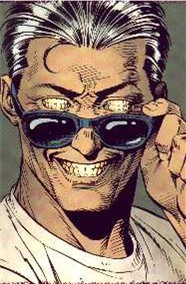
The various works of Neil Gaiman have all profoundly invoked this latter response in me. One story in particular filled me with so much covetous energy that my pride finally collapsed under its weight, forcing the revelation that I could learn a lot by earnestly examining what he did differently than I would and why. In every respect, this has been my way with the world; arriving at the simplest solution after walking the weirdest road to get there. The work which led me to this non-epiphany was none other than Gaiman's comic masterpiece: Sandman. I found a phantom mentor in the details of Morpheus's dark odyssey and by the end of the epic, Gaiman had established himself as one of my literary idols. That's him to the right. Isn't he dreamy? Do, do you get it? Because Morpheus is lord of dreams and... God I really should be shot for that one.

My girlfriend Grace has a truly awe-inspiring gift. She can finding missing pieces of peoples' souls in stories they have not read yet. The first volume of Sandman was just one of many life-altering works of fiction she introduced me to.

Unlike most of the stories she showed me, I did not like Sandman at first. Despite forwards and prologues intended to ease readers into the experience, the plot felt disconcertingly vague. Though far from straightforward, the first story arc, where Morpheus Lord of Dreams (left) is freed from decades of imprisonment and attempts to recover his tools is conceptually simple enough, yet I found myself re-reading passages to make sure I got them 'right' as if I would be tested on them. With saintly patience, Grace urged me on to the second volume, and once I hit the 'cereal convention' I was hooked. I finished the remaining nine volumes in a month and a couple associated spin-offs since the summer as well.

Season of Mists (volume four) was where I really went rabid about the series. If you plan on reading the series, I'd suggest you skip this paragraph, because I consider the premise of this volume to be a tremendous spoiler, but if you're planning on giving the series a pass, hopefully the example will change your mind: Circumstances force Morpheus to ask Lucifer for a favor, even though the former had gravely insulted the latter earlier in the story. So Lucifer literally gives him Hell. He releases all the souls imprisoned, and relieves his demonic legions from duty, and leaves Morpehus to deal with a parade of deities and cosmic entities who all want to stake their claim on the underworld. Mythologies from all over the world intertwine at the afterlife, and they all make different case
s for ownership through threats, bribes and appeals for mercy.

The overarching narrative almost always features this sort of blending. Mortals cross into the realm of dreams, and dreams stride into reality. Morpheus frequently meets with his siblings; all personifications of universal constants like Death, Desire and Destiny, (there's a theme here) known as Endless. And these are all based on the primary plot-arc, which Gaiman frequently suspends to indulges his tangential whims. These little detours are exceedingly bizzaire, describing the death-wish of a forgotten DC Comic character who was obscure to begin with, or offering visions of what the world would be like if humans were ruled by cats. Usually these diversions are interesting and breif enough that they don't disturb the story line, though the arc in 'A Game of You' (volume five); where Gaiman tries to make a thoroughly uninteresting character more interesting through casual psychoanalysis and feminist mysticism; is pretty terrible. It's a crystalization of his worst qualities: pretention, thematic vagueness, and strangeness for the sake of strangeness. I know a few of the collected volumes are arranged differently than their publishing order, so that may be a factor.

Once again, the natural fractures of the comic form makes it the perfect media to convey long, complicated, and involving stories. The episodic release schedule makes the narrative breaks seem less arbitrary, and it also slows the pace, creating a greater sense of scale and allowing readers to consider each aspect of the plot more carefully. Even though I consumed the series all at once, my experience of it continues and grows richer
as I discover all the different aspects of folk lore it incorporated. For instance, I had no idea that Gaiman's Corinthian was based on an actual legend about a dream god's eating peoples eyes, but I learned as much through a folklore class the following quarter.


Comics also have pictures, and they play an important part in Sandman. For starters, a lot things which happen in the story simply translate better through visual channels. And while most graphic novels are drawn by a single artist, Morpheus and co. have been drawn by a number of different talents, each bringing their unique touch and art style to the experience. Volumes 9 & 10 display the most impressive range of variation, moving from sharp, almost cubist aesthetics, to detailed watercolor-like style, to traditional comic styles. You might think this would be visually exhausting, but the art remains consistent for a given chapter or story, so it's easy enough to follow. I frequently found myself wondering what interpretations from other artists might look like. All the change also serves to emphasize the elements which remain constant, like character specific speech bubbles. Dream always speaks in white text against a black bubble, fitting for a nocturnal figure, while Delirium's text is squigly and adorned with rainbows.

As much as I want to be the Daniel to Gaiman's Morpheus (alternate links I considered for that were "Psuedo-spoiler", and "Things That Sound Gay"), I can't say I love Gaiman's writing without saying I hate it as well. Part of it is that damn pride I began with. Part of it is that his approach to story telling seems so similar to that I wish to develop, that the difference which remains has been compressed to a needle sharp kernal of not-exactly rightness. It's like an OCD person being confronted with a row of pictures that are all perfectly straight save one, and then telling them they can't correct it. There's more to it than that, but I've left it for the next post. Look back for it soon.