Showing posts with label Comics. Show all posts

Friday, August 13, 2010

Scott Pilgrim Vs. His Movie

In our hype-saturated world, it's a rare thing for a movie to exceed the promise of its marketing material. Even rarer is the adaptation that manages to eclipse it's source material. This is especially true of videogame films where the compelling ruled worlds of source material are rendered through tedious exposition (rather than exploration and experimentation). Comic-books movies have faired much better. Hell, they've been doing pretty damn well for a while now, but most fans will agree that something is lost in the jump to the silver screen. Snyder's take on Watchman was faithful but uninspired, save for it's ultraviolence. Iron Man 2 was a good time but all the subplots and cameos left it feeling cluttered. Kick-Ass struck a strong balance between surreal, sometimes controversial violence, and nerdy self-deprecating humor, but its satire felt a bit sharper on the ink. 

I expected Scott Pilgrim would suffer similarly. I knew that Edgar Wright nailed the visual style from the moment I watched (and obsessively re-watched) the trailer, but I was worried about the leading man (you are forever George-Michael to me Michael Cera) and the challenge of compressing 6 graphic novels with about 20 characters into 2 hours. Wright not only captures the soul of the comic, he distills it and refines it. He gives it a 1-up, a fire-flower and a starman all at once. Scott Pilgrim vs. The World is not only a brilliant comic adaptation, but a brilliant example of how to bring video games to the movies. Bryan Lee O'Malley's opus is a romance first and foremost, but it is also positively saturated with videogame references, and his take on Toronto is twisted by gamic logic. People throw fireballs, produce weapons out of thin air and take shortcuts through alternate dimensions. Ninjas, Psychic Vegans and robots abound. People erupt into showers of coins when they are defeated. Wright gets the game and he plays it well.

This poster is awesome! Why don't they use this one instead of that other dweeby one?


Spoiler alert; specific examples follow: The film opens with an 16-Bit take on the Universal screen, complete with a digitized soundtrack. Immediately thereafter, you are greeted by a familiar melody from the Legend of Zelda. Beloved, nostalgia inducing sound effects from my Super Nintendo youth punctuate conversations and character interactions. Text occasionally adorns the screen, dividing the film into chapters and visual effects illustrate sound effects and music. This super-imposition of visual sound effects and iconic imagery on normal cinematography not only enhances the light-hearted absurd humor of the movie, it leads to a sort of augmented-reality presentation that is prefect for our time: we are surrounded by reoccurring  icons and sounds in every day life. This is especially true of videogamers and cyber-jockeys and cell-phone junkies. This is the sort of stuff that makes a videogame movie.

There are a few moments where the thing starts to feel like the Wachowski Brother's Speed Racer; the screen splits apart to show closeups of several characters simultaneously, or the background fades to abstraction behind characters before they pull off 'special moves.' But unlike Speed Racer, these anime aesthetics are grounded in fresh characters and meaningful relationships.

Speaking of characters and meaningful relationships, the casting and acting are great. The entire cast glows with the sort of enthusiasm that says "I'm happy to be a part of this." Kieran Culkin steals the show as Wallace Wells (though in the comics, I always imagined he was Asian), though Aubrey Plaza's Julie Powers gives him a serious run for his money. Anna Kendrick is great as Stacy Pilgrim and I wish she had more screen time (though it honestly wouldn't fit with the story). The Sex Bob-Ombs all look and sound exactly like I would have imagined them. I still think Wright could have done better than Michael Cera for the lead (When he scowls or puts on his 'game face' it looks like he's pouting and he's still a bit too mopey and awkward), but the truth is, he also could have done much worse. There are a few moments where he's spot on. Mary Elizabeth Winstead makes Ramona Flowers seem much warmer and more appealing than she was in the comic without sacrificing the character's mystique. Ellen Wong also does an admirable job with Knives Chou, and I plan to keep an eye on her in the future.

The aforementioned dweeby poster.

The plot moves absurdly fast. Not quite 'Gilmore Girls dialogue' fast, but a lot of stuff happens and it happens fast. Again, the pace is pixel perfect for generation net. I can't help but wonder how older audiences would react to the film. Parents may or may not get it. Grandma might have a seizure. The pace is essential for fitting everything in however. I also applaud the edits made to the plot. In the books, (particularly in the second half of the season and the last book in particular), there are times where it feels like Scott is just drifting and O'Malley is killing time. To be honest, the last volume of the book, (released a few weeks ago) felt like a rather sloppy ending. The movie has a much cleaner finish, and the battle of the bands subplot adds some more structure to the narrative. All in all, both the books and the movie are worthy of your time, but for the first time in a long time, I have to say that the movie is better.

Part of me wants more. These characters, and the world they inhabit are just too damn fun. But the story is finished, O'Malley is finished with it, and I worry about what might happen if we try to push this forward. In any event, you should definitely give Scott Pilgrim Vs. The World a watch at your earliest convenience. It's an absolute blast.


Friday, June 18, 2010

A Gamer Romance

I first encountered Scott Pilgrim in a freshman seminar on comic books. Somebody brought in volumes 1 & 2 as examples of Indie Comic books, and I remember randomly flipping to a page where a guy died and turned into an item box containing a Mithril Skateboard which tragically goes to waste because the main character didn't pick skateboard proficiency in the fifth grade. Somebody prodded me to pass the book along, but I had seen enough. I was in love. But I was also younger and dumber and more easily distracted, so it took four more years and an awesome movie trailer before I actually remembered to buy the damn books and give them a read.

This is what volume one (of five) looks like. Most major booksellers will be stocking them to cash-in on the movie buzz.

At first, I intended to read the books and write about them after seeing the movie, but after devouring all five volumes in three days, I decided the comic merited a post of its own. The series taps directly into the casually violent, attention-deficient energy of the gamer subculture and blends it with the lyrical awkwardness of the hipsters. The main character is a proud underachiever and the bassist of a humble bedroom band, yet there is also a sort of soft elitism in play thanks to the staggering number of obscure videogame references; I'm not talking about "Big Bang Theory" name-droppings either; most of them are clever gags that you can only appreciate if you've played the titles in question. In addition to all that, the series displays the same sort of brilliant self-awareness and self-deprecation that was evident in Arrested Development. All these elements blend beautifully to make a beverage that does not only feel fresh, but long over-due.

Despite all of its absurd post modernity, the series' premise is remarkably simple and romantic: Scott Pilgrim must defeat Ramona Flower's Seven Evil Exes to pursue a real relationship. She is literally the woman of his dreams, as she uses extra-dimensional shortcuts, or "subspace highways" that pass through Scott's subconscious. This concept of subspace is not only a nice nod at Super Mario Bros. 2, but a fitting metaphor for the internet's role in online dating. Social networking sites map out the geography of social anxiety. When you're crushing on somebody, you Facebook-stalk them and you are stalked in turn by their status updates; haunting pieces of minutiae from a life you're not actually a privy to. I don't think Brian Lee O'Malley ever intended to get all allegorical with Pilgrim; the books seem far too humble for that. But they can work on multiple levels. The concept of fighting the fast to pursue the present is old as dirt, but stylized video-gamic violence puts a unique twist on things.

Word around the interwebs is that the final chapter in Scott's saga will be out on July 20th. It can't come soon enough.

The characters really sell the stories though. Scott is wonderfully flawed but totally endearing. Ramona...well actually, Ramona's character is kind of weak, but Wallace Wells (Scott's gay roomie/guru), Kim Pine (Scott's sardonic Ex-girlfriend/drummer) and the evil exes (psychic vegan douchebags, chubby half-ninja lesbians and surprisingly nice skateboarders turn superstars) are all incredible. They are people you want to spend time with. Honestly, I'm a little bit nervous about the movie's casting. While the visual style looks incredible, Cera seems a bit too wimpy and reserved to play Scott and I was also disappointed at the decision to go with a Caucasian Wallace Wells.  The side scrolling beat'em up based on the books however, looks incredible. It will be interesting to see how things turn out. Look for my review on the movie and game later this summer!

Monday, May 17, 2010

Will The Real Tony Stark Please Stand Up?

I hate to play the hipster-douche card, but I liked Iron Man before he got all popular. Then again, I liked him after he got popular too. Hell, I even like the sequel. I can understand why the critics are underwhelmed by Iron Man 2. The concept isn't new and shiny. The plot isn't quite as sleek as the first one. There is no timely political subtext to the sequel, as there was with the first film. These are all valid complaints. But Charlie Jane Anders' chief complaint of the movie, that The Villain of Iron Man 2 is Tony Stark bothers the hell out of me. He says it like it's a bad thing. Worse yet, he says it like it's a surprising thing.

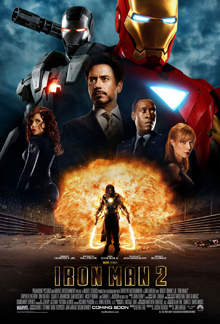
Marvel knows how to make a good movie poster.

Iron Man has always been the asshole superhero. At least, from what I've read of him. Tony Stark is Bruce Wayne minus the baggage and repression, plus narcissism and a drinking problem. The first film is somewhat misleading, because it presents  him as a reformed asshole. A genius arms merchant who develops a conscious along with his awesome suit of armor. In Iron Man 2, Stark is the rock star who has checked out of rehab and into a bar. It is truly the role Robert Downey Jr. was born to play. It's not role-model material, but frankly, our superheroes haven't been role-models for a while now. Dark Knight, Kick-Ass, and Watchmen have all explored the ugly side of being a superhero, and after getting a good look at that blood and grit, I don't see how we could go back to the golden age portrayal of heroes as shining paragons of morality. Much luck to the people trying to make Captain America happen.

One does have to wonder why we like these new, not-exactly-nice-guy heroes. It's not a bad boy thing. Well, maybe it is with the rough justice of Batman and Wolverine. But I think we buy into cocky jerks like Dr. House and Tony Stark for a different reason. In Iron Man 2, Tony's 'reckless' behavior is thinly justified by a soon-to-be terminal case of blood poisoning. I never once thought "Poor Tony!" or "Oh No! Will he make it?" though. On the contrary, I thought "He's Tony Fucking Stark. He'll invent a brand new kind of blood if he has to." And that's why I like such characters. They are aware of their own super-heoric abilities. They're the anecdote to poseury and politically correctness. The antithesis to incompetent sweet-talkers like Sam Rockwell's villain, Justin Hammer.

The suits really are pretty enough to sell the movie by themselves.

All the same, Iron Man 2 is not a high source of moral fiber. It's about as good for you as high-fructose corn syrup, but it's just as delicious. Don Cheadle is a huge upgrade over Terrence Howard, and it's a shame he didn't get more screen-time. His tongue in cheek introduction is excellent. Scarlet Johanson is incredibly hot as Black Widow, and her fight scene is almost on par with the mania that was Kick-Ass's Hit-Girl, though much less violent, as you would expect. Paltrow is still endearing as the anachronistic House Wife/Secretary, Pepper Pots. Mickey Rourke is great as Ivan Vanko, AKA Whiplash, though his climactic battle with Iron Man wraps up a little too quick, just like the Iron Monger fight in the original Iron Man. Samuel L Jackson is always a fun presence, but his Nick Fury cameo feels more than a little bit forced given how much else there was going on with the plot.

After repeatedly hearing "It's not as good as the first one," I had an absolute blast with Iron Man 2. The repartee runs witty, the action scenes are cool-looking and rife with explosions, and the plot feels fairly polished despite it's busyness. If you are a comic book fan, it'll be an excellent time. As is the case with the vast majority of the films I discuss here, I wouldn't recommend bringing grandma. Summer blockbusters are off to a good start.

Sunday, April 18, 2010

Sick Ass

From the moment I saw my first Kick-Ass trailer on YouTube, I was hooked. It's one of those incredibly promising premises I wish I had thought up myself: An average high school boy decides to become a real-life superhero. And that's it. The kid has no super powers, no traumatic past to fuel his efforts, or billionaire fortune to finance . Just a desire to do good by beating up bad-guys. It's a funnier, more realistic, and less political approach to the Watchmen concept, and like that other masked vigilante epic, Kick-Ass was adapted from a comic book by the same name. But is the movie any good? Absolutely. It is hilarious, visually stunning and entertaining throughout. But it's also more than a little disturbing.

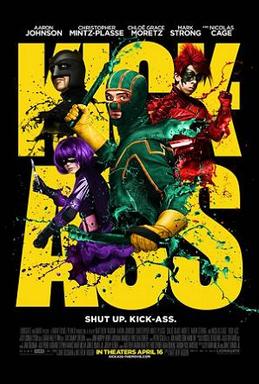
Kudos to whoever came up with the paint spatter motif for the posters.
Staying true to the trend set by Watchmen, Kick-Ass is ridiculously violent, but unlike that other masked vigilante movie, there is a deeper meaning to the uncompromising blood-shed; it essentially allows the movie to function as a sort of cautionary tale. It answers the main character's question "Why has nobody tried to be a superhero before?" People do not dress and fight crime because they would be beaten, shot at and gutted. Even more importantly, the vigilante would be forced to inflict the same death sentences on his prey. It is Batman's no-kill rule that allows him to remain appealing despite the brutal nature of his justice. It's also the most fantastic aspect about his character. Kick-Ass essentially calls bullshit on Batman, and shows people just how bloody being a superhero would be.

At the same time, Kick-Ass pushes the boundaries of aestheticized violence and popular taste. There are two brilliantly choreographed fight scenes in the same vein as The Matrix's seminal lobby shoot out that convincingly present mass murder as something balletic and beautiful. The hook is, both of these massacres, and another intense first-person-shooting scene, are performed by an 11 year-old-girl, acted by a 13 year-old-actress. Hit-Girl is the boldest, most horrifying incarnation of the Child Soldier archetype I have yet to encounter, and yet I couldn't help but cheer as she butchered drug dealers and scum bags with ropes, knifes, guns and swords. Her attacks were simply too creative, and too cleanly executed to not admire, especially when her skills are contrasted against the bumbling titular hero, who spends most of his time in-costume getting beaten up.

There she is, Big Daddy's little murderer.

Even more unsettling than Hit-Girl's actual fight scenes are her training scenes. In what might be his best role since Matchstick Men, Nicholas Cage plays a profoundly disturbed Ex-Cop turned costumed vigilante dubbed Big Daddy; think Batman with guns and a murderous daughter instead of Robin. He buys her daughter butterfly knives for her birthday, drills her on her crime-related factoids, and trains her how to take a gunshot with a bullet-proof vest.  Even though the movie has the decency to point out the truly sick nature of his revenge scheme, the outcome of the story seems to condone his heinous training, leaving a truly immoral aftertaste in the brain.

At the same time, there is more to the movie's message. Dave Lizewski is a truly likable main character, and his super-heroic coming of ages covers topical bases like becoming an Internet celebrity and trying to woo a girl despite rumors of being gay. The movie also lambastes a number of familiar superhero tropes, like rescuing lost cats and talking like a pompous douchebag. The catch is, the ugly, unfunny violence is as much a part of the social commentary and as the simple laughs.

I haven't read the Kick-Ass comics yet, but after watching the movie I fully intend to. I've found that comics are often a more comfortable medium for digesting violence than film, though I understand that they are every bit as violent as the film.


The tag-line is certainly accurate as far as the movie is concerned.

If you are a fan of Superhero flicks, consider Kick-Ass required viewing. Don't take Grandma or the parents though. They may find the violence hard to swallow. Hell, you might too.

Wednesday, November 25, 2009

The Best of All Possible Batmen

You don't need to be The World's Greatest Detective to figure out I'm major Batman fan, but in case my extensive review of The Dark Knight didn't tip you off, I have words to share about Arkham Asylum.


The title of this post might be slightly exaggerated but it gives you a pretty good idea of my opinion about the game. Activision has finally done Bats justice vis-à-vis videogames, halting a dreary, drown-out parade of fail. Their outing (which I experienced via the 360) presents players with the brilliant voice acting of the 90's animated series (which, in my opinion, captures Batman and Joker at their best), the brutal brooding aesthetics of Frank Miller (the only aspect of Miller meriting imitation in my opinion), and the encyclopedic depth of Batman's comic legacy, realized through references, homages, and an impressive character dossier.

Of course, the most important aspect of the game is that it plays like Batman should. The "Freeform Combat" system presents players with the frenetic pacing of the rhythm-action genre in the form of fisticuffs. Conceptually, fights entail frenzied matches of Rock, Paper, Scissors (or Strike, Stun, Dodge) with an emphasis on stringing together long combos to unlock more powerful techniques. It's a much smarter and much more satisfying approach to brawling than typical licensed fair, and even though I happen to be no damn good at it (my combo counter usually peters out at about 8), it's thoroughly enjoyable.

In addition to Zonking and Biffing, (invoked here as old school sound effects; not sexual euphemisms) you also have a utility belt chock full of wonderful toys at your disposal. Batman's signature grapnel gun breaths new life into the hackneyed sneaking trope by allowing you to zip from perch to perch (for some strange reason, the asylum is lousy with indoor gargoyles) to get the drop on fools, as opposed to hiding in boxes or crawling around for five minutes to find the right hiding spot. This is the preferred method for taking out punks with guns, and the only way to navigate situations where thugs have been instructed to kill hostages at the first of Batman. These strategic sequences of cat and mouse, or bat and rats, play more like a strategy or puzzle game than a stealth-action affair, and they truly capture the spirit of Gotham's avenging angel.

My only gameplay gripe, because I've gotta have one, is that the experience feels a little over-engineered at times. You occasionally run into convenient excuses as to why you can't use a gadget, or find yourself forced to clear a room in a very specific way, but I can't stay mad at the game. The very fact that it bothers to explain itself is essentially a good quality, and it's engineering almost always works in the service of variety as opposed to tedium. All the same, I can't help but long for a freer game based on the same model, like an open-ended affair in Gotham.

Lesser oversights include the omission of Shirley Walker's spine-chillingly excellent Batman theme, and the complete absence of Robin. Oracle and Jim Gordan make for good company, but it would have been nice to see at least one of Bruce Wayne's many wards put in an appearence. This is not Christopher Nolan's realistic universe, and therefore there is no excuse to exclude a boy wonder. At the same time, I'm happy to see that the game pays no attention to Batman RIP or Battle for The Cowl. Don't get me wrong, Bruce Wayne has had a hell of a long run, and I can see how killing him off could breathe new life into the Batman mythos, but I'm happy that we got a game that captures him in his prime.


To close on a related tangent, those who are disappointed, or hopelessly confused by the way DC handled the Death of Batman may find some solace in Neil Gaiman's Whatever Happened to the Caped Crusader?. Then again, you might just be more confused. The story (which is, in typical Gaiman fashion, a collection of stories) stands in 'the gutter' between Batman RIP, Final Crisis, and Battle for Cowl, and offers a brief, metafictional look at Bruce Wayne as Batman that is moving and appropriate, if a little sentimental for modern tastes. It is simultaneously an epitaph for his Era, and an indication of what is to come in terms of comic story-telling.

Thursday, July 23, 2009

My Kind of Folk

Even though I love the arcane trappings of magic and the raw symbolic power that pervades the fantasy genre, I am a science fiction man at heart. The reason is very simple really. While Fantasy draws its power from heritage and whimsy, Science Fiction is all about addressing change and exploring possibility. Essentially, one is nostalgic and the other is forward thinking.
So consider yourself forewarned: When Nerdmagedon commences, and battle lines are drawn to determine whether sci-fi or fantasy shall reign supreme, I will stand tall beside the Klingons, Jedi and Cylons against the elves, dragons and fairies.

Believe it or not this post was not inspired by Comicon, which I still have yet to attend. Rather, it stems from the sci-fi genre-bender binge I've been on the whole summer. I'm currently reading a tech-noire with heavy military undertones, playing a space survival horror game, and on the weekends, I get together with friends to re-watch the finest Space Western the world has to yet to see: Joss Whedon's Firefly.


Depending on who you are, that may sound like small praise or blasphemous hyperbole. The space western is still a pretty young sub-genre of science fiction, but what's there is good stuff. The earliest and most prominent example I am aware of is Star Wars, and while the work is too broad to be wholly classified as western, there is no doubt in my mind that it's lawless, frontier atmosphere is what allowed it to stand apart from Star Trek's universe, whose federation of planets seems insufferably tame and preachy by comparison. Another fine piece of fiction to work with the space cowboy concept is the anime Cowboy Bebop, which I shall discuss in detail next post.

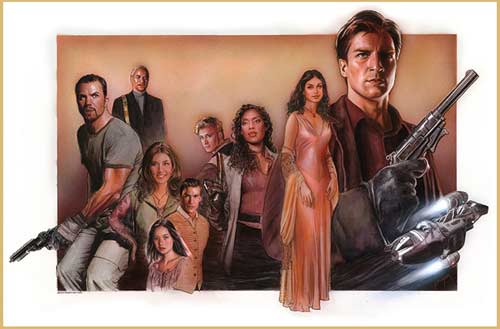
The thing that sets Firefly above the above-mentioned series, is that it is a western first and foremost, with just a little bit of science fiction thrown in for flavor. Almost every character in the cast is based on a classic western archetype. You've got the wise old preacher, the hooker with heart of gold, the crass and crude mercenary brawler, the fancy doctor, and the confederates (Browncoats) who have turned to outlawin' following their defeat in the Civil War (The Unification). The only recurring characters who break the theme are crazy psychic girl, perky mechanic girl, and sarcastic ship pilot. Even the reavers(!), the series reoccurring bogeymen, conform to the old western stereotypes of Indians, in that they are also people, though frightening violent people who have a tendency for scalping and cannot be communicated with.

Now, I love a good western as much as the next sumbitch, but I couldn't rightly tell you that it's one of my favorite genres. By and large, there tends to be a little too much talk of land for my tastes and the folksy atmosphere, where men are supposed to be strong creatures of few words well versed in farming, firearms, and mechanics is hardly hospitable to my nerdy nature and suburban upbringing. The patriotic undertones and lack of cultural diversity also tend to bother me. Seeing how I am an average sample of Whedon's fan base, it is easy to see how he had trouble marketing this series and why Fox decided to pull the plug. Like most other people, I only discovered the show after it had been canceled, and realized that the sci-fi elements addressed all my country western anxieties.


Setting the series in a spaceship, as opposed to a town or a farm gives the series a sense of home (which is essential for the Western) without rendering it sedentary. To inject some cultural diversity into the mix, Whedon sprinkles Chinese throughout the script and refers to his personal take on the evil galactic empire as The Sino-Asian Alliance, acknowledging China and America as the two superpowers most likely to seize control over human society. The cast also has more color than typical American television, let alone a typical western, featuring two black actors, and a Brazilian as well. The real thing which translates the folksiness of Firefly into something nerds can appreciate however is the dialogue. Whedon manages to unite the witticisms of nerd culture with folksome earthiness by relying on plainspoken wit and blunt understatement instead of references to folklore and pop culture.


Interestingly, Serenity, the film intended to serve as the possible salvation/wrap up for Firefly, switches gear's from the television series' western tone to a full on Sci-fi adventure. The western influence and folksy language lingers, but the plot moves away from bank heists, cattle raids and shootouts to encoded messages, insidious viruses, and the mysterious ambitions of the nefarious alliance. Laser weapons start popping up in a world that had only been armed with traditional guns. That was actually the thing that tipped me off to the genre switch.Normally, I would link Picard at this point, but I can see the reasoning behind the toneshift. The movie was a last ditch effort to try and draw in a broader audience for the show, so it needed to be easy to market, and since people are skeptical of stories they can't fit a familiar label to, Whedon decided to give it a more traditional Sci-fi flavor.

All in all it seems like a forgivable evil since the movie is still engaging and enjoyable. If you haven't seen any of Firefly yet, I recommend you rent or buy Serenity, and if you like that, pick up the the show on DVD. I really don't know how much it will set you back, but it's the sort of show that you can watch again and again, picking up new things each time, and the episodes are fairly self-contained, making them great to share with friends.

To those Firefly fans who have not picked up the comic books, I would heartily encourage you to do that as well, regardless of how you felt about the movie. Both series (Better Days and Those Left Behind) take place before the movie and hold true to that original western tone while sewing up a few loose ends. There is nothing particularly ground-breaking in either story, but the dialogue is entertaining and the artstyle is detailed and faithful to the show. Finally, for those of you who are hungering to hear about a certain enigmatic preacher's past, word has it that a lil series called A Shepard's Tale is in the works. It is slightly worriesome that said word came mid 2007 with a projected release date of late 2008, but the announcement came from Ron Glass (with Whedon's permission), so there is still hope yet.

Monday, April 6, 2009

Mr. Sandman

Frequent readers have probably realized this already, and if not, now is as good a time as any to come clean: I am an arrogant bastard. I mean here I am, starting a post about somebody else with a paragraph about myself. Again. With respect to most things I am insecure, but I have tremendous confidence in my creative abilities. It is the very core of my ego, and it has given rise to a terrible involuntary tendency: I immediately deconstruct every story I encounter down to its base premise, and if I find its ingenuity wanting, I am dismissive of it. Even worse, when I encounter works of fiction that genuinely impress, the voices within shriek "If only we thought of this first so you could do it better!" rather than acknowledging obvious virtues and striving to learn from them. Such is the cost of conceit: arrogance preserving ignorance and pride crippling pursuits to realize potential.

The various works of Neil Gaiman have all profoundly invoked this latter response in me. One story in particular filled me with so much covetous energy that my pride finally collapsed under its weight, forcing the revelation that I could learn a lot by earnestly examining what he did differently than I would and why. In every respect, this has been my way with the world; arriving at the simplest solution after walking the weirdest road to get there. The work which led me to this non-epiphany was none other than Gaiman's comic masterpiece: Sandman. I found a phantom mentor in the details of Morpheus's dark odyssey and by the end of the epic, Gaiman had established himself as one of my literary idols. That's him to the right. Isn't he dreamy? Do, do you get it? Because Morpheus is lord of dreams and... God I really should be shot for that one.

My girlfriend Grace has a truly awe-inspiring gift. She can finding missing pieces of peoples' souls in stories they have not read yet. The first volume of Sandman was just one of many life-altering works of fiction she introduced me to.

Unlike most of the stories she showed me, I did not like Sandman at first. Despite forwards and prologues intended to ease readers into the experience, the plot felt disconcertingly vague. Though far from straightforward, the first story arc, where Morpheus Lord of Dreams (left) is freed from decades of imprisonment and attempts to recover his tools is conceptually simple enough, yet I found myself re-reading passages to make sure I got them 'right' as if I would be tested on them. With saintly patience, Grace urged me on to the second volume, and once I hit the 'cereal convention' I was hooked. I finished the remaining nine volumes in a month and a couple associated spin-offs since the summer as well.

Season of Mists (volume four) was where I really went rabid about the series. If you plan on reading the series, I'd suggest you skip this paragraph, because I consider the premise of this volume to be a tremendous spoiler, but if you're planning on giving the series a pass, hopefully the example will change your mind: Circumstances force Morpheus to ask Lucifer for a favor, even though the former had gravely insulted the latter earlier in the story. So Lucifer literally gives him Hell. He releases all the souls imprisoned, and relieves his demonic legions from duty, and leaves Morpehus to deal with a parade of deities and cosmic entities who all want to stake their claim on the underworld. Mythologies from all over the world intertwine at the afterlife, and they all make different case
s for ownership through threats, bribes and appeals for mercy.

The overarching narrative almost always features this sort of blending. Mortals cross into the realm of dreams, and dreams stride into reality. Morpheus frequently meets with his siblings; all personifications of universal constants like Death, Desire and Destiny, (there's a theme here) known as Endless. And these are all based on the primary plot-arc, which Gaiman frequently suspends to indulges his tangential whims. These little detours are exceedingly bizzaire, describing the death-wish of a forgotten DC Comic character who was obscure to begin with, or offering visions of what the world would be like if humans were ruled by cats. Usually these diversions are interesting and breif enough that they don't disturb the story line, though the arc in 'A Game of You' (volume five); where Gaiman tries to make a thoroughly uninteresting character more interesting through casual psychoanalysis and feminist mysticism; is pretty terrible. It's a crystalization of his worst qualities: pretention, thematic vagueness, and strangeness for the sake of strangeness. I know a few of the collected volumes are arranged differently than their publishing order, so that may be a factor.

Once again, the natural fractures of the comic form makes it the perfect media to convey long, complicated, and involving stories. The episodic release schedule makes the narrative breaks seem less arbitrary, and it also slows the pace, creating a greater sense of scale and allowing readers to consider each aspect of the plot more carefully. Even though I consumed the series all at once, my experience of it continues and grows richer
as I discover all the different aspects of folk lore it incorporated. For instance, I had no idea that Gaiman's Corinthian was based on an actual legend about a dream god's eating peoples eyes, but I learned as much through a folklore class the following quarter.


Comics also have pictures, and they play an important part in Sandman. For starters, a lot things which happen in the story simply translate better through visual channels. And while most graphic novels are drawn by a single artist, Morpheus and co. have been drawn by a number of different talents, each bringing their unique touch and art style to the experience. Volumes 9 & 10 display the most impressive range of variation, moving from sharp, almost cubist aesthetics, to detailed watercolor-like style, to traditional comic styles. You might think this would be visually exhausting, but the art remains consistent for a given chapter or story, so it's easy enough to follow. I frequently found myself wondering what interpretations from other artists might look like. All the change also serves to emphasize the elements which remain constant, like character specific speech bubbles. Dream always speaks in white text against a black bubble, fitting for a nocturnal figure, while Delirium's text is squigly and adorned with rainbows.

As much as I want to be the Daniel to Gaiman's Morpheus (alternate links I considered for that were "Psuedo-spoiler", and "Things That Sound Gay"), I can't say I love Gaiman's writing without saying I hate it as well. Part of it is that damn pride I began with. Part of it is that his approach to story telling seems so similar to that I wish to develop, that the difference which remains has been compressed to a needle sharp kernal of not-exactly rightness. It's like an OCD person being confronted with a row of pictures that are all perfectly straight save one, and then telling them they can't correct it. There's more to it than that, but I've left it for the next post. Look back for it soon.

Thursday, March 5, 2009

Watching the Watchmen

It has been forever and I apologize, but a new post has finally arrived, along with some general changes to the Sarcasmancy banner. I will strive to post more consistently in this coming quarter, even in the face of academic trials and personal crises. You also may notice a few more pictures in future posts, like this one here:


On March 5th, at the Steven Jay Ross theater I had the privilege of attending a preview for a little flick called Watchman. You probably don't believe me, and I can't blame you seeing how the movie's been out for weeks and I'm just talking about it now. The intermingling days have been a deluge of deadlines, examinations and group projects on WoW which required extensive study.

The production values at work in this film are flat-out amazing. Every major character, and most of the minor ones as well (like newstand guy and comic book kid), are attired according to the comic book's odd orange, purple, green color scheme down to their last button. Some people have groused over the changes to Night Owl II and Silk Spectre II costumes, but they both look sexier and more practical on screen than they did in the ink.

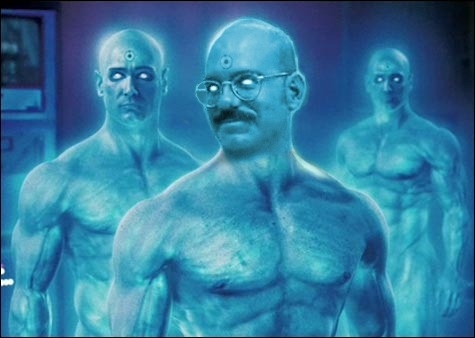
The casting is mostly strong. Edward Blake is amazing as The Comedian, and Carla Gugino displayed an impressive range as Sally Jupiter. Malin Ackerman was stretched more than a little too thin playing Laurie Jupiter, though the character sort of begs for over-acting, and she looks great naked, (though the sex scene is still ridiculously awkward). I personally loved Billy Crudup's take on Doc Manhattan. His soft spoken nature made him far more impressive than the deep, cold monotone the comic led everyone to expect. I can see how some people might feel that it made him too sympathetic, or even too vulnerable for the role, but honestly things could have been much worse:


I find it kinda funny, that lots of critics are criticizing Synder's adaptation for being too faithful to the graphic novel even though many of them backed up Alan Moore's claims of it being 'unfilmable'. Their complaints do not prescribe stylistic adjustments either, but outright objections about the source material. Some complain that politics are adolescent and tediously exaggerated. Others feel the plot is pretentious and needlessly convoluted. Guess what folks? Allan Moore has done this before. Snyder could have afforded to be a little bolder here and there, but the idea of a domesticated, mass-marketable Watchmen is a frightening prospect to a lot of people, and for good reason.

I think William Hoy and Zack Snyder recieved too little credit where editting is concerned. They mannaged to trim most of the fluff from the story and tremendously simplified its ending, which involved a green, tencacled, vagina-eyed monstrousity; a device I always suspected Moore implemented just to poke fun at the way comics escalate. In each volume, plots tend to become more convoluted, bizaire in correspondence with their broadening scale. At first you're saving banks from thugs, then nations from nazis, then planets from aliens, then universes from trans-dimensional disasters that encroach upon the metafictional.

Anyway, instead of whining about how each scene copies those in the comic, or tittering at how much screen time Doctor Manhattan's big blue dong has, it would be nice to see more critics addressing the absurd amount of superfluous violence Snyder injects into the presentation.

Much as I hate to admit it, The Batman may be to blame for this one. Dark Knight was violent. Where PG-13 ratings are concerned it pushed some serious boundaries, and I walked out of the theater predicting a parental backlash. I was relieved to be wrong, because everything between Ledger's pencil trick and Glasgow Smile served a purpose; developing Nollan's darker and more realistic take on Bats. It was also done with intelligence and decency, honoring one of the oldest traditions in the comic industry: It left the blood in the gutter. This practice exiles gruesome acts to the spaces between the pictures, allowing audiences to come up with their own explanations and interpretations of the macabre. I learned all this from Scott McCloud, and you can too if you pick up his excellent book, Understanding Comics, which is one of the few works of contemporary comic-theory available, and the best I have read to date.

Funny thing is, while Watchman is also all about making superhero vigilantism realistic, the spectacular and explicit presentation of it's violence (rife with slick slow-mo and over the top sound effects) serves to establish the exact opposite effect. The ridiculously violent fights feel more like those found in Marvel's flicks and that surreality distances audiences from the heavy themes at work in the script, despite it's relentlessly dark posturing.

Once again, it's a matter of fracture. The tendency in film, by design, is to present audiences with an experience that is as fluid and streamlined as possible, while comics bombard audiences with fractures; from issue, to page, to pannel, to text box or speach bubble, few media are as inherently fragmented as comics. This gives artists a number of channels to choose from when engaging their audience. Watchman was celebrated as a graphic novel, and is favorably compared to it's cinema counterpart for it's ability to pair grim suggestion with stark images of violence. And just as rain water renders war memorials unintelligible by filling in their inscriptions, Snyder wipes away the visual subtlety of Watchman's story by smearing Gibbon's carefully drawn lines with extra blood. Great, now I sound like a page out of Rorschach's journal. And possibly an alarmist to boot.

Understand, that I am a hotblooded young man who likes his steaks bloody, his entertainment violent and his freedom of speech loud. The mantel of Schoolmarm is not one I am eager to adopt. It's rather at odds with the rebellious artist persona I'm trying to cultivate here. Though in all honestly, the movie is too fucking violent. It's like Snyder found the laziest possible way to make the movie as 'challenging' to watch as the comic was to read, except one's stomach is tried as opposed to his intellect. Just a few cuts here (Buzzsaw. Prison Cell.) and there (Rorschach. Pedophile. Cleaver.) would have made it much easier to watch and nobody would have gone wanting for blood at the end of the day.

In closing, I would like to mention I have joined the ranks of the Biased Video Gamer Blog, an up-and-coming site featuring all sorts of gaming goodness, including links to amusing game videos and reviews including a piece on FEAR 2 written by yours-truly. There will be more where that came from as well! I will also continue to cover games here at Sarcasmancy on a fairly regular basis. The next post will be sooner coming than this one was, I promise you.