Showing posts with label Western. Show all posts

Sunday, October 24, 2010

Redeeming Dead

Death is a fairly pedestrian experience in most modern video games. It's like waiting at a stop light. It's a delay or an annoyance at most, but it doesn't really cost you anything. Saves and checkpoints can be reloaded. More lives can be obtained. Dying is a mere hiccup in the emergent narrative of your play session. In most cases, failed attempts aren't even addressed by the game's given narrative. Mario will inevitably beat bowser. Nathan Drake never really dies. That time you used your face as a catcher's mitt for a Bullet Bill? Those leaps of unfounded faith? Your brilliant idea to charge the a platoon of fortified enemies? Don't sweat it slick. They were bad dreams. Outtakes. Omake. Life is cheap, so waste it as you see fit.

That's part of the charm of video games, obviously. Real-life is much stingier with second chances, and  it's incredibly liberating to be able to leap off the highest cliff you can find without fear of consequences. But there's also a helluva lot to be said for games that allow you to die an appreciable death. A meaningful defeat that gives you cause to pause and reflect on what just happened is an incredibly valuable experience. It's also hard as hell to balance. If you make losing too costly, players won't have the will to start over. Make it too mild and... actually, many players don't seem to mind at all, hence the recent trend of games that mitigate the cost of death, or do away with it altogether. But it's a sore absence if you ask me. So today, I'd like to take a moment to address games that redeem the value of death in play, either by having it significantly influence mechanics, giving it appreciable narrative gravity, or just doing something interesting with it. Mega spoilers abound, so take caution.

Now this here is how you do a Western, I tell you wut. Hats off to them Rockstar boys.

Red Dead Redemption is a game I've been meaning to talk about for some time. The most frequent indictment brought against RDR is that it is simply GTA with horses and this is largely true. When friends asked me what the biggest difference was between RDR and GTA4, I said it was the way horses control versus cars. It was an off the cuff the answer, and looking back I realize that "the environment" would have been a better answer. The frontier Rockstar presents you with is the most impressive digital landscape I've yet encountered, and it is teaming with flora and fauna that you can interact with. At some point in the game, you will be killed by a cougar. Wolves will attack you in packs. You will hunt bears and skin them. You will pick wild flowers and herbs and sell them to buy bullets and whatever. The extent to which you interact with these elements is still mostly elective however, similar to GTA's Taxi/Police/Ambulance mini-games. There are a few missions where you hunt plants and animals toward the end of the game, but the vast majority of the game has you completing missions by riding horses and shooting fools, similar to the way you drive cars and shoot fools in Liberty City.

So what does this have to do with death? Nothing. I just wanted to talk mechanics for a little bit. The game does do something interesting with death, however.

After hundreds of shoot-outs, fetch-quests, horse-chases and other decidedly western trials, John Marston meets his end at the hands of the US Army in the final mission. Some context is necessary to appreciate the significance of this death. Marston is an ex-gangster who has been pressed into tracking down his former gang members by the US Government who is holding his family hostage as collateral. You complete this task about three quarters into the game at which point you are reunited with your family. The last few missions have Marston simply acting as a husband and a father. John's son Jack, is particularly ambivalent toward his father. He realizes that his father did not leave him out of choice, but he also struggles with abandonment issues and does not know the full details of his father's past or his service to the government. The game has you reconcile John with his gentler, slightly bookish son. After John dies protecting his family, the game allows you to continue playing in it's world, as traditional of RockStar titles, but you continue to play as Jack instead of John.

By continuing your father's legacy, the legacy of the character you have played throughout the entire game, the values of the old west are validated, and John's questionable life is redeemed through Jack. Video games rarely consider what happens after a character dies. Usually, they simply imply that evil wins and justice is not served. The fact that Red Dead Redemption goes farther, is refreshing and interesting. That said, Marston's ultimate demise doesn't cut as sharply as it could, seeing how you will have likely seen him die several dozen times before his canonical death.

Reach offers solid gunplay and good times online, 
but it could do more with its premise.

Another recent game that nearly does death justice is Reach. It's not quite as poignant or novel as RDR, which is a much longer, more emotionally involved affair, but you do adopt the role of a marine fighting in a military campaign doomed to failure. Reach is by no means the first title to put you in this position, but it's still fairly fresh territory for video games, and watching your squad mates die one by one, until you are finally left to your own last stand makes for a novel experience. More can be done with this premise however. Halo has never been a series for subtlety or ambivalence. It's monotonous rhetoric of duty, teamwork and sacrifice has always reached propagandistic proportions, and the game never once has Noble Team question their orders or consider their own chances. But showing the losing side of a battle, where even when you win the game, the good guys lose, is an interesting jumping off point for future titles to tackle.

This is a great game and you should buy it.

As I implied at the beginning of this post, death is used most impressively when it gives players cause to pause and reflect. To that purpose, few titles are as effective as Minecraft. When you die, you drop all of your items, and you only have a few minutes to collect your belongings. "That sounds like corpse running," you might point out. Very good. It is corpse running. But unlike the corpse runs of MMO's where reclaiming your belongings is a forgone conclusion and running back to your body is just a hassle, you very often won't be able to retrieve your lost goods in Minecraft. Loss is painful and consequential. It makes you think twice and weigh risk against reward. The game also introduces Creepers; easily the vilest new video-game of the last decade: hissing, walking bombs that can destroy your house as well as your body. What is valuable about having your house blown up you ask? Like the rest of Minecraft, a minimalistic gem of a game, the risk of death scales to your aspirations in play. The deeper you dig, the more you stand to gain. The deeper you go though, the harder it is to reach the surface and reclaim your loot. The grander your architectural schemes, the longer the shadows cast by Creepers. When you succeed, the triumph is not at all artificial or forced, but organic.

Finally, an oldie but a goody that I've been looking for a long time. Planescape: Torment, recently resurrected and available for purchase from Good Ol' Games. I'm not too far into the campaign yet, but I've played enough to tell you that it is superbly written. The game was created at the end of a magical era, where people still used written description to supplement game narratives, as opposed to relying solely on graphics and cinematics. As for how the game handles death, it marries your ability to come back to life with the narrative: you play as an accursed soul caught in limbo who cannot die or return to life as you know it. From what I have gathered so far, your ultimate goal may be to die once and for all; a fascinating quest to say the least.

I know there are hundreds of titles that handle death in innovative, inspiring ways which I have not addressed here. There are even several recent titles that deserve to be examined, Demon Souls being chief among them. But I won't weigh in on a title I haven't played yet, and this was never intended to be a comprehensive list of any sort. If you have ideas of games that work with death in interesting ways however, I would love to hear them. My thesis may work along similar lines. I realize this update has been a long time coming. Hopefully the length compensates for it somewhat. I'll try to have something on Johnathan Strange and Mr. Norrell up before October is out, but I make no promises. Check back soon!

Tuesday, September 7, 2010

A Shotgun, A Zerg And You

A little while ago I quipped that "Blizzard got Firefly in my Starcraft  and I couldn't be happier." The truth though, is that you can always be happier, especially if you're both cynical and optimistic, and while Starcraft II: Wings of Liberty is an excellent title, it could do even more with it's country-western mash-in. But before I start in on the narrative, I want to repeat, the first installment of Starcraft II is an excellent piece of videogame. Even if you don't plan on partaking of the game's robust multi-player component, the single-player campaign is a parade of finely crafted, uniquely challenging missions that boasts surprising replay value. 


Each mission in the campaign has a unique hook that prevents it from being a typical game of Starcraft. Waves of fire or tides of lava will force you to move your base from point A to point B. Swarms of zombified marines will besiege your base come eventide, forcing you to hunt their lairs during the day. In one mission, you must intercept shipping routes and rob trains (which, to my eye, is the pinnacle of this sci-fi western strategy concoction, but more on that later). These variations keep the campaign fresh and many of them beg second playthroughs.


To further replay value, you accumulate limited funds and research points throughout the campaign which can be allocated to purchase and upgrade troops in various ways. There are also several points in the narrative when you are forced to take sides in disputes between two opposing characters, resulting in two unique missions and two unique narrative outcomes. One decision determines which special unit you will have access to, and another affects which enemies you will face in a later mission. At long last, a strategy videogame that let's you make meaningful tactical decisions in your virtual crusade This is a feature that could stand to be played up a lot more in Heart of the Swarm, though I have to wonder how that sort of diplomacy will translate to the Zerg campaign.

I assume the multiplayer is good because people treat it like a fucking sport, but I can't really comment on it because I haven't touched it yet. WoW aside, the prospect of PVP in Blizzard games kind of terrifies me. I don't have the lightning quick reflexes, or the patience to memorize hotkeys and stats for each unit in the Terran, Zerg and Protoss hierarchies. I would not last five minutes in a campaign. Or worse, I would provide my opponent with just enough interest for him to bat m around the map for twenty minutes while an audience of thousands looks on with scornful cackling. Yeah. That's how it works right? Maybe I'm making it worse. An old penny-arcade comic comes to mind, but I can't seem to find it. I might take a stab at it provided I find a friend to tutor me, but harsh memories of DotA (admittedly, not a real Blizzard game) and Warcraft III are enough to steer me clear for now. I'm not here for the bloodsport anyway.


No sir, I enlisted to follow the trials and travails of James Raynor and his raiders. That said, I haven't read any of the extraneous fiction available to flesh out the game's universe. I didn't even pay particularly close attention to the narrative of the first game. I did however, develop considerable respect for Blizzard as storyteller during my tenure as a WoW-addict, specifically when I was taking hits of Litch, and I wanted to see where they were gonna go with their return to the RTS format. 


In brief, the storyline for the first installment of a planned trilogy is good, and the smartest move Blizz makes is tapping into the same creative leylines that Joss Whedon channeled to create Firefly. It's a space-western right down to the twangy soundtrack and cowboy dialog, and it helps Starcraft II curb it's harshest artistic criticism; that it's nothing more than a Warhammer clone. That said, it accomplishes this feet via another imitation. James Raynor is conflicted, moody and lovable, but not as compelling as Malcolm Reynolds. Despite his folksy phrases, Jim lacks the humble and at times bumbling, charm that made Mal so fresh. Raynor comes off as a bit too heroic, and heroically flat. The supporting cast is similarly likable-but-bland, lacking the complicated relationships that made Serenity's crew so damn exciting to be around. One of the problems is that the plot is a bit too grand for it's own good. Raynor's civil war baggage and lady problems, two tried-and-true staples of the western genre, are handled quite well, but the practical aspects of his revolution, the down-to-earth, everyday concerns that Firefly made so damn compelling, are shortchanged.


Among the supporting cast, Tychus Findlay easily steals the show. 


Desperation, particularly as precipitated by scarcity of resources, is an essential theme of The Western. That seems like it would make a natural fit with the resource obsessed strategy genre, yet I never got the sense that Raynor and his crew were ever scraping. Yeah, they plunder tech from The Dominion, but I never got the sense that they were worried about having a warm meal, or that they wouldn't have enough minerals to fuel their flagship. You have to make some hard calls when it comes deciding between that last mercenary contract or upgrading your infantry, but the fact is, you've got extra money to spend. The train job mission is a step toward scarcity, in spirit and aesthetic, but most of the other missions, fun as they are to play, provide players with a glut of resources that diminish The Western's characteristic leanness


And leanness isn't the only thing lost. For a game obsessed with details by play-style, the narrative seems to gloss over a lot of logistics that have a lot of dramatic (and game-play) potential. How does Raynor hide his raiders from The Dominion? How do the mercenary troops get along with the raiders? The funny thing is, Blizzard has proven themselves brilliant at filling in these world-building gaps, time and again through the tiny quests in World of Warcraft. I can't help but wonder how they might have more effectively translated that world-building to Starcraft II.


I'm not saying that Starcraft II should aspire to be Firefly: The Game, or that it should be World of Starcraft. It shouldn't. I'm not even saying that Starcraft II fails as a story-telling game. It doesn't. As game narratives go, it's a real winner. But it could be even better, and I hope Blizzard continues to push the envelope in the next two installments. 

Friday, February 19, 2010

How The West Was Fun

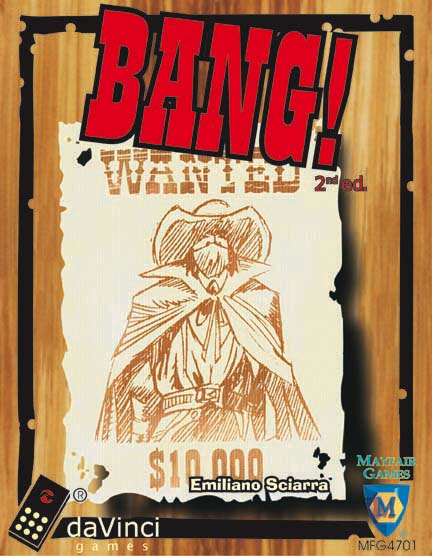
I've picked up a lot of party traditions in college and playing Bang! is definitely one of my favorites. Even, or perhaps especially, in this modern climate of electronic gaming, it is one of the best multiplayer investments you can make. Rock Band and Smash Bros. are a helluva lotta fun, but with larger gatherings, the four player limit strains your ability to entertain. Bang! is an excellent backup plan, and in my opinion, an essential addition to any gamer nerd's library of traditional (read: non-electronic) titles.


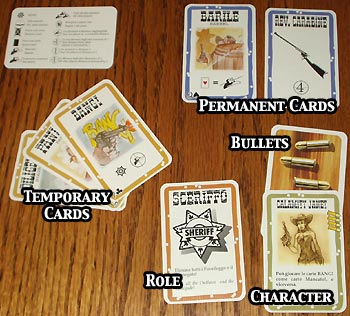
The game is basically a card driven variation of the game Mafia featuring basic role-playing elements like health, items, character roles and abilities. Each game features three basic factions: The Sheriff and his Vices, who want to purge the town of undesirables, the Outlaws aiming to take over the town by killing the lawmen, and the Renegade who must be the last man standing in order to win. Only the Sheriff's identity is public however, resulting in many cases of mistaken identity and hilarious alliances. In addition to the four different roles that determine players' agendas, each player draws a character card that has a special power, allowing them to draw more cards, or use cards in special ways. The rest of the deck consists of permanent equipment cards (guns and horses) which you lay down in front of you, and instant action cards (shooting, dodging, stealing cards) which you hold in your hand. The game's first expansion, Dodge City, is fairly essential as it introduces the Renegade role and semi-permanent single-use equipment cards. People tend to ignore the second two expansions which introduce condition cards that change the terms of play for one round.

pic taken from RPG.net and found through google
Here's a basic setup to give you an idea of what the game is like. Absent are the semi-permanant equipment cards of Dodge City and the Condition cards of High Noon and Fistful of Cards.

It sounds complicated, and it is, but it's much easier to explain, set-up and learn than something like Catan, or even Monopoly for that matter. Munchkin, another nerd favorite, tends to involve less guile and more negotiation, up until the end game when everybody starts screwing each other over. In Bang! you can run some truly impressive cons and screw people over without intending to, all in one match, sometimes with the same action. Word to the wise: flat out stating your role tends to make the game harder and less fun. By outing yourself as an outlaw, you provide other more cunning outlaws with a sacrificial lamb. All they have to do to look like good guys is shoot you dead. The exception to this rule is to claim to be the vice. No matter what you actually are, you want to look like the vice to the Sheriff. In fact, it's become something of an unspoken rule with my group. "I'm the vice!" "No, I'm the vice!" etc.

I'm not gonna lie here; one of the reasons Bang! is a favorite is that in addition to providing players with an endless stream of awful puns, it makes a 'bang-up' drinking game (see what I mean about the puns?). The most obvious drinking variation is to have players drink whenever their characters do; in game, you recover health by downing beers, tequila and canteens. It's a serviceable rule-set, but rather uninspired and a bit dry for my tastes. I say take a swig of brew whenever somebody hits you or after failing to hit somebody else, and if you're really feeling manly, take a shot of something harder whenever using a recovery item! Disclaimer: This is actually fucking terrible advice. Trust me, I tried it. Shot of sodium rich soy sauce + gulps of dehydrating alcohol = painful hangover. Just stick to tequila. Or Juice.

Pic taken from myfairgames.com ; as usual, found through google
Despite a couple odd tweaks, The Bullet is definitely the edition you want. It has all the expansions, a couple of extra characters with ridiculous but fun powers, a sweet-looking bullet case, and a so-cheesy-it's-awesome Sheriff's Badge.

Some less alcoholic house rules that have proven fun are playing with two character powers at once (though some combinations are prohibited for balance reasons) and The Dual Schofield Rule, which states that a player may equip 2 Schofields and shoot at two different targets once in one turn. Normally, players can only shoot once in a turn, and they can only equip one gun. The rule sprang up after we watched the new 3:10 to Yuma and saw Charlie Prince waste about a hundred people with a pair of Schofields. It's the perfect house rule since it can only be implemented in rare circumstances, and it has a greater impact on style than substance. Other rule changes we use involve using the older versions of certain cards; as mentioned in the picture above, certain features were tweaked slightly in The Bullet edition of the game, including Ragtime being mistakenly misprinted as a "Shoot any player" card instead of a "Steal from any player" card, and a couple of character's lives being adjusted.

All in all, I cannot recommend Bang! highly enough since it's the sort of game almost everybody can enjoy, and at ~ $40 for The Bullet Edition, you'd be hard pressed to find a finer bargain. So git along, giddy up and have a gun fight or few. You won't be disappointed. In closing, some mood music.

Monday, July 27, 2009

Japan's Finest! Space Cowboys and Hiphop Samurai!

Howdy Amigos. As promised last time, we're heading back to the Old West in space via the Far East on Earth. Our mission? To examine one of the finest anime ever produced: Cowboy Bebop. If you get tired of my palaverin' on about intergalactic cowboying, just click the links to the awesome tunes, and check out the amusing embedded video (!). If you make it all the way to the end, I have some words about the hip-hop swordplay of Samurai Champloo too. If that don't satisfy, I dunno what to tell ya, there's just no pleasing some folk.


Premise-wise, Cowboy Bebop probably sounds very similar to Firefly. In both cases you've got a crew of lovable misfits drifting around a loosely policed galaxy looking for enough work to pay the repair bills and keep food on the table. The Bebop's Crew is smaller, and they work as bounty hunters (called "Cowboys" in the series) instead of outlaws, but the real distinction between the two shows is a matter of style. While Firefly is solely a western within it's sci-fi trappings, Bebop is by turns, a Hong Kong Kung-Fu flick, a film noir, and a Jazz Odyssey.

In fact, it's the music that makes the show. Series director Shinchiro Watanabe is as renowned for awesome music as Joss Whedon is for witty dialogue, and Yoko Kanno, who might be considered the John Williams of anime, penned the score. Listening to the opening and closing themes will do your ears good and give you a feel for the general poles of the show (funky and frenetic vs. soulful melancholy) , but there is so much more to hear before you can really appreciate the incredible range of the soundtrack (and what I've linked here just tips the 'berg). Musicality is a general theme for the show, with episodes referred to as sessions and named after record titles or various pieces of music.


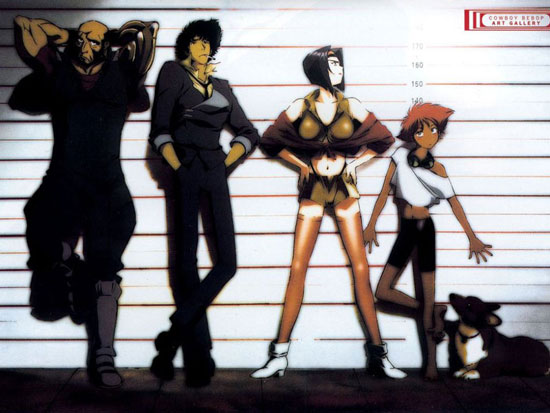
Meet the cast and crew of the Bebop. From left to right we've got ex-cop Jet Black, ex-triad Spike Spiegal, femme fatale Faye Valentine, crazy girl Ed, and Ein the data dog.

The eclectic nature of the music reflects on the quality of the writing. There is the eastern emphasis on the journey as opposed to the ending, but unlike so many other anime and manga, the narrative does come to a coherent and decisive conclusion. There aren't any plot holes either, at least, not in the sense of incoherence, though it does suffer from cavernous blind spots which move beyond titillation and into exasperation; a distinction I measure by the moment viewers stop thinking "I wonder what happened there..." and start wondering "Did the writers even bother?" In this case, I am referring to the "main plot" of the series that focuses on Spike's history with the criminal element and his missing lady-love Julia. What little we learn of it is compelling enough to move you along with the story, but when looking back at it you can't help feel that something significant was left unsaid. Part of the problem may be that I love the enigmatic (if shallow) main bad-ass, Vicious too much; possibly because he reminds me of another ruthless, effiminate silver-haired swordsmen.

Before bidding a fair well to space westerns for the foreseeable future, I must acknowledge that Cowboy Bebop is not the only anime to do space cowboys, and some may dispute my claim that it does them best; namely Trigun fans. I'd be lying if I tried to tell you I enjoyed Trigun as much as Bebop, but before you decide to nail me to your cosplayed crucifix cannons (officially my strangest alliteration ever), allow me to qualify my decision: Trigun is a better Western, but a worse Space Western because the space aspect of the show is restricted to just a couple of episodes. Mostly it's just Vash The Stampede wandering around a barren desert planet, shooting at folk without killing them, devouring doughnuts and shouting "Love and Peace!". In case you ever wondered who would win a shoot out between Vash and Spike, allow me to present you with the following hypothetical:


For those wondering why the Japanese have such a yen (or should I say Zen?) for Westerns, the simple answer is that they are trying to get back at John Sturges for stealing the plot of Akira Kurosawa's Seven Samurai to make The Magnificent Seven. Feeble jokes aside, our romanticization of the gunslinger parallels Japan's treatment of Samurai, and I believe it accounts for much of the cross cultural genre bending.

Interestingly enough, Shichiro Watanabe's other genre blending masterpiece is about swordsman in the Edo period; Samurai Champloo. As I mentioned earlier, Watanabe is renown for musical shows, and Champloo happens to be Hip-hop flavored, which means it's about as historically accurate as Cowboy Bebop is historically predictive. Fortunately, it's also just as entertaining, and frequently entertaining in the same ways. Once again, we've got a two guy one girl set up, (though we've ditched the dog and the kid who were included in Bebop to lighten up the show's blueszy atmosphere) and we follow the trio through a trail of odd jobs as they seek out "The Samurai who Smells of Sunflowers". Unlike Bebop, the story telling is completely rooted in the eastern school of the journey, with the plot mounting up to a final duel between the two guys that never ends up happening.

Jin, Mugen and Fuu, just chillin'

Yoko Kanno doesn't come around again, presumbly because hip hop ain't her thang, but the music continues to impress anyway, and in closing, I present you with this link to Samurai Champloo's closing theme. Til next time, See You Space Cowboy.

Thursday, July 23, 2009

My Kind of Folk

Even though I love the arcane trappings of magic and the raw symbolic power that pervades the fantasy genre, I am a science fiction man at heart. The reason is very simple really. While Fantasy draws its power from heritage and whimsy, Science Fiction is all about addressing change and exploring possibility. Essentially, one is nostalgic and the other is forward thinking.
So consider yourself forewarned: When Nerdmagedon commences, and battle lines are drawn to determine whether sci-fi or fantasy shall reign supreme, I will stand tall beside the Klingons, Jedi and Cylons against the elves, dragons and fairies.

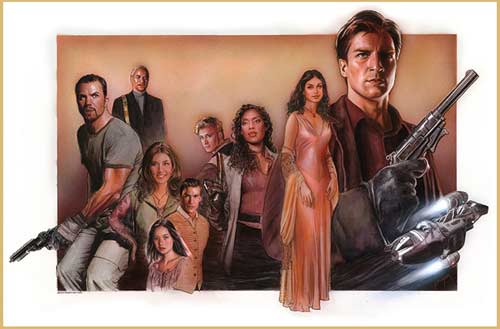
Believe it or not this post was not inspired by Comicon, which I still have yet to attend. Rather, it stems from the sci-fi genre-bender binge I've been on the whole summer. I'm currently reading a tech-noire with heavy military undertones, playing a space survival horror game, and on the weekends, I get together with friends to re-watch the finest Space Western the world has to yet to see: Joss Whedon's Firefly.


Depending on who you are, that may sound like small praise or blasphemous hyperbole. The space western is still a pretty young sub-genre of science fiction, but what's there is good stuff. The earliest and most prominent example I am aware of is Star Wars, and while the work is too broad to be wholly classified as western, there is no doubt in my mind that it's lawless, frontier atmosphere is what allowed it to stand apart from Star Trek's universe, whose federation of planets seems insufferably tame and preachy by comparison. Another fine piece of fiction to work with the space cowboy concept is the anime Cowboy Bebop, which I shall discuss in detail next post.

The thing that sets Firefly above the above-mentioned series, is that it is a western first and foremost, with just a little bit of science fiction thrown in for flavor. Almost every character in the cast is based on a classic western archetype. You've got the wise old preacher, the hooker with heart of gold, the crass and crude mercenary brawler, the fancy doctor, and the confederates (Browncoats) who have turned to outlawin' following their defeat in the Civil War (The Unification). The only recurring characters who break the theme are crazy psychic girl, perky mechanic girl, and sarcastic ship pilot. Even the reavers(!), the series reoccurring bogeymen, conform to the old western stereotypes of Indians, in that they are also people, though frightening violent people who have a tendency for scalping and cannot be communicated with.

Now, I love a good western as much as the next sumbitch, but I couldn't rightly tell you that it's one of my favorite genres. By and large, there tends to be a little too much talk of land for my tastes and the folksy atmosphere, where men are supposed to be strong creatures of few words well versed in farming, firearms, and mechanics is hardly hospitable to my nerdy nature and suburban upbringing. The patriotic undertones and lack of cultural diversity also tend to bother me. Seeing how I am an average sample of Whedon's fan base, it is easy to see how he had trouble marketing this series and why Fox decided to pull the plug. Like most other people, I only discovered the show after it had been canceled, and realized that the sci-fi elements addressed all my country western anxieties.


Setting the series in a spaceship, as opposed to a town or a farm gives the series a sense of home (which is essential for the Western) without rendering it sedentary. To inject some cultural diversity into the mix, Whedon sprinkles Chinese throughout the script and refers to his personal take on the evil galactic empire as The Sino-Asian Alliance, acknowledging China and America as the two superpowers most likely to seize control over human society. The cast also has more color than typical American television, let alone a typical western, featuring two black actors, and a Brazilian as well. The real thing which translates the folksiness of Firefly into something nerds can appreciate however is the dialogue. Whedon manages to unite the witticisms of nerd culture with folksome earthiness by relying on plainspoken wit and blunt understatement instead of references to folklore and pop culture.


Interestingly, Serenity, the film intended to serve as the possible salvation/wrap up for Firefly, switches gear's from the television series' western tone to a full on Sci-fi adventure. The western influence and folksy language lingers, but the plot moves away from bank heists, cattle raids and shootouts to encoded messages, insidious viruses, and the mysterious ambitions of the nefarious alliance. Laser weapons start popping up in a world that had only been armed with traditional guns. That was actually the thing that tipped me off to the genre switch.Normally, I would link Picard at this point, but I can see the reasoning behind the toneshift. The movie was a last ditch effort to try and draw in a broader audience for the show, so it needed to be easy to market, and since people are skeptical of stories they can't fit a familiar label to, Whedon decided to give it a more traditional Sci-fi flavor.

All in all it seems like a forgivable evil since the movie is still engaging and enjoyable. If you haven't seen any of Firefly yet, I recommend you rent or buy Serenity, and if you like that, pick up the the show on DVD. I really don't know how much it will set you back, but it's the sort of show that you can watch again and again, picking up new things each time, and the episodes are fairly self-contained, making them great to share with friends.

To those Firefly fans who have not picked up the comic books, I would heartily encourage you to do that as well, regardless of how you felt about the movie. Both series (Better Days and Those Left Behind) take place before the movie and hold true to that original western tone while sewing up a few loose ends. There is nothing particularly ground-breaking in either story, but the dialogue is entertaining and the artstyle is detailed and faithful to the show. Finally, for those of you who are hungering to hear about a certain enigmatic preacher's past, word has it that a lil series called A Shepard's Tale is in the works. It is slightly worriesome that said word came mid 2007 with a projected release date of late 2008, but the announcement came from Ron Glass (with Whedon's permission), so there is still hope yet.