Showing posts with label Movies. Show all posts

Sunday, January 23, 2011

The Dark Side of the Barre

This is an expanded edition of the review of Black Swan I wrote for The Technique, though the original never got published on account of school being cancelled for the first week due to 8 inches of snow and ice. I'm actually glad I get to post it here, because I have more to say about this movie than most. Actually, it did get published on the Technique's website, which you should totally visit so I don't get in trouble for posting this extended edition here. Have mercy editorial powers that be!


A simple enough poster, but it does a good job of balancing between pretty and scary.


Black Swan is modern day re-telling of Tchaikovsky’s famous ballet, Swan Lake.  Rather than a tragically beautiful, tale of lost true love however, the film offers a frightening and at times hideous look at the obsessive, self-destructive side of ballet.

For those who don’t know the fairy tale, a princess named Odette is cursed by the evil magician Von Rothbart to spend her days as a swan and regain her human form at night. The enchantment can only be undone by true love, and while she successfully wins the heart of the handsome Prince Siegfried, he is seduced away by Rothbart’s daughter, a black swan princess named Odile. Deprived of the true love that gave Odette her life back, she kills herself.  When the ballet is performed, it is traditional for the same ballerina to dance both the roles of Odette and Odile. Thus, the dancer must be able to convey both a demure, pure-hearted maiden and an aggressive, lusty temptress.

The film translates the tail to the modern day, following a young ballerina named Nina, played by Portman, who is a dancer in New York City Ballet (NYCB). After spending years in the corpse de ballet, she is given the opportunity to dance the swan princess, though the director of NYCB feels that Nina is only capable of dancing the vulnerable and innocent White Swan. She is a technical perfectionist, but her movements are repressed and inexpressive. Vincent Cassell does an admirably creepy performance as Thomas, the creative director of NYCB who tries to draw out Nina’s inner-Black-Swan and serves as the film’s Von Rothbart. While there is no obvious equivalent to Siegfried, there is a another ballerina named Lily, played by Mila Kunis, who is both a bitter rival and an object of desire to Nina. As Nina struggles to get in touch with her dark side, she begins to suffer from strange rashes and dreams, and things take a turn for the surreal. 

As a former ballet dancer I loved the movie, mainly because it is does a brilliant job of showing off the ugly, and downright scary side of an otherwise beautiful art-form in a compelling fashion. All the major psychoses of classical dance are touched upon, if only superficially, from bulimia, to nervous itches and nail-biting, to the terror that is a “stage mom.” Barbara Hershey gives a strong performance as Nina’s possessive, domineering mother, who was once a ballerina herself and now lives vicariously through her daughter. This is a real, and all-too-common phenomena in the world of dance that lay audiences may not appreciate. Indeed, deprived of the context of experience, Nina's exaggerated mommy issues can seem ham-handed and excessive.

Nina's turbulent relationship with Lily may seem equally absurd, though it is again very accurate when taken as a broad symbol of relationships in the ballet world.  Lily offers care and concern for Nina in a way that deliberately damages her. She presents herself as a friend who Nina can confide in, when really she is only trying to draw out and exacerbate the stresses Nina is trying to fight. She tells the director that she is worried about Nina's health under the pretense of concern, only to erode the director's faith in Nina's ability to handle the role. Nina is intimidated by her strong personality and enraged by her machinations, but as evidenced by her attraction to the director, she is also drawn to people that try to control her, and as a result, Lily becomes an object of lust as well as scorn.

The film touches on the horrible fickleness and ephemerality of success in ballet by means of Beth McIntyre, played by Winona Ryder. Beth is the former prima ballerina whose pointe shoes Nina is stepping into. Nina idolizes Beth to the point of obsession manifested through kleptomania. Admittedly, this is the most tenuously developed thread of the film, but the horrible accident that Beth suffers parallels the catastrophic career ending injuries that are a constant danger in ballet. The fact that Beth's career ends before her accident, which may or may not have been self-inflicted, drives home the message of the movie: ballerinas live and die by their opportunities to dance.

For the most part, the film is paced quite well and keeps the tension high by jumping between Nina’s interactions with this damaged cast of characters. Black Swan is not flawless however, and there are a few moments toward the end where the film goes off the rails and scenes that should be horrifying come across as silly instead, like Nina's final confrontation with Beth. A few clichés abound as well. Sex and drugs are invoked as obvious symbols of Nina’s descent into black-swandom. In fact, things don't really go to hell until Nina has an orgasm. Yes, it's an ancient, anachronistic trope, but seeing how this is the retelling of a cautionary fairy tale about innocence and sexuality, it is not merely appropriate but essential for the story.

Those seeking a romantic story with beautiful dancing would be better served by saving money to see a live ballet performance. Much has been made of the training Portman had to endure to prepare herself for her role, and while it’s clear she knows her way around a barre, the scenes she dances herself are not technically impressive or terribly difficult, which is amusing because Nina is supposed to have flawless technique.

Speaking from personal experience and the other dancers I have talked to, those who have a background in ballet seem to enjoy the film more than those who don’t; provided that they go in looking for a gripping story rather than impressive footwork. That having been said, the film is titillating, surreal and tense enough to entertain audiences with little interest in dance. I also have to stress that this movie is by no means a chick-flick. If anything, it is more akin to a supernatural horror film. To all guys who balk at the thought of watching a ballet movie, there is racy lesbian encounter between Portman and Kunis to consider.

All in all, Black Swan is a compelling film that explores the dualities that exist between dancers and the roles they suffer for, and the ramifications of pursuing perfection.

Friday, August 13, 2010

Scott Pilgrim Vs. His Movie

In our hype-saturated world, it's a rare thing for a movie to exceed the promise of its marketing material. Even rarer is the adaptation that manages to eclipse it's source material. This is especially true of videogame films where the compelling ruled worlds of source material are rendered through tedious exposition (rather than exploration and experimentation). Comic-books movies have faired much better. Hell, they've been doing pretty damn well for a while now, but most fans will agree that something is lost in the jump to the silver screen. Snyder's take on Watchman was faithful but uninspired, save for it's ultraviolence. Iron Man 2 was a good time but all the subplots and cameos left it feeling cluttered. Kick-Ass struck a strong balance between surreal, sometimes controversial violence, and nerdy self-deprecating humor, but its satire felt a bit sharper on the ink. 

I expected Scott Pilgrim would suffer similarly. I knew that Edgar Wright nailed the visual style from the moment I watched (and obsessively re-watched) the trailer, but I was worried about the leading man (you are forever George-Michael to me Michael Cera) and the challenge of compressing 6 graphic novels with about 20 characters into 2 hours. Wright not only captures the soul of the comic, he distills it and refines it. He gives it a 1-up, a fire-flower and a starman all at once. Scott Pilgrim vs. The World is not only a brilliant comic adaptation, but a brilliant example of how to bring video games to the movies. Bryan Lee O'Malley's opus is a romance first and foremost, but it is also positively saturated with videogame references, and his take on Toronto is twisted by gamic logic. People throw fireballs, produce weapons out of thin air and take shortcuts through alternate dimensions. Ninjas, Psychic Vegans and robots abound. People erupt into showers of coins when they are defeated. Wright gets the game and he plays it well.

This poster is awesome! Why don't they use this one instead of that other dweeby one?


Spoiler alert; specific examples follow: The film opens with an 16-Bit take on the Universal screen, complete with a digitized soundtrack. Immediately thereafter, you are greeted by a familiar melody from the Legend of Zelda. Beloved, nostalgia inducing sound effects from my Super Nintendo youth punctuate conversations and character interactions. Text occasionally adorns the screen, dividing the film into chapters and visual effects illustrate sound effects and music. This super-imposition of visual sound effects and iconic imagery on normal cinematography not only enhances the light-hearted absurd humor of the movie, it leads to a sort of augmented-reality presentation that is prefect for our time: we are surrounded by reoccurring  icons and sounds in every day life. This is especially true of videogamers and cyber-jockeys and cell-phone junkies. This is the sort of stuff that makes a videogame movie.

There are a few moments where the thing starts to feel like the Wachowski Brother's Speed Racer; the screen splits apart to show closeups of several characters simultaneously, or the background fades to abstraction behind characters before they pull off 'special moves.' But unlike Speed Racer, these anime aesthetics are grounded in fresh characters and meaningful relationships.

Speaking of characters and meaningful relationships, the casting and acting are great. The entire cast glows with the sort of enthusiasm that says "I'm happy to be a part of this." Kieran Culkin steals the show as Wallace Wells (though in the comics, I always imagined he was Asian), though Aubrey Plaza's Julie Powers gives him a serious run for his money. Anna Kendrick is great as Stacy Pilgrim and I wish she had more screen time (though it honestly wouldn't fit with the story). The Sex Bob-Ombs all look and sound exactly like I would have imagined them. I still think Wright could have done better than Michael Cera for the lead (When he scowls or puts on his 'game face' it looks like he's pouting and he's still a bit too mopey and awkward), but the truth is, he also could have done much worse. There are a few moments where he's spot on. Mary Elizabeth Winstead makes Ramona Flowers seem much warmer and more appealing than she was in the comic without sacrificing the character's mystique. Ellen Wong also does an admirable job with Knives Chou, and I plan to keep an eye on her in the future.

The aforementioned dweeby poster.

The plot moves absurdly fast. Not quite 'Gilmore Girls dialogue' fast, but a lot of stuff happens and it happens fast. Again, the pace is pixel perfect for generation net. I can't help but wonder how older audiences would react to the film. Parents may or may not get it. Grandma might have a seizure. The pace is essential for fitting everything in however. I also applaud the edits made to the plot. In the books, (particularly in the second half of the season and the last book in particular), there are times where it feels like Scott is just drifting and O'Malley is killing time. To be honest, the last volume of the book, (released a few weeks ago) felt like a rather sloppy ending. The movie has a much cleaner finish, and the battle of the bands subplot adds some more structure to the narrative. All in all, both the books and the movie are worthy of your time, but for the first time in a long time, I have to say that the movie is better.

Part of me wants more. These characters, and the world they inhabit are just too damn fun. But the story is finished, O'Malley is finished with it, and I worry about what might happen if we try to push this forward. In any event, you should definitely give Scott Pilgrim Vs. The World a watch at your earliest convenience. It's an absolute blast.


Tuesday, July 20, 2010

Dreams, Madness and Obsession

Inception is an amazing spectacle. It is the most impressive, visually arresting experience Hollywood has produced since The Matrix. Cities warp, bend and crumble into the ocean. Bullets fly and cars chase only to be outclassed by runaway freight trains. An elevator rises and descends through the tormented echoes of a man's sundered family life. The roles and performances are palpably calculated, but convincing and at moments, genuinely moving. It is the stuff dreams are made of, but Inception is not a movie about dreams. Dreams are the set-up, the backdrop, the pretense, but as Stephen Totillo suggests in his review of the film, Inception is about virtual realities; virtual realities so immersive and convincing, that ‘video games should be jealous.’ This is both a good and a bad thing.


The issues associated with virtual realities, particularly those realities that are so convincing that they can be considered alternate realities, need to be addressed. People are already getting lost in fantasy worlds, obsessing over virtual possessions and personas. This movie will help people understand how we get lost and why we don’t want to be found. More importantly, this film will help people appreciate the profound, if tragic beauty, in surrendering oneself to another world. As Totillo suggests in his review, this film is a clear representation of the joys of virtual reality: wondrous new frontiers to explore with strange new rules to master. God help us all if we actually learn how to develop this tech. That would be the end of it for me, I can promise you.

At the same time, dreams have a hell of a lot more to offer than the rigidly ruled framework of Nolan’s film allows, as anyone who read Sandman well-knows. My subconscious hosts far greater horrors than throngs of orderly, humanoid projections. The idea that peoples’ intellectual property conveniently congeals in safes and vaults is also a missed opportunity; ideas themselves can be labyrinthine dungeons that people wade through. Secrets can be monsters themselves, as the film half-illustrates through Mal. Everything is a bit too clear-cut for the movie to actually be about dreams. But it’s perfect for obsession.

On Facebook I butted into a friend’s discussion about the movie, chiefly, whether it was about madness or not. Again, I would argue that the film is too organized for most manners of madness, but it is perfect for obsession; a madness forged from focus and getting lost in relentless routine. Leonardo Decaprio’s Tom Cobb is an obsessed man. His presentation of ideas as parasites is compelling, but the sort of cancerous ever-growing idea he describes specifically pertains to the ideas we obsess over, like stories, memories and what could have been or what may yet be.

I suspect that Nolan obsessed over Inception himself. The complexity of the final job sequence feels like something that was tweaked, adjusted and edited endlessly. Little logistic issues haunt the film in hindsight. Why do we end up in the dream world Cobb created if we’re in another person’s dream? If base-dreamer is ‘kicked’ out of one level, why don’t the others automatically join him or get lost in subconscious limbo permanently? None of these little questions amount to an actual hole in the plot, but the degree of engineering involved with the exposition leaves the whole film feeling a bit more mechanical than it should.

In many ways, Inception feels like it was meant for something bigger than a single movie. I wanted more time to digest the ideas in play. I wanted to see more of this technology and its possibilities. I wanted to see more of the characters as well. It would be fun to explore the thieves’ various histories, or even see if there's an actual relationship behind that kiss between Joseph Gordon Levitt and Ellen Paige. That said, I do not want to see Inception 2 in theatres three summers hence. There is no way to follow up from the film’s ending without destroying it.

In closing, I’d like to leave you with anecdote about how obsession. After seeing the movie, my friends and I were hanging out in the theater lobby, discussing the intricacies of the plot when this guy walked up to our circle and started standing there in a way that screamed "I have an opinion about the movie that I need to share." He asked what we liked about the movie. I applauded the effects, the plotting and it's use of rules. He politely acknowledged my praise and proceeded to tell us that the film stole his intellectual property, citing it's use of the number 528 in relation to music. He was Doctor Horowitz of 528love.com. Never heard of him? He promises you will (though I left his site unlinked for a reason).

Apparently, 528 is the magical musical frequency of love, one of the nine cardinal frequencies of the universe. He went on to claim that Inception was a brilliant piece of propaganda by multinational corporations owned by evil tyrants like Rupert Murdock (an evil tyrant to be sure, but one who is completely unrelated to Inception). All this from three numbers which appeared in the movie three times at most. Horowitz was so utterly taken with this concept that it completely totalized the movie. He couldn't see anything else but his frequency and its conspiracies. It was an unsettling experience. Maybe it's because I was so close to grasping the truth that those evil multinationals have been repressing all these years, but I suspect it was because I was confronted with raw fanaticism. Not the sort that has been has been cultivated throughout the years by dogma and religion, but the kind that springs up unbidden.

It was a surreal ending to an already surreal experience, and oddly ironic that an obsessed man should decry intellectual property theft in a movie about an obsessed intellectual property thief.

Thursday, June 17, 2010

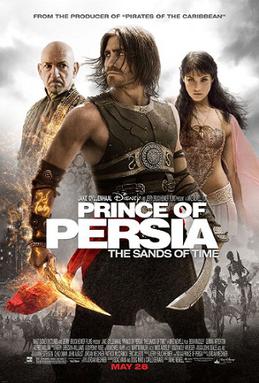
On Prince of Persia and The Problem with Videogame Movie Adaptations

Videogames and Hollywood share an unfortunate history. The 1993 film adaptation of Super Mario Bros, with it’s uncharacteristically dark interpretation of the game’s whimsical Mushroom Kingdom, set a trend of videogame film failures that continues to this day. Mario’s failure was followed by hasty adaptations of the popular fighting game series, Street Fighter and Mortal Kombat. The early aught’s adaptations of the popular Tomb Raider and Resident Evil franchises saw bigger budgets and larger returns, but failed to rise above mediocrity. Hopes and expectations were at an all time high for Hollywood’s most recent videogame venture, Prince of Persia: The Sands of Time. According to movie-rating aggregation site Rottentomatoes.com, Prince constitutes “…A substantial improvement over most video game adaptations,” even though it holds a meager ranking of 39% positive reviews. With a budget of $200 million and experienced talent such as Jerry Bruckheimer, Jake Gyllenhaal, and Sir Ben Kingsley, one cannot help but wonder where things went wrong.


It must be noted that videogame adaptations of movies suffer from a similar lack in quality. For gamers, it is all but a forgone conclusion that titles released alongside summer blockbusters and holiday season epics will be shovelware: under-developed, derivative software that is designed to capitalize on the film’s hype. By and large, gamers ignore these cheap cash-ins. Sometimes a quality release will be overlooked because it is a licensed property, as was the case with the cult classic, Chronicles of Riddick: Escape From Butcher Bay, the videogame prequel to the 2004 science fiction film The Chronicles of Riddick. Fittingly enough, the new Prince of Persia game released alongside the feature film has met with lukewarm reviews.

Gamers have a much harder time ignoring poor film adaptations of their favorite franchises however. This is partially due to the fact that gamers are, amongst other things, extremely passionate fans. After witnessing an atrocious trilogy of videogame adaptations, videogamers created an online petition to try to convince German filmmaker Uwe Boll to stop making videogame related movies altogether. There is much more than nostalgia at stake when a game is adapted for the silver screen, however. A videogame’s debut on the silver screen is its introduction to the public at large. It opens the experience of that videogame’s fictional universe to people who have never played videogames before. If an adaptation is shallow, bombastic and incoherent, it reflects poorly on that specific title, and the videogame medium as a whole, reinforcing the popular beliefs that games are unsophisticated and juvenile.

But is this portrayal of videogame narratives inaccurate? In her article, “Why You Will Never Be Happy With Video Game Films,” videogaming journalist Leigh Alexander suggests that the primary problem with videogame movies are videogame narratives. Alexander begins by her discussion with an examination of Resident Evil: Degeneration, a computer animated, direct-to-disc short film based on the popular game franchise. Unlike Paul Anderson’s trilogy of live-action movies based on the popular game series, Degeneration was developed by series’ creators Capcom, and set within the same continuity as the videogames. While Paul Anderson attempted to explain and contextualize the zombie virus that wreaks havoc in the videogame in his films, Degeneration does away with exposition altogether in favor of action. Alexander suggests that fans of the videogames will likely be more receptive to Degeneration, despite its narrative incoherence, because it is truer to their experience of the games than Anderson’s live-action films.
Alexander concedes, “Perhaps to an extent; unfamiliar with the language of games, films often mistranslate a title's appeal.”

This does not appear to be what happened with the movie adaptation of Prince of Persia: The Sands of Time, however. On the contrary, the film’s creators seem well aware of the fact that they are batting against the odds with their adaptation. Jordan Mechner, creator of the 2003 hit video game on which the movie is based, worked closely with executive producer Jerry Bruckheimer to capture the feel of the game. In an interview with the popular videogame news blog Kotaku, screen writer Doug Miro also professed Bruckheimer’s respect for the source material, and stated, “It still hasn't been proven that a game movie can be done. The perception is that it can't." Miro is hopeful that Prince would turn the tide for videogame movies, just as X-men and Spider-man opened the floodgates to comic-book adaptations.

Being somewhat jaded by previous adaptations, I was pleasantly surprised by the film’s familiarity and respect for its source material. Subtle details such as costuming and set design were immaculately reproduced. There was a great deal of skepticism about the decision to cast Jake Gyllenhaal as the titular prince, but his acrobatic heroics and wry wit accurately captured the spirit of the game’s protagonist. The filmmakers clearly interpreted the game’s charm faithfully and accurately. Yet the movie was not nearly as engaging as the game it was based on. What went wrong?

Alexander’s article presents one possible explanation; “The dominant problem [with videogame films], though, is that the narratives of games are unfortunately not nearly as sophisticated, intelligent, affecting or entertaining as we think they are.” There is no denying the simplicity of the average videogame narratives. Their characters tend to be archetypical, and their plots fall into familiar patterns. But Alexander’s phrasing captures an important detail: Gamers genuinely perceive their experiences in games to be complex, rich narratives.

Jesper Juul examines the unique difficulties of translating narratives between different media in his article “Games Telling Stories? A Brief Note on Games and Narrative.” To clarify what is being translated, Juul uses Seymour Chatman’s model to divide narrative into Discourse (the telling of the story) and Story. The latter constituent is further divided into Existents (characters, settings, objects) and Events.


Discourse
Story
Existents
Events
Narrative


Juul uses the example of Atari’s 1983 Star Wars arcade game to demonstrate how these narrative building blocks can be rearranged and garbled in the shift from a non-interactive media to an interactive one. The arcade game is solely based on ‘the death star’ sequence of Star Wars: A New Hope, with the player assuming control of a virtual X-wing fighter. There is no Darth Vader or Han Solo. No Tatooine or Millenium Falcon. Any contextual knowledge of the Galatic Empire and the Rebel Alliance is contingent on the arcade cabinet’s art and the player’s knowledge of the film. In addition to excising these crucial existents from the story, the arcade game offers outcomes that directly betray the events of the movie; the player can fail to blow up the Death Star, loosing the game. If the player succeeds in destroying the Death Star, a second one will appear, also betraying the events of the first movie, (though it is amusing to note that the threat of the death star is revived in Return of the Jedi). Clearly, the components of story are subject to warping and fragmentation in the transition from movie to games.

It must be said that Juul’s example is something of a strawman; videogame technology has come a long way since Atari arcade machines, and modern examples of the form are much more capable of telling complicated narratives. Eidos’ and LucasArt’s Lego Star Wars series follows the events of the films quite faithfully (albeit through the filter of Legos). Juul does acknowledge the emergence of “cut-scenes” in games, non-interactive sequences where the player must watch instead of play, but he over-emphasizes their relationship to Existents and Events. I would argue that this mixed presentation is a discursive decision. Alternating between “non-interactive” narration and the capacity for play creates a very complicated relationship between audience and “text.”

Jull acknowledges that his model fails to account for the avant-garde. Movie-watching can be an interactive, discursive experience. Scenes may be interpreted in a variety ways and craft may be analyzed and appreciated on many levels. I would even argue that choosing to simply “receive” the given visual narrative at face value, constitutes a meaningful interpretative decision. Obviously, in videogames the prevalence of interactivity is much more pronounced. The vast majority of ‘the narrative’ will not progress unless you play, (unlike film) and this strongly influences players’ relationships with the game and its characters. Even though the game’s frame narrative is fictitious, the player’s interactions with the game’s rules; his losses and his victories; are real.

I believe this complicated interaction accounts for player’s deep narrative investment in games. Repeatedly experiencing, and eventually overcoming failure over the course of a narrative makes the quest unpredictable and exciting. It creates a second order narratological system, not unlike the second order semiological system Roland Barthes’ uses to describe the mythological. Each isolated victory and defeat in play, carried out in accordance with the game’s ‘text;’ the language established by it’s rules, graphics, and control interfaces can be likened to a single completed story. The sum total of these stories creates the gamers experience with the game as a whole. As with Barthes’ model, I present the following spacialization is only a metaphor:


Discourse (game text)
Story (game text)
Discourse
(game play)
Story (Game play)
Existents
Events
Existents
Events
(game play) Narrative
Narrative (game text)


When a gametext is transferred to a movie, writers not only need to flesh out the simplistic, conventional characters that currently define the videogame genre; they must also create a more structured, faster paced experience. My greatest complaint concerning the Prince of Persia film is that the fabled Dagger of Time; a weapon with the power to rewind time; sees very little use in the actual movie. In the videogame, players must use the daggers rewinding mechanic frequently to undo botched jumps and fights. It was a revolutionary mechanic for videogames, because it situated a players’ ability to come back from the dead within the narrative context of the game. Contrary to Juul’s assertion that “Game’s are almost always chronological,” I would argue that the stories of videogames are inherently circular. To experience them is to replay them, time and again, exploring their various permutations. Movies are experienced in a single narrative line, regardless of whether the chronology of their plot is shuffled or not.

I suspect that videogame movies will become more successful when their uni-directional narratives start to leverage the circular discourse of gameplay. It is interesting to note that these types of gamic trends are already surfacing in non-videogame movies. Ruben Fleischer’s Zombieland features a number of these visual motifs that evoke a videogame feel, including richly stylized violence and a number of “rules” for survival that are represented by colorful icons, reminiscent of “achievement” graphics. One scene even depicts a “zombie killer of the week,” a wink at online scoreboards for multiplayer games. More recently, these trends were evident in Kick-Ass, which featured elaborately choreographed violence, an intense first-person shooting sequence, and a murderous child-hero. The trailer of the upcoming Scott Pilgrim vs. The World is rife with videogame graphics and sound effects. As a gamer, it is gratifying to see these motifs and patterns migrate to the mainstream, and I look forward to the day that Hollywood does a videogame adaptation justice.

Monday, May 17, 2010

Will The Real Tony Stark Please Stand Up?

I hate to play the hipster-douche card, but I liked Iron Man before he got all popular. Then again, I liked him after he got popular too. Hell, I even like the sequel. I can understand why the critics are underwhelmed by Iron Man 2. The concept isn't new and shiny. The plot isn't quite as sleek as the first one. There is no timely political subtext to the sequel, as there was with the first film. These are all valid complaints. But Charlie Jane Anders' chief complaint of the movie, that The Villain of Iron Man 2 is Tony Stark bothers the hell out of me. He says it like it's a bad thing. Worse yet, he says it like it's a surprising thing.

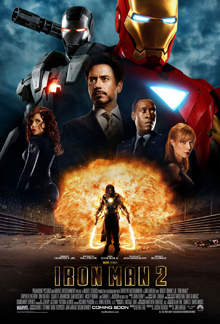
Marvel knows how to make a good movie poster.

Iron Man has always been the asshole superhero. At least, from what I've read of him. Tony Stark is Bruce Wayne minus the baggage and repression, plus narcissism and a drinking problem. The first film is somewhat misleading, because it presents  him as a reformed asshole. A genius arms merchant who develops a conscious along with his awesome suit of armor. In Iron Man 2, Stark is the rock star who has checked out of rehab and into a bar. It is truly the role Robert Downey Jr. was born to play. It's not role-model material, but frankly, our superheroes haven't been role-models for a while now. Dark Knight, Kick-Ass, and Watchmen have all explored the ugly side of being a superhero, and after getting a good look at that blood and grit, I don't see how we could go back to the golden age portrayal of heroes as shining paragons of morality. Much luck to the people trying to make Captain America happen.

One does have to wonder why we like these new, not-exactly-nice-guy heroes. It's not a bad boy thing. Well, maybe it is with the rough justice of Batman and Wolverine. But I think we buy into cocky jerks like Dr. House and Tony Stark for a different reason. In Iron Man 2, Tony's 'reckless' behavior is thinly justified by a soon-to-be terminal case of blood poisoning. I never once thought "Poor Tony!" or "Oh No! Will he make it?" though. On the contrary, I thought "He's Tony Fucking Stark. He'll invent a brand new kind of blood if he has to." And that's why I like such characters. They are aware of their own super-heoric abilities. They're the anecdote to poseury and politically correctness. The antithesis to incompetent sweet-talkers like Sam Rockwell's villain, Justin Hammer.

The suits really are pretty enough to sell the movie by themselves.

All the same, Iron Man 2 is not a high source of moral fiber. It's about as good for you as high-fructose corn syrup, but it's just as delicious. Don Cheadle is a huge upgrade over Terrence Howard, and it's a shame he didn't get more screen-time. His tongue in cheek introduction is excellent. Scarlet Johanson is incredibly hot as Black Widow, and her fight scene is almost on par with the mania that was Kick-Ass's Hit-Girl, though much less violent, as you would expect. Paltrow is still endearing as the anachronistic House Wife/Secretary, Pepper Pots. Mickey Rourke is great as Ivan Vanko, AKA Whiplash, though his climactic battle with Iron Man wraps up a little too quick, just like the Iron Monger fight in the original Iron Man. Samuel L Jackson is always a fun presence, but his Nick Fury cameo feels more than a little bit forced given how much else there was going on with the plot.

After repeatedly hearing "It's not as good as the first one," I had an absolute blast with Iron Man 2. The repartee runs witty, the action scenes are cool-looking and rife with explosions, and the plot feels fairly polished despite it's busyness. If you are a comic book fan, it'll be an excellent time. As is the case with the vast majority of the films I discuss here, I wouldn't recommend bringing grandma. Summer blockbusters are off to a good start.

Sunday, April 18, 2010

Sick Ass

From the moment I saw my first Kick-Ass trailer on YouTube, I was hooked. It's one of those incredibly promising premises I wish I had thought up myself: An average high school boy decides to become a real-life superhero. And that's it. The kid has no super powers, no traumatic past to fuel his efforts, or billionaire fortune to finance . Just a desire to do good by beating up bad-guys. It's a funnier, more realistic, and less political approach to the Watchmen concept, and like that other masked vigilante epic, Kick-Ass was adapted from a comic book by the same name. But is the movie any good? Absolutely. It is hilarious, visually stunning and entertaining throughout. But it's also more than a little disturbing.

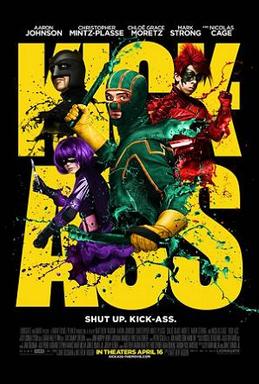
Kudos to whoever came up with the paint spatter motif for the posters.
Staying true to the trend set by Watchmen, Kick-Ass is ridiculously violent, but unlike that other masked vigilante movie, there is a deeper meaning to the uncompromising blood-shed; it essentially allows the movie to function as a sort of cautionary tale. It answers the main character's question "Why has nobody tried to be a superhero before?" People do not dress and fight crime because they would be beaten, shot at and gutted. Even more importantly, the vigilante would be forced to inflict the same death sentences on his prey. It is Batman's no-kill rule that allows him to remain appealing despite the brutal nature of his justice. It's also the most fantastic aspect about his character. Kick-Ass essentially calls bullshit on Batman, and shows people just how bloody being a superhero would be.

At the same time, Kick-Ass pushes the boundaries of aestheticized violence and popular taste. There are two brilliantly choreographed fight scenes in the same vein as The Matrix's seminal lobby shoot out that convincingly present mass murder as something balletic and beautiful. The hook is, both of these massacres, and another intense first-person-shooting scene, are performed by an 11 year-old-girl, acted by a 13 year-old-actress. Hit-Girl is the boldest, most horrifying incarnation of the Child Soldier archetype I have yet to encounter, and yet I couldn't help but cheer as she butchered drug dealers and scum bags with ropes, knifes, guns and swords. Her attacks were simply too creative, and too cleanly executed to not admire, especially when her skills are contrasted against the bumbling titular hero, who spends most of his time in-costume getting beaten up.

There she is, Big Daddy's little murderer.

Even more unsettling than Hit-Girl's actual fight scenes are her training scenes. In what might be his best role since Matchstick Men, Nicholas Cage plays a profoundly disturbed Ex-Cop turned costumed vigilante dubbed Big Daddy; think Batman with guns and a murderous daughter instead of Robin. He buys her daughter butterfly knives for her birthday, drills her on her crime-related factoids, and trains her how to take a gunshot with a bullet-proof vest.  Even though the movie has the decency to point out the truly sick nature of his revenge scheme, the outcome of the story seems to condone his heinous training, leaving a truly immoral aftertaste in the brain.

At the same time, there is more to the movie's message. Dave Lizewski is a truly likable main character, and his super-heroic coming of ages covers topical bases like becoming an Internet celebrity and trying to woo a girl despite rumors of being gay. The movie also lambastes a number of familiar superhero tropes, like rescuing lost cats and talking like a pompous douchebag. The catch is, the ugly, unfunny violence is as much a part of the social commentary and as the simple laughs.

I haven't read the Kick-Ass comics yet, but after watching the movie I fully intend to. I've found that comics are often a more comfortable medium for digesting violence than film, though I understand that they are every bit as violent as the film.


The tag-line is certainly accurate as far as the movie is concerned.

If you are a fan of Superhero flicks, consider Kick-Ass required viewing. Don't take Grandma or the parents though. They may find the violence hard to swallow. Hell, you might too.

Sunday, March 28, 2010

Hurts So Good

The title of this post is more than an awful pun. The Hurt Locker is an excruciating film, but it is excruciating for all the right reasons. I'm not a big fan of Kafka, but I heard a quote from him a couple years back that's been kicking around ever since; "I think we ought to read only the kind of books that wound and stab us. If the book we are reading doesn't wake us up with a blow on the head, what are we reading it for?" There's a lot to be said for stories (and movies) that let us dream and remove us from reality. Hell, it's the sort of fiction I am more inclined to produce myself, but by and large, I have found that the stories which wound, stab and bludgeon us tend to make more of an impression on our lives. Case in point: The Hurt Locker.

There are three movie posters in this post, but only this one is any good. The other two are make it look like a generic action flick and feature broad, bland tag-lines that have next to nothing to do with the film.

For those who don't know, the movie is about an army Explosive Ordnance Disposal (EOD) unit in Iraq nearing the end of it's rotation. Even though it is currently being marketed as an action affair (read my rant in the poster captions), it is a much more cerebral experience. Whereas the modern action film is all about constant movement, Hurt Locker is about waiting.  The explosion does not receive as much emphasis as the bomb that has not yet gone off. When firearms are drawn, they usually result in standoffs as opposed to firefights, and the most compelling exchange of firearms is a protracted sniper duel in the desert. Each of these scenes are overlaid with other sources of abstract tension. I will try to keep spoilers to a minimum, but I make no promises. Proceed with caution.

The film begins with the death of the EOD squad leader, and the arrival of his replacement, an experienced army ranger with an apparent death wish. Even before the team goes on their first mission together, we have a huge knot of emotional tension in play. The youngest member of the unit is wracked with guilt over the death of his commanding squad leader, and the middle member of the squad has a rather curt introduction with the new squad leader. Their first deployment together is a haunting echo of the prior squad leader's death, but whereas the last squad leader died despite being cautious and cooperative with his squad, the veteran ranger is reckless, non-communicative and unbelievably cocky. But he survives, and disarms a frightening number of bombs in the process. This victory obliterates traditional moral paradigms. It is unfair that the last commander died when he played by the book, and it is unfair that some cocky son of a bitch swaggers up like a hero and comes out on top even though he places his squad at risk. This unfairness is one of the wounds Hurt Locker inflicts on it's audiences.


"You'll know when you're in it." Really? Is this the best the marketing department could come up with? Worse yet, the poster emphasizes guns and explosions as opposed to the bombs themselves. 

Admittedly, unfairness in war is hardly fresh territory. It is the films' decision based approach to unfairness in war that is compelling. Each mission in the movie confronts viewers with the no-right answer situations soldiers h face on the battlefield. Do you shoot that Iraqi holding a cellphone? He might be dialing in the bomb your squad mate is disarming. Or maybe he doesn't have a cellphone at all. Your squad leader has led you into a firefight, and you think you see movement. You ask what to do, and he tells you "Be smart. Make a good decision." These scenarios serve as richter scale, charting the jagged line between figuring shit out for yourself and doing as you are told. Having never served in the military, it would be absurd and offensive for me to speculate about what that sort of life is like, but from what I've read and heard from people who have served, The Hurt Locker seems to accurately capture the dynamics of that life. War is about working together by yourself. It is about waiting, and knowing when you can't afford to wait any longer.

For me, the most compelling scene in the movie--your cue to skip this paragraph if you intend to see the film-- was not the sniper battle, or any of the bomb diffusion sequences, but a scene in the cereal aisle of a supermarket. Our Angel of Death army ranger stands before the candy colored sprawl of boxes, at a loss for which box he should pick up. That was the point at which the movie thrust the knife home for me. Two seconds ago, we were in Iraq, cutting bomb wires and now cereal. There is no patriotic swell of music, or some lofty speech about how the sacrifices made have all been noble and good; just a man and cereal.

"War is a Drug." This is a slightly better tag-line, but drug imagery has no explicit presence in the film. The metaphor is accurate, but its brevity makes it sound simple and cheap-witted. Some movies don't need soundbites to succeed.

Hurt Locker isn't an easy movie to watch but it is gripping, deeply effective and very timely. I love Netflix--it is to movies what TiVo is to the TV-- but you really should see this film in theaters. As far as suspenseful atmospheres go, it's hard to beat a dark stadium and an inescapably large screen. Hopefully it's well-deserved Oscar for Best Picture will give it some legs in extended release theaters.


Friday, March 19, 2010

(My Adventures with) "My Adventures with Machinima"

I wrote an article for my Introduction to Literary Journalism class titled "My Adventures with Machinima." If you scroll down a couple paragraphs, you can find the third, post-final draft of it, right here on this very web page! As you may surmise from the quoted section of the title, it deals with machinima. Don't know what machinima is? Awesome. Consider it as if it were written just for you, gift-wrapped on a silver platter and garnished with gold-bullion! But first, please indulge me in a bit of meta-fictional wool-gathering.

I don't really know what to call what I do here, but I now know it isn't Literary Journalism. That is a craft that requires more physicality than I can offer, and a greater ability to relate one reality to a broader communal reality; the finding of universal truths in particular truths. I've learned that I tend to deal better with finding universal truths in fabricated realms, relating non-realities to reality. The story I wanted to tell with this article is one such narrative.

Internet cultures, such as bloggers, gamers and youtube viewers, are shaped by the absence of physical community. While journalists must link physical action to text, the two are already linked for us. Text and action exist on the same plane. They are unified and inextricable. Their intersection is our home. The story I wanted to tell about machinima was one of physical homelessness. Of finding a way to communicate with communities that are only half-there. Of making real movies with virtual objects. A story that demonstrates how physicality and physical journalism falls short in a post-paper communities.

But I had other obligations. I had to demonstrate that I could do 'literary journalism' effectively and report facts along with scenic imagery rooted in physical detail. I had to explain an art-form in its infancy, born from another very new art-form that is still scarcely recognized as such. To my young and inexperienced voice, these agendas tell opposing stories, and the narrative I conceived was lost. Maybe I'll come back to it someday when I can do it justice. Maybe I'll turn to the drink. In the meantime, here it is:

My Adventures with machinima
By Hank Whitson

I sit at my computer, slack-jawed and glassy-eyed as cybernetic soldiers in brightly colored body armor exchange witty dialogue and occasional bursts of gunfire.For the past hour and twenty minutes, I have been watching seasons one and two of Red vs. Blue, a wildly successful machinima series from Rooster Teeth productions made using the Halo series of videogames. I shouldn’t be sitting and staring. I have papers to write and tests to study for, but each episode is only four to five minutes long. Seven at tops. What’s the harm of one more? I click the link to the next episode, Radar Love, and become viewer number 467,796. I’m lucky my melted brain isn’t dribbling down my chin.

The word machinima, a portmanteau of ‘Machine’ and ‘Cinema,’ is still too young for Merriam-Webster and Oxford English. It can be pronounced “Mah-shin-ee-ma” or “machine-ee-ma,” and like ‘film,’ it can refer to an individual movie or an entire craft of movie-making. The recently established Academy of machinima Arts and Sciences defines it as “filmmaking within a real-time, 3D virtual environment, often using 3D video-game technologies.” In machinima, the virtual worlds of videogames serve as sets, the game characters are actors, and the graphic models for weapons and objects serve as props. The medium combines aspects of filmmaking, such as cinematography and film editing, with aspects of computer animation and game development, such as 3D model designing and computer programming.

I first heard the term in 2007 when I was playing World of Warcraft (WoW), a popular online game. While I had fun watching the fan-made movies on Youtube, I never paid machinima much attention until I read Alexander Galloway’s book, Gaming: Essays on Algorithmic Culture, which mentions machinima as a part of an artistic movement referred to as ‘Countergaming.’ According to Galloway, countergaming changes the way people interact with electronic games by modifying or completely repurposing videogame software. I found Galloway’s book last spring as a part of an independent study course examining the relationship between narrative structure and gameplay systems. I was thrilled by his concept of countergaming, not only because I thought it was insightful, but because it was an aspect of gaming—a whole artistic movement no-less—that I was completely unfamiliar with. Given my interest in the relationship between storytelling and play, machinima seemed like the best angle to examine the countergaming movement. I had no idea I was setting out to profile a movement that only half-exists.

Most machinimatographers do not think of themselves as countergamers. Indeed, I have yet to find anymore than a handful of people aside from Galloway who use the term ‘countergaming.’ machinima does repurpose videogame software in a way that radically alters people’s relationship with videogames, however. A machinima-film is completely non-interactive, or at least as non-interactive as television or cinema. Those who watch machinima are no longer relating to the game as players, but as viewers. At the same time, the act of machinima-making forces users to interact with the videogame program from an entirely new perspective. Machinimatographers use the virtual world of the videogame as movie set rather than a platform for play, and as such, they are occasionally required to adjust the parameters of the games’ program. Furthermore, they must use a second computer program to record the footage they create. After the footage has been created, they must use a number of other computer programs such as audio editing software and special effects programs to produce the movie.

From the beginning, machinima has had a sense of humor. Even though machinimatographers typically do not set out to change videogames with their films, as per Galloway’s countergaming movement, machinima have parodied the videogames’ they are based on from the beginning. The consensus among bloggers, online encyclopedias, and machinima makers is that machinima started in 1996 with “Diary of a Camper.” Diary is a one and a half-minute movie created by a group called The Rangers, using footage from id Software’s Quake, a seminal first-person-shooting (FPS) computer game. The movie portrays a group of soldiers gathered in a virtual cistern. The squads’ leader commands two members of his team to go check out another portion of the level through the in-game text chat, which appears in the upper left corner of the screen. The two soldiers comply, only to be blown away by another soldier who had been laying in wait. Such behavior is generally regarded as poor sportsmanship, and in videogame slang players who practice it are derogatorily referred to as ‘campers.’ After the other members of the squad arrive and avenge their fallen comrade, they comment that the camper seemed familiar. In closing, the commander states that he was John Romero, the father of the FPS genre, and the creator of Quake. From the start, machinima has served as source of humor and commentary on the videogaming community as a whole.

Ironically, the machinima community itself is incredibly fragmented. As an art-form founded in virtual space that films action in virtual space, machinima has no physical forum or home. Machinimatographers do not congregate at cafes, bookstores or theatres, but at web forums, blogs, and Youtube. This online atmosphere is tremendously decentralized and cliquish. In a lengthy blog post examining the world of machinima circa 2007, Hugh ‘Nomad’ Hancock of machinimafordummies.com writes, “There is no machinima community.” Hancock laments how easy it is for machinima pieces to get lost amongst the sea of video available on the internet. When there are millions of video’s on Youtube alone, carving out an audience for your five minute flick is a daunting prospect indeed. Hancock goes on to explain that machinimatographers have splintered into groups surrounding specific videogames and video-capture programs. This is understandable considering the complexity associated with modern videogame systems. As machinimatographers refine specific filming techniques for a particular game, those techniques tend to become less applicable to other games based on different play-systems.

In the absence of a central forum to inquire about machinima, I decided to try and find machinima-makers on a local level. I learned that UCI offered a class on machinima about four years ago that was taught by associate professor of film and media, Peter Krapp. I had spoken to Krapp earlier in relation to my research on games, and when I asked him for advice about whom to speak to, he referred me to Nathaniel Pope and Ian Beckman, two former graduate-students who had created machinima for his class and continued to work in the field. I wrote emails to Nate and Ian, requesting interviews and inquiring if I might have a chance to watch them work with machinima. Both men agreed to be interviewed, though they mentioned that they live out of town, and stated that they weren’t working on any machinima projects at the present time. Unfortunately, geography and scheduling conflicts prevented me from arranging physical interviews with Nathan and Ian, though the incorporeal nature of our correspondence seemed appropriate for the digitized, decentralized machinima community.

I exchanged a few emails with Nathan Pope before reaching him over the phone. He had a young, enthusiastic voice and began by telling me he was glad to help a fellow Anteater and a friend of Peter’s. I learned that he first got involved with machinima through Prof. Krapp’s class while pursuing a film major, and that he had added minors in Economics and French. He now works with Xfire, a company specializing in video-capture for videogames. In a gaming context, video-capture specifically refers to digitally recording gameplay footage. Just as filmmaking is only one function of filming, machinima is only one potential use of video-capture. It is an essential tool for bug-testers, and game-designers as well as machinimatographers.

Nate explained the fundamentals of making machinima to me. As with traditional film, the project generally begins with writing a scenario and a rough script. Next, the team will do video-capture, collecting the raw footage that will be edited together to create a movie. It should be noted that footage in machinima does not necessarily conform to behavior that is typical in play. Projects set in first-person shooting games, for example, may not feature any use of guns or weapons. In Rooster-Teeth’s Red vs. Blue series for instance, most footage shows characters speaking to each other. Depending on the type of video-capture program being used, one person may not need to play the part of a camera-man; moving around the other characters and recording their interaction from a first-person perspective. The members of the machinima-making teams who control recorded characters are generally referred to as puppeteers rather actors, since very little in the way of traditional acting is done during this stage of filmmaking.

The next step is the editing process. This entails piecing together the collected video-capture footage, though most of the ‘acting’ that occurs in machinima is also a form of editing. Most machinima narratives are driven by dialogue, which is relayed through voice recordings that are dubbed over the video-captured footage. Nate mentioned that measuring the duration of a scene to correspond to scripted voice acting could be very difficult, and that amateur machinimatographers frequently overshoot or undershoot their scenes; a problem his group ran into while making machinima in class.

One key advantage machinima has over more traditional forms of filmmaking is a very low cost of production. “For a thousand bucks, you’re machinima ready. For ten thousand, you’re professional,” Nate said. The tools you purchase; a powerful computer with top of the line video editing software and a copy of whatever game will serve as your template, can be used to make an entire series of films, whereas traditional films have to hire actors, and build actors for every feature film. Nate also noted that it is much easier to make machinima with small groups of people. He said the average crew for machinima-making is about three to four people.

Nate had a lot to say about the relationship between videogames and machinima: “You can take machinima and appropriate it for whatever you like to do, but it is also an extension of your gaming experience. It extends your experience of play beyond the act of play. It frees the act of gaming for the masses.” As a gamer who has tried and miserably failed to explain complicated videogames to non-gamers on more than one occasion, I can appreciate the value of ‘freeing the act of play.’ Many videogames have some truly fantastic artwork, and the gaming industry has reached a point where it is putting out some truly admirable fiction as well. At times it saddens me to think that some people will never experience that art and those narratives because they are not experienced enough with gaming controls and rules of play. I would never suggest that machinima serve as an absolute substitute for playing videogames as some of their stories can only be appreciated through play, but I believe machinima movies are an excellent form to demonstrate how far videogames have come since Pong.

Getting in touch with Ian Beckman was a bit of challenge, and it’s no surprise why: he’s a busy guy. After trading emails and a failed attempt at talking over MSN, I ended up emailing him my questions, and he responded promptly with links to two other interviews about his work for Machinima.com, his participation in various film festivals, and his machinima series, Azerothian Super Villains. Ian has worked with a variety of different media, including Flash animation, live-action filming, and according to his interview at MMOwned.com, he got his start doing stop-motion animation with Legos.

Ian had many insights to share about the production of machinima. When I asked him what goes into making a typical machinima, he responded “Writing is incredibly important because you have only a certain amount of things you are able to do. If you want your characters in Warcraft to mimic The Ghostbusters for example, prepare for a lot of work ahead of you.” Designing situations that accommodate game engines can be a challenge even with an engine as complicated and robust as World of Warcraft. He also expressed his preference for ‘compositing’ machinima, as opposed to directing multiple players over ventrilo—a chat program designed for use in multiplayer games. By using this composite method of machinima-making, Ian doesn’t need to depend on other players to act as his camera men or actors. He noted that players tended to be impatient, and explained: “I save my directing for the voice actors because they’re the ones that really bring life into stiff characters that often repeat animation.”

When I commented that the most popular series in machinima tended to be comedies, Ian responded “I think machinima lends itself to comedies only because you know you’re watching a videogame. It’s just unbelievable, you know?” I do. The current level of graphics and virtual behavior available to film-makers is still extremely limited. Characters in World of Warcraft are capable of laughing, dancing, waving, sobbing, sitting and laying-down animations, but the game’s code currently does not allow for actions that involve other players, aside from combat. It’s incredibly difficult to create dramatic tension when you can’t show your characters hugging each other or shaking hands.

Incredible difficulty isn’t enough to deter a passionate machinimatographer, however. Ian referred me to Martin Falch’s one-and-a-half hour epic, “Tales of The Past III.” The films’ opening sequence, a full scale war between WoW’s two main factions is definitely dramatic. An armored cavalry thunders across a volcanic wasteland. Green-skinned orcs and trolls cross swords with humans, elves and dwarves. It’s the stuff of Tolkiens’ dreams. Yet when the commanders of each faction address their troops, they use identical arm-waving animations to rally them into battle. There is a poetic irony to be appreciated in this similarity between mortal enemies, but it is only evident to those who are familiar with WoW lore. The movie’s main narrative is even less accessible, as it is based on a specific sword that ties into the game’s lore. The writing didn’t do the film any favors either. I try to watch the film as if I was a first time viewer, who knows nothing about the land of Azeroth or The Scarlet crusade, and I find myself cringing at every close-up. The characters’ faces are expressionless save for a blinking ‘effect’ that looks like it was engineered in Microsoft paint. Throughout the experience, Nathan’s comment about drama and machinima kept echoing in my head: “A lot of machinima is humor-based. It’s easier with comedy. Drama can feel contrived.”

One of the best examples of contrived videogame drama is actually a product of Hollywood. Final Fantasy: The Spirits Within, one of the earliest big-budget adaptations of a major videogame property, was universally panned for the limited dramatic range of its nearly photorealistic computer-generated cast. Computer generated imagery (CGI) has come a long way since the release of The Spirits Within back in 2001, however. The tremendous fiscal and critical success of CGI-heavy films like The Lord of the Rings trilogy and Avatar seem to suggest that graphical animation is dramatically viable and tremendously profitable.

It is also interesting to note that Heavy Rain, a title Playstation 3 title marketed as an ‘interactive movie’ as opposed to a typical videogame, was released on February 23rd of this year to great critical acclaim. Other games have earned distinction and created controversy with their liberal use of non-interactive in-game movies or ‘cut-scenes.’ Some players welcome the sequences, feeling that the sequences help tell more complicated and engrossing stories, while others complain that they break up the flow of the action and hinder the gaming experience. Hideo Kojima’s Metal Gear Solid 4: Guns of The Patriots has been a particularly divisive title for featuring over nine hours of cut-scenes.

This developing trend of cinematic videogames and the enduring presence of CGI in Hollywood may turn people with machinima skills into a wanted commodity for the game and movie industries. In many ways, machinima is the ideal hobby for young filmmakers looking to build a portfolio and gain experience. As Nate and Ian both noted, it is easy and relatively inexpensive compared to traditional filming. It also provides experience with digital technology as well as the major areas of traditional film-design, such as writing, shooting, and editing.

I was curious to know how videogaming companies felt about their games being repurposed to make movies. The videogame industry places great emphasis on intellectual property (IP) cultivation, or developing fictional universes that can act as marketable franchises. Big publishers like Electronic Arts and Activision-Blizzard treat every new game title as a potential franchise-starter, and they defend their copyrights fiercely. If a fan makes an inappropriate video using gameplay featuring an iconic character, like Mario for example, it could potentially mislead and offend would-be buyers. When I contacted Blizzard’s press department by email requesting an interview, they very tactfully explained that they did not have the time to speak to college students doing profiles, and wished me the best of luck with my project.

The last question I asked Ian Beckman was “Do you think playing and knowing about videogames was important for enjoying machinima?” His response surprised me. “Definitely. I know a lot of people who have interest in something like Azerothian Super Villains and still think it has something to do with Warcraft. In my series, I aim to keep the comedy strictly to the characters, so everyone can enjoy them. The name of the game is mass appeal.” I would have thought a machinima master like Ian would be ready to champion his art-form, and proclaim that it was perfectly capable of standing on its own merit. But the truth is most machinima films are about the videogames they are based on. Appreciating their humor requires a familiarity with the terms and context of play. In conclusion, Ian write “It’s unfortunate people haven’t given machinima that much of a chance yet to shine on it’s own accord.”

My adventures with machinima have given me lots of laughs, and I believe that the medium does have a lot of potential. As gaming and online video continue to grow in popularity, I suspect machinima makers will grow in importance and popularity. At the same time, I think there are plenty of machinima that can be enjoyed by a broad audience right now.

To test my theory and help machinima get some exposure, I decide to share one of my favorite movies with my family. My mom and dad gather around the family computer as I pull up Youtube and type in the phrase “Why are we here?” The first episode of Red vs. Blue pops up third on a long-list of movies. I click on the picture and turn up the volume. The movie opens with a slow pan up the side of a building, revealing two robotic looking soldiers standing side by side on the roof. One soldier is in yellow armor, and the other is in red.

“Hey” the soldier in red asks.
“Yeah?” the yellow soldier responds.
“You ever wonder why we’re here?”
“It’s one of life’s great mysteries isn’t it? Why are we here? I mean, are we the product of some cosmic coincidence, or is there really a god watching everything? You know, with a plan for us and stuff. I dunno man, but it keeps me up at night.”

The camera cuts back and forth between the soldiers without a word, creating the perfect visual representation of an awkward pause. Mom giggles, and Dad is wearing a smirk.

“What?! I meant why are we out here in this canyon?” Red asks
“Oh. Uh…Yeah.” Yellow manages sheepishly.
“What was all that stuff about god?”
“Uh. Hmm… nothing?”
“You want to talk about it?”
“No.”

The exchange is minimalistic. Both soldiers face each-other, with their heads tilting ever-so-slightly in rhythm with the dialogue. Their orange-visored helmets betray no emotion, giving the lines a deadpan delivery. My parents are already laughing loud-enough that some of the dialogue is obscured.


“Seriously though, as far as I can tell it’s just a boxed canyon in the middle of nowhere with no way in or out.” Red says.
“Mm-hmm,” Yellow affirms
“The only reason we have a red base here, is because they have a blue base there. And the only reason they have a blue base over there is because we have a red base here… Even if we were to pull out today, and they were to come take our base? They would have two bases in a box canyon. Whoop-de-fuckin-do.”

The crowd went wild. The remaining two minutes of the episode enjoyed continuous laughter and giggles. You don’t need to be a videogamer to appreciate the absurdity of color-coded aggression. In fact, it’s the sort of non-logic a gamer never notices in the act of play. Asking why you’re shooting at the bad guys or trying to steal their flag from their base would be like asking why one heads to the end-zone in football. Machinima provides a bridge between the world of gaming and the world of narrative. It can fill in the gaps of gaming logic, and address issues in videogaming culture as well. Machinima-making offers dedicated fans a whole new way to experience their favorite titles and the work they produce provides the rest of us with a good laugh.

Friday, March 12, 2010

The Animatrix: Halo Edition!

I've never been a huge fan of the Halo series. I have thoroughly enjoyed each of the games in the main trilogy, passed on ODST and Wars, and while I am intrigued by Reach, I am not waiting on baited breath for its launch. Overall, the series is the poster child of super big-budget videogame design: enjoyable if not terribly innovative game design, pleasing music and artwork, and a conventional but incredibly detailed story. That same spirit pervades Halo: Legends, an anime styled collection of short films in the fine nerd art meets cross-marketing spirit of The Animatrix.

From Wikipedia

Given gamers' flagging interest in the Halo series after the conclusion of the main trilogy, and the Xbox 360's less than stellar sales in Japan, playing the animation compilation card is a predictable move for Microsoft. Fortunately, they spend the money to do the trend right, hiring well known anime studios like Bones, Production I.G. and Toei Animation to do what they do best. A pity the narratives don't measure up to the quality of the animation.


Looking to accessorize your new Mjolner armor? Nothing says "Death to the Covenant!" like a little teddy bear cellphone keychain . Pic was swiped from Kotaku.

To be perfectly honest, Legends is a largely forgettable experience. Origins parts I and II are a nice primer for Halo virgins and those who didn't pay close attention to the story in the games. It is also where Legends overlaps most prominently with the Animatrix template. It does for Halo what The Second Renaissance (also divided into parts one and two) did for The Matrix franchise. The Duel, which Mike Fahey hails (link under the pic) as "Far and away the best short of the DVD", is a unique and impressive visual experience that tells an utterly hackneyed tale of bushido honor and loyalty. I was similarly unimpressed with The Package, a CGI romp that shows the Spartans kicking ass with vehicles that didn't exist in the game, who save (spoiler alert?) some scientist  I was supposed to recognize but didn't.

Homecoming is perhaps the most promising story in the collection, giving a grim and fascinating glimpse at how the Spartan II recruiting campaign works. It isn't a cheerer upper, but few in the collection are. Take Prototype for example; a story about a squad leader with a gift for leading his squad to their doom. Contrary to Fahey, I rather liked that one. Again I disagree with Fahey on The Babysitter, which I felt was one of the best pieces in the package. While the Samus Aran style twist may not have blown any minds, it tells a unique tale about tensions within the ranks of the UNSC army and it comes to a legitimately poignant close.

No, that is not Master Chief, but yes, that thing does Shoop Whoops.

Not everything is all ass kicking and seriousness however. In fact, my personal favorite is "Odd One Out," a totally bizarre parody of the Halo Universe staring Spartan 1337. Yes, I know '1337 speak' is supposed to be old hat and unfunny by now, but it dovetails nicely with the feature's absurd nature which is an incredible refreshing presence in the somber halo universe. If it has been a while since you've watched something and had an emphatic "What the fuck?" at the end, you would be hard pressed to do better than this short, which features kung-fu fighting kids raised by an AI, dinosaurs, an idiot spartan hero, rainbow laser beams, and a motherly AI.

The tale confirmed a long held suspicion about Halo's universe: it would be infinitely more endearing and entertaining if it had a better sense of humor. Not the only humor of quick quips and snide remarks--don't get me wrong, I like quippery and snideness--but the ability to look absolutely foolish. So many new franchises, especially in the world of video gaming, are utterly desperate to be treated as grown-up art form. I can understand this desperation. I can even sympathize with it. Videogames are growing up and it's time people recognize it. That respect does not lie in melodrama, gore and swearing, but in the ability to laugh at ones self.

Friday, February 12, 2010

The Summer Effect

This last Thursday, one of my best friends came over to my apartment and presented me with a choice: Watch 500 Days of Summer for the first time or watch Zombie Land again. For most guys, this is a no-brainer. Through the twisted magic of monogamy, (with my fiancee, not my friend) we ended up settling on the former. Here's the shocking part: It was the right choice. I don't mean to say it is a better movie than Zombie Land on the whole, such a thing borderlines blasphemy and is difficult to fathom, but it is an excellent enough film that you should see it at least once, regardless of who you are, even when presented with other fine options of entertainment. In fact, I would go so far as to call it the best romance since Love Actually.

It's a damn good movie, but the aesthetic is so Indie it stings at times.

Each scene or couple of scenes are excerpted days from a romance, all shuffled and played out of order in a way that is far more powerful than a traditional telling. Just like love actually interviews numerous different narratives of love together, Summer presents readers with a number of shifting currents at work in the relationship. This cutting allows the movie to tell a much deeper and far more honest love story than Hollywood's Meg Ryan meets Tom Hanks model. It even sets it apart from other Indie boy meets girl stories. Though, before proceeding, it may be prudent to provide a brief explanation of what I mean by indie.

In the beginning, the phrase stood for Independent Music, meaning music that was not published by a major record label. Hipsters, the metric unit of the indie subculture, will claim that said music is independently published because it's too cool or sophisticated for us mere sheeple to appreciate. Translation: not enough people would want to buy the music to motivate a major record label to sell it. That's a broad statement and a crude summary of the politics in play behind the music, but it's a useful enough explanation to help you understand where the greater Indie aesthetic is coming from. Like many counter-cultures it is a rejection of the mainstream, and it's particular interest lies where commercialism and artistic taste intersect, particularly where music is concerned. Like many other counter cultures however, the demographic has been identified (2o something college grads) and the market has been branded, and there is a specific sort of fiction and a specific style of dress associated with the aesthetic. One can consider the indie movement as the baroque movement of the post .com period, and Hipsters celebrate their awkwardness through ironic self-deprecation.

500 Days of Summer is that sort of movie; a celebration of being strange, and of not putting up with consumerism's exploitative bullshit. As such, it can come across as preachy in a roundabout way, but like most things indie, the hipster self-deprecation mutes it's own activism. Psychologists and pop cultural scholars scratching their heads over where a social movement comes into it's own should take a look at Summer just to see how everything conforms to this movement. Everything in the movie from the wardrobe, to the soundtrack, to the little animations that separate each day in the relationship, to the lead Zoey Deschanel's alluring yet awkward good looks is all decidedly 'Indien.'

Pic swiped from Starpulse via Google. Here she just looks pretty. The awkward comes through in the trailer however.


So how does all this awkwardness tie in to the plot? Aside from shuffling the chronology, the story flips the dynamics of boy meeting girl. Tom is the "new" sort of boy, the kind of leading man that would give Hemingway another excuse to drink. He falls for girls hard, talks about his feelings with his friends, and cares about his appearance enough to feel insecure about it. Meanwhile, the titular Summer is an old-fashioned guy. She is non-committal fiercely sexual, and very guarded about her emotions. This gender-reversal is nothing new, but the delivery here is nuanced and authentic to the times we live in.


If you're a person like me, who has come to despise Hollywood's formulaic approach to romance, or a person like either of the movies protagonists, you will love it. Fans of more conventional fair will probably enjoy it too because there is real, legitimate romance happening here. It may even be an sobering experience of sorts. So if you're searching for a movie to watch this valentide, give 500 Days of Summer a shot.