Showing posts with label Narrative Analysis. Show all posts

Sunday, October 24, 2010

Redeeming Dead

Death is a fairly pedestrian experience in most modern video games. It's like waiting at a stop light. It's a delay or an annoyance at most, but it doesn't really cost you anything. Saves and checkpoints can be reloaded. More lives can be obtained. Dying is a mere hiccup in the emergent narrative of your play session. In most cases, failed attempts aren't even addressed by the game's given narrative. Mario will inevitably beat bowser. Nathan Drake never really dies. That time you used your face as a catcher's mitt for a Bullet Bill? Those leaps of unfounded faith? Your brilliant idea to charge the a platoon of fortified enemies? Don't sweat it slick. They were bad dreams. Outtakes. Omake. Life is cheap, so waste it as you see fit.

That's part of the charm of video games, obviously. Real-life is much stingier with second chances, and  it's incredibly liberating to be able to leap off the highest cliff you can find without fear of consequences. But there's also a helluva lot to be said for games that allow you to die an appreciable death. A meaningful defeat that gives you cause to pause and reflect on what just happened is an incredibly valuable experience. It's also hard as hell to balance. If you make losing too costly, players won't have the will to start over. Make it too mild and... actually, many players don't seem to mind at all, hence the recent trend of games that mitigate the cost of death, or do away with it altogether. But it's a sore absence if you ask me. So today, I'd like to take a moment to address games that redeem the value of death in play, either by having it significantly influence mechanics, giving it appreciable narrative gravity, or just doing something interesting with it. Mega spoilers abound, so take caution.

Now this here is how you do a Western, I tell you wut. Hats off to them Rockstar boys.

Red Dead Redemption is a game I've been meaning to talk about for some time. The most frequent indictment brought against RDR is that it is simply GTA with horses and this is largely true. When friends asked me what the biggest difference was between RDR and GTA4, I said it was the way horses control versus cars. It was an off the cuff the answer, and looking back I realize that "the environment" would have been a better answer. The frontier Rockstar presents you with is the most impressive digital landscape I've yet encountered, and it is teaming with flora and fauna that you can interact with. At some point in the game, you will be killed by a cougar. Wolves will attack you in packs. You will hunt bears and skin them. You will pick wild flowers and herbs and sell them to buy bullets and whatever. The extent to which you interact with these elements is still mostly elective however, similar to GTA's Taxi/Police/Ambulance mini-games. There are a few missions where you hunt plants and animals toward the end of the game, but the vast majority of the game has you completing missions by riding horses and shooting fools, similar to the way you drive cars and shoot fools in Liberty City.

So what does this have to do with death? Nothing. I just wanted to talk mechanics for a little bit. The game does do something interesting with death, however.

After hundreds of shoot-outs, fetch-quests, horse-chases and other decidedly western trials, John Marston meets his end at the hands of the US Army in the final mission. Some context is necessary to appreciate the significance of this death. Marston is an ex-gangster who has been pressed into tracking down his former gang members by the US Government who is holding his family hostage as collateral. You complete this task about three quarters into the game at which point you are reunited with your family. The last few missions have Marston simply acting as a husband and a father. John's son Jack, is particularly ambivalent toward his father. He realizes that his father did not leave him out of choice, but he also struggles with abandonment issues and does not know the full details of his father's past or his service to the government. The game has you reconcile John with his gentler, slightly bookish son. After John dies protecting his family, the game allows you to continue playing in it's world, as traditional of RockStar titles, but you continue to play as Jack instead of John.

By continuing your father's legacy, the legacy of the character you have played throughout the entire game, the values of the old west are validated, and John's questionable life is redeemed through Jack. Video games rarely consider what happens after a character dies. Usually, they simply imply that evil wins and justice is not served. The fact that Red Dead Redemption goes farther, is refreshing and interesting. That said, Marston's ultimate demise doesn't cut as sharply as it could, seeing how you will have likely seen him die several dozen times before his canonical death.

Reach offers solid gunplay and good times online, 
but it could do more with its premise.

Another recent game that nearly does death justice is Reach. It's not quite as poignant or novel as RDR, which is a much longer, more emotionally involved affair, but you do adopt the role of a marine fighting in a military campaign doomed to failure. Reach is by no means the first title to put you in this position, but it's still fairly fresh territory for video games, and watching your squad mates die one by one, until you are finally left to your own last stand makes for a novel experience. More can be done with this premise however. Halo has never been a series for subtlety or ambivalence. It's monotonous rhetoric of duty, teamwork and sacrifice has always reached propagandistic proportions, and the game never once has Noble Team question their orders or consider their own chances. But showing the losing side of a battle, where even when you win the game, the good guys lose, is an interesting jumping off point for future titles to tackle.

This is a great game and you should buy it.

As I implied at the beginning of this post, death is used most impressively when it gives players cause to pause and reflect. To that purpose, few titles are as effective as Minecraft. When you die, you drop all of your items, and you only have a few minutes to collect your belongings. "That sounds like corpse running," you might point out. Very good. It is corpse running. But unlike the corpse runs of MMO's where reclaiming your belongings is a forgone conclusion and running back to your body is just a hassle, you very often won't be able to retrieve your lost goods in Minecraft. Loss is painful and consequential. It makes you think twice and weigh risk against reward. The game also introduces Creepers; easily the vilest new video-game of the last decade: hissing, walking bombs that can destroy your house as well as your body. What is valuable about having your house blown up you ask? Like the rest of Minecraft, a minimalistic gem of a game, the risk of death scales to your aspirations in play. The deeper you dig, the more you stand to gain. The deeper you go though, the harder it is to reach the surface and reclaim your loot. The grander your architectural schemes, the longer the shadows cast by Creepers. When you succeed, the triumph is not at all artificial or forced, but organic.

Finally, an oldie but a goody that I've been looking for a long time. Planescape: Torment, recently resurrected and available for purchase from Good Ol' Games. I'm not too far into the campaign yet, but I've played enough to tell you that it is superbly written. The game was created at the end of a magical era, where people still used written description to supplement game narratives, as opposed to relying solely on graphics and cinematics. As for how the game handles death, it marries your ability to come back to life with the narrative: you play as an accursed soul caught in limbo who cannot die or return to life as you know it. From what I have gathered so far, your ultimate goal may be to die once and for all; a fascinating quest to say the least.

I know there are hundreds of titles that handle death in innovative, inspiring ways which I have not addressed here. There are even several recent titles that deserve to be examined, Demon Souls being chief among them. But I won't weigh in on a title I haven't played yet, and this was never intended to be a comprehensive list of any sort. If you have ideas of games that work with death in interesting ways however, I would love to hear them. My thesis may work along similar lines. I realize this update has been a long time coming. Hopefully the length compensates for it somewhat. I'll try to have something on Johnathan Strange and Mr. Norrell up before October is out, but I make no promises. Check back soon!

Tuesday, July 27, 2010

Here's Hoping for a Little More Persona-ality

On August 1st, I will be heading east to settle in the Deep South, where I shall remain for two years, learning the mysterious Kung-Fu of the digital media scholar. Videogames will be the primary focus of my studies, though I suspect that I will have very little time to game and blog once the program actually commences, and I've tried to fit in as much gaming as possible in the past few weeks. Red Dead Redemption, Alien Swarm, Alan Wake, and Transformers War for Cybertron have all consumed considerable hours and you can expect to read about some of them soon, but two 'last-gen' titles have staked the greatest claim on my time: Persona 3 Portable, and Persona 4.

Awesome anime cover. It's also worth noting that the game includes a free soundtrack CD. Admittedly, most of the soundtrack is maddeningly repetitive, but it gradually wears you down to the point that you find yourself humming the tunes as you go about your day.

While Square-Enix may hold Japan's best recognized role-playing franchises, Atlus' Persona series, the most popular chapter of their Shin Megami Tensei multiverse, is the best example of the J-RPG genre, combining typical turn-based battling and world-saving with high-school dating and social drama. It's a recipe ripe for parody, but the two go together kind of like gin and tonic; a taste not everybody will appreciate, but those who do will keep on drinking till the wee hours of the morning. "So it's a game for alcoholics?" you ask, with a wry smile dripping down your face. "No smartass!" I exclaim, pounding my fist on the table. "It's a game about relationships! Whether or not relationships lead to drinking is up to you. Wino."

Persona is the most character driven series I've ever played. Not all of the characters tremendously deep, but conversing with characters and developing meaningful connections with them is the bread and butter of the series. Each potential character-relationship represents one of twelve tarot-card themed Arcana. Each of these arcana represents a division of supernatural entities called "Persona" that your characters can summon to magic and kick-ass in battle. In order to unlock more of these supernatural entities, you need to become closer to the people who represent that arcana. This little set up is referred to as the social link system, and it transforms socializing into an essential aspect of developing your character, which is really quite poetic when you think about it.

Unlike the one-shot character quests that are typical to Bioware RPGs (IE; Mass Effect 2's Loyalty Missions), you establish relationships with other characters in Persona over a period of months. Both titles gradually occur over the course of an academic school year, and each character you can hang out with has their own weekly schedule. Budgeting your time to try and fit everyone in is a huge part of the game. Word to the wise? On your first play-through, don't try to max out every social link, even if you have a guide. There are just too damn many things to keep track of, and it can turn the gameplay into a chore. Completionists need not fear, both games have New Game+ systems that will let you carry over your social link progress from prior attempts, (Though to get one special persona in P3, you really do have to max everything and everybody on your first time through. Much luck).The number of embedded narratives packed into this game are staggering, and while a few characters are obnoxious (Kenji and Bebe from P3, Ai from P4) most of them are quite likable and some are very endearing (if you feel nothing for P4's Nanako you have no soul).

The thing that I would love to see other games emulate is the gradual sense of progress in forming character relationships. I'm not saying that every game should follow Persona's daily routine model (which is not without it's faults), but the emphasis on communicating with characters' and tactfully solving their problems with something other than gunfire, magic and martial arts is incredibly refreshing. So yes, more of that please.

This is the recently released third version of Persona 3 and it is definitely the one you want to pick up; provided you have a PSP. It features two distinctive campaigns depending on which gender you pick as well as the expansion of the original game. The only thing sacrificed are moving character sprites as you walk around school and the mall.

At the same time, it would awesome to see Persona take a page from Mass Effect 2's book where dialogue interaction is concerned. Most conversations essentially boil down to you picking among three or four dialog options in hopes of making the person you're talking to like you better. I think it would be awesome to have a few social links where you debate, argue, or even mock people instead of acting nice all the goddamn time. I don't want to see a Paragon/Renegade dialectic, but I do want a few more 'colorful' dialog and interaction options. There are several cases where the game gives you the option to be a complete ass, but you find yourself playing nice to advance the link, which really feels like a missed opportunity for fun and diversity.

This brings me to my biggest complaint about Persona, which is that while the games are supposedly about developing your individual character, the narrative skews towards repression and conformity at every turn. They are about being successful and popular in high school. P4 even defines a Persona as "The mask used to overcome life's hardships." All the while, I can't help but wonder, "why wear a mask at all?" Yes, there are certain times in life where you need to put on a pretty face and say the nice thing instead of the true thing. Most of us get our fill of that in real-life. One of the great joys of playing videogames is that they let you break free from all the rules and complications of real life. There has to be some middle ground between overcoming every obstacle with superior firepower and being a model student. The shonen trope of "fighting to protect my nakama" comes on really strong and runs very thick in both P3 and P4.

Another aspect of Perona's social link system that could use some work is having relationships affect the course of the story in more profound ways. Right now, both games have been arranged so you can be everybody's best friend if you play your cards right. I think it would be cool if being a friend to some people meant getting shit-listed by others, as that's how things tend to work out in real life. It may not please perfectionists, but it would greatly increase the game's replay value.

Speaking of value, it's a tough call as to which game is the better experience. Persona 3 Portable is the third version of Persona 3 Atlus has released, and each iteration has added hours of play time to an already considerable quest. In terms of tone, P3 is the more serious narrative. The characters are chiefly concerned with discovering the secrets behind mysterious monsters called Shadows that emerge during 'the dark hour', a hidden hour of the day that appears at midnight when most of the worlds inhabitants turn into coffins. Persona 4 is set in the same universe, though the narratives don't noticeably overlap. Persona 4's main story , has the main characters wandering into strange worlds through the television to solve a string of bizarre murders in the rural town of Inaba and it features a giant stuffed mascot character. So.. its a little harder to swallow in terms of seriousness. That said, I found the characters to be generally much more interesting and likable than P3's cast. Honestly, both titles are worth playing, but if you're having trouble deciding, go with P3P. It's always possible Atlus will make a portable version of P4.

All in all, Persona is weird little series (like the vast majority of titles from the Shin Megami Tensei brand), but it is extremely engrossing and it has a lot of charm. If you're a fan of Japanese videogames (particularly RPGs and Dating Sims), I can't recommend it highly enough.

Tuesday, July 20, 2010

Dreams, Madness and Obsession

Inception is an amazing spectacle. It is the most impressive, visually arresting experience Hollywood has produced since The Matrix. Cities warp, bend and crumble into the ocean. Bullets fly and cars chase only to be outclassed by runaway freight trains. An elevator rises and descends through the tormented echoes of a man's sundered family life. The roles and performances are palpably calculated, but convincing and at moments, genuinely moving. It is the stuff dreams are made of, but Inception is not a movie about dreams. Dreams are the set-up, the backdrop, the pretense, but as Stephen Totillo suggests in his review of the film, Inception is about virtual realities; virtual realities so immersive and convincing, that ‘video games should be jealous.’ This is both a good and a bad thing.


The issues associated with virtual realities, particularly those realities that are so convincing that they can be considered alternate realities, need to be addressed. People are already getting lost in fantasy worlds, obsessing over virtual possessions and personas. This movie will help people understand how we get lost and why we don’t want to be found. More importantly, this film will help people appreciate the profound, if tragic beauty, in surrendering oneself to another world. As Totillo suggests in his review, this film is a clear representation of the joys of virtual reality: wondrous new frontiers to explore with strange new rules to master. God help us all if we actually learn how to develop this tech. That would be the end of it for me, I can promise you.

At the same time, dreams have a hell of a lot more to offer than the rigidly ruled framework of Nolan’s film allows, as anyone who read Sandman well-knows. My subconscious hosts far greater horrors than throngs of orderly, humanoid projections. The idea that peoples’ intellectual property conveniently congeals in safes and vaults is also a missed opportunity; ideas themselves can be labyrinthine dungeons that people wade through. Secrets can be monsters themselves, as the film half-illustrates through Mal. Everything is a bit too clear-cut for the movie to actually be about dreams. But it’s perfect for obsession.

On Facebook I butted into a friend’s discussion about the movie, chiefly, whether it was about madness or not. Again, I would argue that the film is too organized for most manners of madness, but it is perfect for obsession; a madness forged from focus and getting lost in relentless routine. Leonardo Decaprio’s Tom Cobb is an obsessed man. His presentation of ideas as parasites is compelling, but the sort of cancerous ever-growing idea he describes specifically pertains to the ideas we obsess over, like stories, memories and what could have been or what may yet be.

I suspect that Nolan obsessed over Inception himself. The complexity of the final job sequence feels like something that was tweaked, adjusted and edited endlessly. Little logistic issues haunt the film in hindsight. Why do we end up in the dream world Cobb created if we’re in another person’s dream? If base-dreamer is ‘kicked’ out of one level, why don’t the others automatically join him or get lost in subconscious limbo permanently? None of these little questions amount to an actual hole in the plot, but the degree of engineering involved with the exposition leaves the whole film feeling a bit more mechanical than it should.

In many ways, Inception feels like it was meant for something bigger than a single movie. I wanted more time to digest the ideas in play. I wanted to see more of this technology and its possibilities. I wanted to see more of the characters as well. It would be fun to explore the thieves’ various histories, or even see if there's an actual relationship behind that kiss between Joseph Gordon Levitt and Ellen Paige. That said, I do not want to see Inception 2 in theatres three summers hence. There is no way to follow up from the film’s ending without destroying it.

In closing, I’d like to leave you with anecdote about how obsession. After seeing the movie, my friends and I were hanging out in the theater lobby, discussing the intricacies of the plot when this guy walked up to our circle and started standing there in a way that screamed "I have an opinion about the movie that I need to share." He asked what we liked about the movie. I applauded the effects, the plotting and it's use of rules. He politely acknowledged my praise and proceeded to tell us that the film stole his intellectual property, citing it's use of the number 528 in relation to music. He was Doctor Horowitz of 528love.com. Never heard of him? He promises you will (though I left his site unlinked for a reason).

Apparently, 528 is the magical musical frequency of love, one of the nine cardinal frequencies of the universe. He went on to claim that Inception was a brilliant piece of propaganda by multinational corporations owned by evil tyrants like Rupert Murdock (an evil tyrant to be sure, but one who is completely unrelated to Inception). All this from three numbers which appeared in the movie three times at most. Horowitz was so utterly taken with this concept that it completely totalized the movie. He couldn't see anything else but his frequency and its conspiracies. It was an unsettling experience. Maybe it's because I was so close to grasping the truth that those evil multinationals have been repressing all these years, but I suspect it was because I was confronted with raw fanaticism. Not the sort that has been has been cultivated throughout the years by dogma and religion, but the kind that springs up unbidden.

It was a surreal ending to an already surreal experience, and oddly ironic that an obsessed man should decry intellectual property theft in a movie about an obsessed intellectual property thief.

Friday, July 2, 2010

Fullmetal Finale

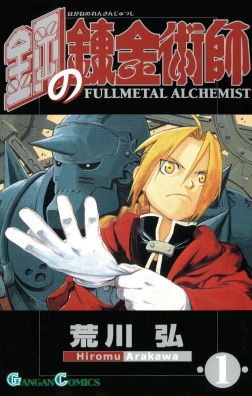
Now that it has finally drawn to a close, I can definitively say that Fullmetal Alchemist is the best manga I have ever read. For those who have never heard of it, the comic series' follows two brothers who attempt to revive their dead mother using the art of alchemy. Their spell goes horribly wrong, and Ed, the elder brother ends up loosing his arm and his leg, while the Al younger brother loses his entire body. Ed manages to save his brother by attaching his soul to a suit of armor, and he replaces his lost limbs with robotic prostheses. The two set out to find the Philosophers Stone to recover their lost bodies. While the series' successes can't be attributed to any single element, I believe the most refreshing thing about the series is it's occidental quality; both in terms of aesthetics and narrative structure.
Edward and Alphonse Elric.

Coming from a westerner, I realize that probably seems incredibly arrogant. I'm not trying to say that all manga should strive to follow the conventions of Western fiction but there are certain elements of manga storytelling, and Shonen in particular, that are down-right hackneyed. Most Shonen heroes have no motivation beyond, "I must become stronger so I can protect those dear to me!" The hero gains enough strength to defeat whatever evil that is threatening his beloved comrades, only to run into a bigger and badder beast later on. I can't help but wonder what these school age superheroes would do with their lives if the bad guys ever stopped bothering them.This eternal dissatisfaction with oneself is extremely appealing to adolescents, who really do have to defeat waves of school work while navigating their hormones and the fucked up social conventions that dominate high school, but what do you do when you're done fighting? Shonen rarely attempts to answer those questions. 

Fullmetal Alchemist's characters all have hopes and dreams beyond defeating the bad guys. Admittedly, the bad guys themselves are flat, seeing how they're all based on the seven deadly sins. But considering that the villains are homunculi; artificial humans created by alchemy, their unidimensionality is actually quite logical. And series creator Hiromu Arakawa does a brilliant job of personifying Lust, Greed, Gluttony, Sloth, Pride, Wrath and Envy in compelling ways that make them threatening and loathsome. 

The other welcome westernization in Fullmetal Alchemist is the ending. Anime and Manga conclusions tend to feature incoherent plot twists, pathetic anticlimaxes, or an explosive, mind-fuck apotheosis. It's partially an East vs. West thing (the emphasis over there being on the journey as opposed to the destination) and it's partially a symptom of the grueling work ethic that defines Japanese culture. Sometimes, creators simply snap from the pressure, as was the case with Evangelion's original ending, which is so horrible it's hilarious. Then again, the "good" ending of Evangelion involves the birth of at least one god and the whole of humanity exploding into puddles of orange juice. This is pretty much par for the course as fas as anime endings go. The obvious explanation is that each of these endings are cultural echoes of what happened to Hiroshima, but knowing that does little to clarify what the hell is happening to the characters you have been following for 26 episodes. 

More frequently, especially when it comes to anime adaptations of ongoing manga, artists have to cobble together an ending for a series that has only just begun. This was the case with the original Fullmetal Alchemist anime, where the artists had Ed take a trip to Nazi Germany out of nowhere.
Fortunately, the recently released conclusion of the manga is everything fans could hope for. It's comprehensive, creative, moving at times, and while it lays the main adventure to rest and ties up the important subplots, it also gives readers a good idea of how the characters will live out their lives now that they have vanquished the ultimate evil. There are some over-the top moments in the final fight, but the plot moves too fast to take itself too seriously. That's another thing I love about the series; it is not mellow-dramatic or over-wrought. The plot earns whatever emotional response it desires from it's readers with compelling events. There is very little introspective whining and none of the dramatic posturing that plagues series like Dragon Ball, Bleach and Naruto.  

Behold the self-portrait of a genius mangaka. I can't wait for Hiromu Arakawa 's next manga!

That said, Fullmetal Alchemist is still very much a manga. The story has a European aesthetic but the art style is very Japanese. The humor is visual and situational as opposed to sarcastic and cynical. While the pacing of the fights are much more visceral and realistic than most manga, the violence is very highly stylized and at times so complicated that it warrants considerable exposition. If you have the slightest interest in manga, consider Fullmetal Alchemist a must read. Or if you're pressed for time, watch the new anime series, titled Fullmetal Alchemist: Brotherhood, which faithfully follows the plot of the manga at the expense of some abridgment. You can get started here now!

Monday, May 17, 2010

Will The Real Tony Stark Please Stand Up?

I hate to play the hipster-douche card, but I liked Iron Man before he got all popular. Then again, I liked him after he got popular too. Hell, I even like the sequel. I can understand why the critics are underwhelmed by Iron Man 2. The concept isn't new and shiny. The plot isn't quite as sleek as the first one. There is no timely political subtext to the sequel, as there was with the first film. These are all valid complaints. But Charlie Jane Anders' chief complaint of the movie, that The Villain of Iron Man 2 is Tony Stark bothers the hell out of me. He says it like it's a bad thing. Worse yet, he says it like it's a surprising thing.

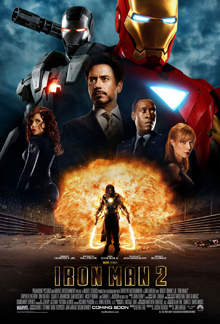
Marvel knows how to make a good movie poster.

Iron Man has always been the asshole superhero. At least, from what I've read of him. Tony Stark is Bruce Wayne minus the baggage and repression, plus narcissism and a drinking problem. The first film is somewhat misleading, because it presents  him as a reformed asshole. A genius arms merchant who develops a conscious along with his awesome suit of armor. In Iron Man 2, Stark is the rock star who has checked out of rehab and into a bar. It is truly the role Robert Downey Jr. was born to play. It's not role-model material, but frankly, our superheroes haven't been role-models for a while now. Dark Knight, Kick-Ass, and Watchmen have all explored the ugly side of being a superhero, and after getting a good look at that blood and grit, I don't see how we could go back to the golden age portrayal of heroes as shining paragons of morality. Much luck to the people trying to make Captain America happen.

One does have to wonder why we like these new, not-exactly-nice-guy heroes. It's not a bad boy thing. Well, maybe it is with the rough justice of Batman and Wolverine. But I think we buy into cocky jerks like Dr. House and Tony Stark for a different reason. In Iron Man 2, Tony's 'reckless' behavior is thinly justified by a soon-to-be terminal case of blood poisoning. I never once thought "Poor Tony!" or "Oh No! Will he make it?" though. On the contrary, I thought "He's Tony Fucking Stark. He'll invent a brand new kind of blood if he has to." And that's why I like such characters. They are aware of their own super-heoric abilities. They're the anecdote to poseury and politically correctness. The antithesis to incompetent sweet-talkers like Sam Rockwell's villain, Justin Hammer.

The suits really are pretty enough to sell the movie by themselves.

All the same, Iron Man 2 is not a high source of moral fiber. It's about as good for you as high-fructose corn syrup, but it's just as delicious. Don Cheadle is a huge upgrade over Terrence Howard, and it's a shame he didn't get more screen-time. His tongue in cheek introduction is excellent. Scarlet Johanson is incredibly hot as Black Widow, and her fight scene is almost on par with the mania that was Kick-Ass's Hit-Girl, though much less violent, as you would expect. Paltrow is still endearing as the anachronistic House Wife/Secretary, Pepper Pots. Mickey Rourke is great as Ivan Vanko, AKA Whiplash, though his climactic battle with Iron Man wraps up a little too quick, just like the Iron Monger fight in the original Iron Man. Samuel L Jackson is always a fun presence, but his Nick Fury cameo feels more than a little bit forced given how much else there was going on with the plot.

After repeatedly hearing "It's not as good as the first one," I had an absolute blast with Iron Man 2. The repartee runs witty, the action scenes are cool-looking and rife with explosions, and the plot feels fairly polished despite it's busyness. If you are a comic book fan, it'll be an excellent time. As is the case with the vast majority of the films I discuss here, I wouldn't recommend bringing grandma. Summer blockbusters are off to a good start.

Sunday, March 28, 2010

Hurts So Good

The title of this post is more than an awful pun. The Hurt Locker is an excruciating film, but it is excruciating for all the right reasons. I'm not a big fan of Kafka, but I heard a quote from him a couple years back that's been kicking around ever since; "I think we ought to read only the kind of books that wound and stab us. If the book we are reading doesn't wake us up with a blow on the head, what are we reading it for?" There's a lot to be said for stories (and movies) that let us dream and remove us from reality. Hell, it's the sort of fiction I am more inclined to produce myself, but by and large, I have found that the stories which wound, stab and bludgeon us tend to make more of an impression on our lives. Case in point: The Hurt Locker.

There are three movie posters in this post, but only this one is any good. The other two are make it look like a generic action flick and feature broad, bland tag-lines that have next to nothing to do with the film.

For those who don't know, the movie is about an army Explosive Ordnance Disposal (EOD) unit in Iraq nearing the end of it's rotation. Even though it is currently being marketed as an action affair (read my rant in the poster captions), it is a much more cerebral experience. Whereas the modern action film is all about constant movement, Hurt Locker is about waiting.  The explosion does not receive as much emphasis as the bomb that has not yet gone off. When firearms are drawn, they usually result in standoffs as opposed to firefights, and the most compelling exchange of firearms is a protracted sniper duel in the desert. Each of these scenes are overlaid with other sources of abstract tension. I will try to keep spoilers to a minimum, but I make no promises. Proceed with caution.

The film begins with the death of the EOD squad leader, and the arrival of his replacement, an experienced army ranger with an apparent death wish. Even before the team goes on their first mission together, we have a huge knot of emotional tension in play. The youngest member of the unit is wracked with guilt over the death of his commanding squad leader, and the middle member of the squad has a rather curt introduction with the new squad leader. Their first deployment together is a haunting echo of the prior squad leader's death, but whereas the last squad leader died despite being cautious and cooperative with his squad, the veteran ranger is reckless, non-communicative and unbelievably cocky. But he survives, and disarms a frightening number of bombs in the process. This victory obliterates traditional moral paradigms. It is unfair that the last commander died when he played by the book, and it is unfair that some cocky son of a bitch swaggers up like a hero and comes out on top even though he places his squad at risk. This unfairness is one of the wounds Hurt Locker inflicts on it's audiences.


"You'll know when you're in it." Really? Is this the best the marketing department could come up with? Worse yet, the poster emphasizes guns and explosions as opposed to the bombs themselves. 

Admittedly, unfairness in war is hardly fresh territory. It is the films' decision based approach to unfairness in war that is compelling. Each mission in the movie confronts viewers with the no-right answer situations soldiers h face on the battlefield. Do you shoot that Iraqi holding a cellphone? He might be dialing in the bomb your squad mate is disarming. Or maybe he doesn't have a cellphone at all. Your squad leader has led you into a firefight, and you think you see movement. You ask what to do, and he tells you "Be smart. Make a good decision." These scenarios serve as richter scale, charting the jagged line between figuring shit out for yourself and doing as you are told. Having never served in the military, it would be absurd and offensive for me to speculate about what that sort of life is like, but from what I've read and heard from people who have served, The Hurt Locker seems to accurately capture the dynamics of that life. War is about working together by yourself. It is about waiting, and knowing when you can't afford to wait any longer.

For me, the most compelling scene in the movie--your cue to skip this paragraph if you intend to see the film-- was not the sniper battle, or any of the bomb diffusion sequences, but a scene in the cereal aisle of a supermarket. Our Angel of Death army ranger stands before the candy colored sprawl of boxes, at a loss for which box he should pick up. That was the point at which the movie thrust the knife home for me. Two seconds ago, we were in Iraq, cutting bomb wires and now cereal. There is no patriotic swell of music, or some lofty speech about how the sacrifices made have all been noble and good; just a man and cereal.

"War is a Drug." This is a slightly better tag-line, but drug imagery has no explicit presence in the film. The metaphor is accurate, but its brevity makes it sound simple and cheap-witted. Some movies don't need soundbites to succeed.

Hurt Locker isn't an easy movie to watch but it is gripping, deeply effective and very timely. I love Netflix--it is to movies what TiVo is to the TV-- but you really should see this film in theaters. As far as suspenseful atmospheres go, it's hard to beat a dark stadium and an inescapably large screen. Hopefully it's well-deserved Oscar for Best Picture will give it some legs in extended release theaters.


Thursday, January 28, 2010

The Face of Things to Come

Facade is the most important videogame that most gamers have never heard of- if it is in fact a videogame at all. It's the face of things to come; the place videogaming will go when it outgrows it's core demographic (18-35 year old males) and ventures beyond Bioware and Bethesda's combat-driven realms of fantasy.

 
Meet Trip and Grace, your hosts for the evening

So what is Facade? To put it simply, it's a 'watch a marriage falling apart simulator.' You play as a friend of Grace and Trips, a couple you set up in college. The game begins with Trip inviting you over via answering machine message, and after picking a name and gender, you arrive at their apartment where the harsh tones of an argument are escaping the front door. Trip lets you in, retreats to the kitchen to retrieve Grace (more hushed aggression), and you all exchange pleasantries. Where things go from there is up to you. The two trade passive-aggressive remarks over drinks that grow increasingly less passive, ask for your frank opinion with leading questions to spite each other, and react to whatever else you elect to say or do. In addition to typing out dialogue, you can kiss or hug both characters, sip drinks and pick up the hideous sculptures that adorn the couple's apartment. 

The AI's text recognition is better than you would expect provided you stick to suggested path of topics: drinks, interior-decoration, and careers will almost inevitably pop up, though all roads lead back to Grace and Trip's characters. Trip turns out to be a manipulative, waspy, superficial asshole, while Grace is insecure, frigid and hypercritical; fresh faces in a medium populated by cliches, though neither character is particularly likable. If you sit and speak only when necessary, watching the evening take it's course, you're in for a rather trying exchange; this may not be a typical videogame, but the violence the form is known for is still present. It's just mediated through incrimination and accusations instead of fisticuffs and gunfire. And true to form, said violence is also vastly more enjoyable when you participate in it as opposed to just watching things fall apart. 

Blunt crudeness and belligerence will get you thrown out; on my second play-through I greeted Trip with an insult and he slammed the door in my face before the evening could get underway. But if you play Iago and subtly play off their reactions and assertions the evening is much more fun: a kiss here, a disagreement there, followed by a perfectly innocent inquiry about their sex-life... oh it's a fun night. It offers the domesticated, matured equivalent of the illicit glee one derives from tearing through Liberty City with a machine gun and a Humvee.

Of course, one could also play towards reconciling the arguing couple. As the happy ending available, one might look at it as implied goal of the game. Unsurprisingly, it is also the most difficult outcome to achieve, and I have yet to accomplish it. This is partially because I don't think they deserve a happily ever after, and partially due to shoddy controls. Trip and Grace frequently speak at the same time, so clarifying the recipient of your replies can be frustrating and difficult. Just as hardcore gamers tend to scorn casual titles that trade accessibility for precision, I found myself wishing for a more structured conversation system. Then again, conversations in real life don't adhere to strict frameworks, and trying to impose them may stifle the experience, which is already rather stunted by the limitations of AI. More reliable rule sets and inputs must be determined before Facade can be considered a successful gaming experience.

Blatantly stolen (via google) from The Atlantic's article on the game. Please don't sue me!


Then again, Michael Mateas and Andrew Stern weren't setting out to create a gaming experience, but an Interactive story. The download for Facade is hosted at InteractiveStory.net as opposed to Facadegame.net, and on Wikipedia, it is listed as Facade (interactive story) as opposed to Facade (game). Then again, they also entered the game in Slamdance and the Independent Game Festival as a contestant, suggesting that they don't mind their creation be regarded as a videogame. But rather than trotting out the weary old query "What is a game?" and turning down the interesting, but over-emphasized narratology vs. ludology line of inquiry, I'm interested in exploring how Mateas and Stern could have succeeded at telling a better story with Facade.

I believe that Interactive Fiction is unique and significant enough as a medium to stand apart from videogames and drama, but Facade doesn't make that argument. It borrows a problem, perhaps the most serious problem, from videogame narratives: the main character is a looking-glass. You can pick a name and a gender, but these choices have no influence on your presence in the story. Aside from the tidbit that you introduced Grace and Trip, your relationship to them, and your involvement in the narrative is completely incidental. In order for interactive narratives to grow, developers need to escape this idea of the 'window character'. The screen is our window; the avatar must be our vehicle.

One way to do this would be to take a page from Bioware and allow the character to choose from a number of different histories relating to Trip and Grace. Maybe you're Trips boss, or Grace's ex-boyfriend turned platonic friend. Maybe you did introduce the two of them back in college, but if that's the case, let the player decide how that first meeting went down. Could he already see the seeds of dissent that have now blossomed into bitter fruit? These decisions may make the game more linear, but they will also provide the player, or reader/actor, with context to make the experience meaningful.

Another possibility for engaging the player would be to place the operator outside of virtual world altogether, giving them a directorial position like the godlike control one has in The SIMs. Rather than determining the player's actions, you could mediate the character's interactions interactions by planting memories in their heads to control the flow of conversation. Or you could adjust factors like room temperature and the weather outside to affect the general mood of the preceding. Finally, you could flesh out the characters' desires and histories as you go along, making the narrative increasingly cohesive or convoluted as you please.

Facade isn't important for what it is, but for the ideas it represents. It's a jumping off point both in terms of subject matter and form for what will come, or rather, what is now arriving.


Sunday, January 10, 2010

Charting New Territory

I held out against the appeal of owning a PS3 for a long time. This was fairly easy in the beginning, seeing how there was no appeal for a good long while. Things got a little harder when MGS 4 and Little Big Planet were released, though a host of much-touted but sorely disappointing titles (anybody remember Lair? or the one that should have been called Goddess of War?) were enough to sober me. I heard that Uncharted: Drakes Fortune, was a good enough game, and that the Ratchet and Clank series was still going strong, warming me back up to the idea of PS3 ownership, though I wasn't swayed until I heard the praise for Uncharted 2: Among Thieves.


I think Uncharted is a pretty cool guy, eh seeks Cintamani Stone and doesn't afraid of anything.

In a world where journalism and marketing hype are not only indiscernible but treated interchangeably, the value of high praise has pretty much dissolved. There are a few phrases that still command some attention however and "Best Game I Ever Played" is one of them. I heard it applied to Uncharted 2 more than once. Now, that's not a bridge I'm willing to jump off of, but I will say Uncharted 2 won my vote for best game of 2009 (against some stiff competition), and that it is the most cinematically pleasing video game I have played thus far.

Now my use of "cinematically" is problematic for a couple reasons. First of all, it is not actually a word, and secondly, when a game is described as cinematic, it generally means that there uses lots of cut-scenes; narrative videos that transform operators into an audience as opposed to players. Many 'cinematic games' tell excellent stories, but they also have the obnoxious habit of seizing control of players right before they get to do something incredible. That is never a problem in Uncharted 2. Rather, the game employs cinematic techniques in gameplay to excellent effect (Reader beware, spoilers ensue henceforth.)

The coolest moments of the game, the ones that make you hold your breath and exhale an emphatic "Holy mackerel!" when they pass, all exist within the context of play. Building collapsing in the middle of a firefight? The firefight continues as the world slides apart beneath you. Hero decides to carry a wounded comrade to safety as villains chase you with machine guns and rocket launchers? All you. Chase scene with Jeeps in the Himalayas? "Let me guess: you drive the jeep?" No. Because you have done that in other games and doing it again is considerably less incredible than jumping from jeep to jeep while sniping at tires and bad guys. Playing Uncharted 2 is the closest most of us will ever get to living Indiana Jones' life. Until Uncharted 3 anyway.

In addition to letting players take part in the action, there are host of cinematic touches that don't actually change the gameplay so much as they surprise the player. That may not sound like much, but when you remember that video games as a medium are dominated by explosive imagery and constant movement, visually surprising a gamer is an impressive feat indeed, and Naughty Dog pulls it off consistently throughout the narrative. They do this by employing time tested cinematic techniques that have yet to arrive in video games. You'll be walking through a hushed frozen cavern, and part of the foreground will turn out to be a monster; a surprise in a game that has been devoid of the supernatural thus far. Another example is when you manage to escape a tank by going onto a mountainous ledge, only for the tank to suddenly start to go over the wall and think better of it. In text, these sound like cheap, "Gotcha" moments and they may be; but in play, such direction makes for an exhilarating experience.

The content of the narrative itself may not be groundbreaking, but the quality of the writing and voice acting that delivers it is superb. There is more chemistry between Nathan Drake and each one of the lovely heroines than there is in most modern adventure movies, let alone most video games. How people can still be transfixed by 'characters' like Bayonetta when there are personalities like Elena Fisher and Chloe Frazer boggles my mind a bit. Leather, long legs and boobs are awesome, but there are other ways to be appealing, and indeed sexy, in video games. I am similarly perplexed by the antiquated trend of the mute hero in adventure games. I can understand the case for "immersability" in a role-playing context (though I tend to disagree with it), and Link has a long standing laconic legacy so he gets a reprieve, I can't imagine another action/adventure scenario that would benefit from a lack of speech. After enjoying Nathan Drake's wit and charm, taciturn protagonists seem woefully under-realized. Then again, this is another issue entirely; one deserving it's own discussion.

In conclusion Uncharted 2 is an incredible game right down to the details. The graphics are lush with details and pop off the screen with color, the sound effects are spot on and the music swells with the same majesty as John Williams scores. Just listen to this theme! Even stripped of this presentation and the narrative, you have an incredibly tight 3rd person shooter featuring positively effervescent freedom of movement. You read that right: your ability to climb, hang and jump from almost everything in the environment bubbles with possibility. If games like Gears of War and MW2 didn't feel dated before, they should now. Uncharted 2's multiplayer may not offer as many guns and brutal methods of execution as those other titles, but it is more balanced and mobile, which to my mind, equates to greater variety in play.

Long story short: If you have a PS3 you should do yourself a favor and play through Uncharted 2: Among Thieves. It is the best video game of 2009.

Monday, December 28, 2009

A MMOdern Day Fairytale

Merry Christmas fellow smart asses! I have no gold, frankincense or myrrh to give, and while I could beat on a drum for you, the ba-rum-pum-pum-pum thing wears thin real quick. Instead, I offer you a review/plot analysis/rant on Avatar, the decade's final blockbuster epic.

This poster looks awesome. Why haven't I seen it anywhere?

When I first heard the film's title some time last summer, I didn't like it. I don't have anything against the word avatar; on the contrary, I think it's a brilliant shred of language. I was put off because James Cameron apparently pilfered it from the excellent animated series by the same name. To my mind, the cartoon was there first, and it's upcoming movie adaptation was better deserving of the title. Besides, seeing how it will be suffering from the directorship of M. Night Shyamalan, it will need all the advertising cache it can get. My opinion of the flick did not improve when I heard about it's universes nomenclature from a friend working on the films advertising. The moon is called Pandora? Really, the most hackneyed mythological reference in science fiction, again? Okay, whatever... but Unobtanium!? Human's are searching for something called un-ob-fucking-tanium? I assume that's supposed to be cute, but it just sounds moronic. There isn't a bus short enough for it to ride on. I understand that you are a visionary Mr. Cameron, but you hired a linguist to help you invent an entire language for the Na'vi, so why not spend five minutes with a writer and see if you can come up with a name that's just a touch sharper?

[Inhale. Exhale. /rant]

Despite my hostilities, Avatar won me over. It is a good movie, and you will most likely have fun if you go see it. You will probably enjoy it even if you don't typically like Sci-fi, because James Cameron is a master of making things that most people like. Even if you found Titanic to be trite and over-long, Avatar is still a spectacle well-worth watching for it's technical brilliance. The movie's ill-named moon has been meticulously rendered, and it's ecology has been populated with flora and fauna that make George Lucas' offerings look like the set pieces for a particularly cheap episode of SG-1. Even Lord of the Ring's Gollum, who exorcised the embarrassing shade of Jar-Jar Binks and proved that CGI characters could be emotionally compelling, seems terribly dated when compared to the Na'vi. There was never a moment in the movie where the illusion fell apart, and I found myself wondering what the mo-cap or voice actors behind the curtain actually looked like. As far as my brain cared, the actors really were big blue cat people. The movie dazzles easily even if you don't spring for the Real3D experience, though the extra $4 or $5 really does make an appreciable difference. For those of you who are wondering where life after HD will take us, this seems a likely path.

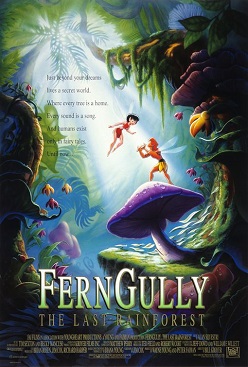
There's a story here too, of course, and it is a serviceable scaffold for the brilliant spectacle. It's very easy to figure out who you are supposed to cheer for, and the components of the plot are very familiar. I have heard it compared to Ferngully by a number of people, which surprises me because: (A) I had no idea so many people remember Ferngully and, (B) from a narrative perspective the parallels are almost dead-on. An average joe is magically transported to a naturalistic society where he falls in love with a beautiful woman and together they fight to protect it from evil humans and giant bulldozers. Don't let Avatar's sci-fi trappings fool you. Both films are fairy tales, but what Ferngully accomplishes with pixie dust, Avatar does with an idealized concept of online gaming.

In case you forgot what it looked like. I know I did.

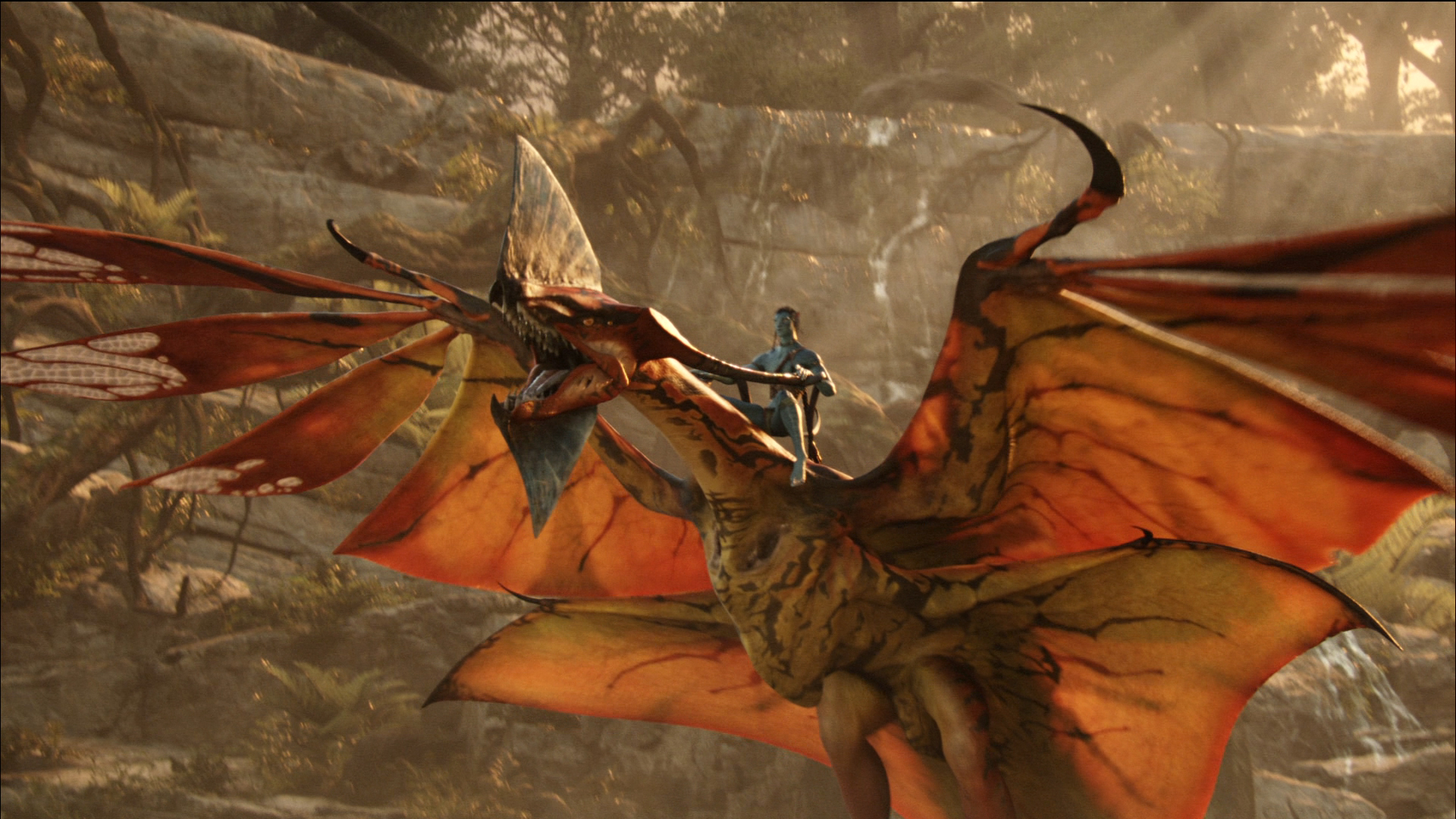
The film's title refers to technology that allows researchers to mentally control biological avatars (created from human and na'vi DNA) to explore Pandora. Humans cannot wander Pandora as they please, you see, because it's very air is poisonous. This establishes a dynamic to similar to online games which are themselves, fantastic worlds that cannot be explored without a surrogate body. The crucial difference, is that Pandora is physically real, as is the Avatar driver's experience of it. Jake Sully, Avatar's aforementioned Average Joe, is a paraplegic ex-marine, and using his Avatar magically gives him back the use of his legs. This is an idealized reversal of a user's typical experience with MMO's, wherein players must give up their physicality to gain the mystical abilities of virtual reality, though the rest of the gaming parallels carry strong. Jake is chosen to learn the ways of the Na'vi; a process that handsomely mirrors leveling up in online gaming. He must learn to speak the local language, hunt the forest's various monsters, and master the Na'vi's magical ability to connect with animals. This last ability bears particular similarity to World of Warcrafts mount system. In fact, a key turning point in the movie entails capturing one's epic flying mount as seen below:

And not one gold paid for it. Hax.

I don't mean to imply that James Cameron intended to make a movie about playing MMOs, but the themes at work certainly cater to the desires of the WoW demographic. In this movie, withdrawing from human society to live in a fantasy world is not only plausible, but noble. Humanity is the bad guy on Pandora, and it's respective avatars are Mr. Corporate Greed and General Texas. Sure, there are good humans, like the nerdy scientists who developed the avatar project to promote cultural exchange and understanding, and Cameron is sure to include one gold-hearted fighter pilot so audiences know he doesn't think all soldiers are bad, but they are all on the Na'vi's side; the right side. Now, I'm no stranger to plots with clear-cut (read: over-simplified) good guys and bad guys where violence is the only solution, but for some reason, it's presence in Avatar bothers me more than usual. As long as the movie is, and it is looong, the climactic battle ending feels too abrupt and easy. I can't help but wonder what would have happened if Cameron stretched the story out over the course of a couple sequels rather than cramming everything into one sitting. I have no doubt that we'll be back to Pandora, though I'm not sure where the franchise will go from here.

Despite those gripes, Avatar is an excellent piece of cinema, and an important victory for big budget film-making in this age of economic dreary. You should give it a watch when you have the chance, because it really is the sort of movie best experienced on the big-screen.

Tuesday, December 8, 2009

Dresden'd for Greatness

About two years ago, I was perusing the Sci-fi/Fantas section in a local bookstore when a description caught my eye; "Think Buffy the Vampire Slayer staring Phillip Marlowe." I may have been aware that the quoted book's title was Small Favor, though I didn't devote much attention to the cover, or who wrote it. The statement crackled with such potential that I snatched up the hardcover, and proceeded to the checkout, only dimly aware of the possibility that I was stumbling into the latest installment of a long running series. If somebody told me I was about to start on Book Ten of the Dresden Files, I may have tried to start at the beginning. A glad thing I didn't know any better. It was one of the best impulse buys of my life. Starting out late didn't hamper my enjoyment of the earlier books in the series, in fact, knowing what was in store made me more charitable toward Jim Butcher during his "warm up period."

The first two books are enjoyable enough, but things really start to pick up here.

Needless to say, the book delivered on the promise of Entertainment Weekly's one liner. The Dresden Files are a helluva lot of fun. The series isn't for everybody; grandma probably won't get it, and fans of "higher literature" including Tolkien devotees will probably look down upon it as low-brow genre fiction. I've even heard people, or at least internet people, refer to it as the Y-chromosomes' answer to Twilight. There is a shred of accuracy to this statement, insofar as the books are clearly written for a male audience, just as Twilight is obviously written for women folk, but the parallels stop there. Unlike Meyer, Butcher can write. The pacing is fast, the plotting starts out serviceable and gets increasingly tighter as the series continues, and the characters, while archetypal, are memorable and believably developed. And most importantly, Butcher doesn't take himself, his protagonist, or his series too seriously. On the contrary, self-deprecation runs high in the Dresden Files. Each book has an element or two which rib's the fantasy genre in one way or another, be by featuring a Billy Goat's Gruff as an antagonist, or a subplot involving a pack of teenage LARPers who gain the ability to turn into were-wolves.

If you do not find this even a little bit awesome, The Dresden Files is probably not for you. Also: seek medical attention.

Despite the fantastic trappings and occasional absurdity of the situations, the action in the Dresden Files is typically driven by very real issues; chiefly, responsibility and relationships. I don't mean the spider-man sort of responsibility about using your powers for good either. There is a bit of that here and there, but usually, the books are concerned with the responsibilities of us mere mortals: sticking to your principals as much as practicality will allow, asking for help despite putting other people out or putting them in danger. These are universals, even if they are broadly drawn, and the fantastic elements of the narrative make them far more interesting and enjoyable than they are in real life.

DOING IT WRONG

Not everything that is Dresden Files is golden however. The Syfy channel (or Sci-fi Channel back at the time of productions) mangles the original series something fierce. Some people liked it well enough, though it tried my tolerance with rather weak writing, and a host of totally unnecessary departures from the source material. Harry Dresden wears a leather jacket as opposed to his signature duster, negating the wild-westish aesthetic of the series. His wizard's staff is now a hockey stick; was this modernization supposed to make him seem hipper some how? Bob, the wisecracking, randy skull that serves as Harry's sidekick is anthropomorphized as a British dandy, and not the good kind like you want. Karen Murphy is now inexplicably a mother. Michael, and the rest of the carpenter family are completely absent. There's really only one way to sum up my feelings about these changes. But like I said, some people really dug it, and it's on Hulu, so you might as well give it a go if you're interested.

The books however, are definitely a must for modern fantasy fans. If you've completed your term at Hogwarts and are wondering where to head next, spending some time in the windy city with Harry Dresden would be a good call.

Tuesday, November 10, 2009

Dingos Frisky and Chicken Robotic

It's been quite a stretch since I've talked about animation, what with the abrupt, inexplicable suspension of my Japan's Finest! segment (don't worry, it will be back when you are least prepared for it) and it occurred to me that I never discussed any western animation, which is quite criminal really. Disney and The Simpsons are the obvious points of departure and for that reason, they will be ignored outright. Instead, I would like to discuss [adult swim], a network whose quirky line-up has found particular favor with the internet generations.


I was initially drawn to the network for it's anime, "dubbed down" though it was (quit scoffing you little weaboo brats! we didn't have torrents or crunchyroll.com back then) and I was only dimly aware of the network's original shows. It seems like most people felt the same, because the network really started to gain popularity when it became a refugee camp for prime time toons that more conservative networks had cancelled. Over the years, [as] has continued to develop it's own bizzaire brand of programming, and while most of it is incoherent, mind-scarring, crap, it has produced several gems. Among these, you are probably most familiar with Seth Green and Matthew Senreich's Emmy-winning stop-motion cavalcade...


In many ways, Robot Chicken is the natural evolution of Saturday Night Live. It's a sketch-based show, ripe with amusing nonsense and pop-cultural parodies, but faster paced, cheaper to produce, and funnier (by current comparison anyway) than it's predecessor. Fast and cheap may not necessarily sound like appealing adjectives, but if a sketch bombs in SNL, you get to wait five minutes for the damn thing to play out, while the average chicky robot sketch clocks in at around 30 seconds. You're on to the next joke before you can decide whether you liked the last one or not. I will concede that a certain degree of physical comedy is lost in the transition from actor to action figure, though (sadly) it's less than you might expect. Also, GI Joes typically have less trouble with the booze and drugs. Hey-oh!

It's also clear that Seth Green learned a thing or few from Seth McFarlan while working on Family Guy; specifically, how to play to your demographic with relevant pop-cultural references. Each episode of Robot Chicken balances it's satires of the now (300, Resident Evil, Mario Kart) with parodies of the late 80s and early 90s (Rainbow Bright, Teenage Mutant Ninja Turtles, Transformers). Even more importantly, Green and Senreich have a gift for locking on to the embarrassing or absurd aspect of those things you used to love and viciously ridiculing them. The internet generations live in a perpetual state of iteration; we constantly destroy who we are to become somebody new. Perpetually. Indefinitely.

This cynical "anti-nostalgia" was present from the founding of [adult swim] in programs like The Brak Show, Sealab 2021, and Harvey Birdman Attorney at Law, which revive and twist classic cartoons like so many sons wished back to life by a gnarled monkey paw (too obscure? ah what the hell, we'll go with it). These early efforts pale before The Venture Brothers, however.


The show is parody of Johnny Quest and the Hardy Boys. It's a simple premise, one that sounds like it could be very easily exhausted in a single sitting. Indeed, one of the episodes of Harvey Birdman Attorney at Law entails a custody battle between Race Bannon and Dr. Quest for Johnny and Hadji. It was a funny enough episode, but you knew every joke before it happened. Venture Brothers is admittedly starting to show some strain in its 4th season, but it had 3 seasons of solid gold and it's still mostly enjoyable because it simultaneously sustains the absurd dynamics of it's source material while mocking itself with modern cynicism.

The titular brothers, Hank and Dean Venture both behave as if they were still in cartoon's Hanna-Barbera era (lolrhyme). Hank is an impulsive idiot who idolizes batman and Dean is a neurotic simpering milquetoast. Their father, Rusty Venture, a former "boy adventurer" himself, is not only cirminally negligent but borderline evil, yet he is rendered oddly sympathetic through a severe inferiority complex and his general haplessness. Brock Samson, the family's former-secret agent bodyguard, strikes an endearing balance between housewife and homocidal maniac, and the cast is rounded out by a number of delightful supporting characters like Doctor Orpheus, Molotov Cocktease and Henry Killinger.

Two Big Dysfunctionals

Perhaps the most innovative twist of the venture universe is the institutional relationship between heroes and villains. The Guild of Calamitous Intent assigns each villain a hero or team to antagonize, or "arch", as an arch nemesis. Both hero and villain must adhere to a convoluted code of conduct in their mutual aggression that lampoons the hackneyed conventions of the good and evil dynamic. The absurdities of the code prevent either party from ever accomplishing anything, allowing the show to capture the mundane spirit of everyday frustrations while remaining true to the laughable formula of action-adventure cartoons. In fact, it's interesting to note that the aforementioned strain evident in the show's most recent season stems from the fact that static characters are finally starting to change. As much as the internet generation loves changing themselves, they tend to abhor change in the familiar.

The final show I'd like to talk about is a personal favorite.


How to describe Frisky Dingo? Well, to begin with, the title has nothing to do with the plot. Like Venture Bros, the absurdity of the good and evil dynamic is central to the show, and it is captured through the unusual relationship between Killface, a verbose hulking super villain trying to raise funds for his doomsday device (see below), and Xander Crews, a millionaire playboy/superhero/impossible douche bag.


To accommodate bankrupt attention-spans like mine, each episode is a bite-sized 15 minutes, but like bonbons, they are best enjoyed when many are consumed in a single sitting. For all it's apparent (and actual) nonsense, there are some impressive narrative circles and a lot of running gags to be enjoyed.

Friday, October 2, 2009

They Come in Squalor!

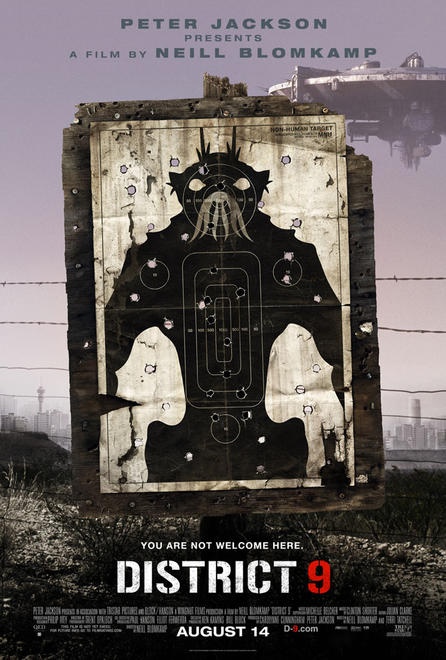
I think enough time has finally passed for me to give District 9 a good talking about without having to worry about catastrophic spoilers. Of course, if you have not seen it yet but you still intend to, do that before reading what I have to say, as the plot will be divulged, and dissected in detail henceforth.

District 9's premise, "what if Aliens came to Earth, not in war or peace, but poverty and desperation?" can be thought of as a return to classic sci-fi form, insofar that it is less concerned with the fantastic trappings of its own genre (laser gunfire, warp drives, paradoxes) , and more concerned with the scenario's social implications. The psuedo-documentary format is a brilliant frame for such examinations, because examining humanity is what documentaries do. We do eventually arrive at flashy firefights, foreign biology and space travel tropes as well, resulting in an intringuing, unique experience. Some critics, whose names I have made a point of not remembering, have complained that the film is simply a mishmash of old and familiar sci-fi tropes, and is therefore not original. Though honestly, if amalgamations cannot be considered original, Homer's a hack, Shakespeare's a schmuck and... you can see where I'm going with this.

The film opens with a collage of interviews and handy cam footage which informs us that an alien ship arrived in the skies of Johannesburg, South Africa in 1982, and ever since, the area has been inhabitted by a populous of alien aliens (Guffaw!) referred to as the Prawns, presumably because Cthulhu-Grasshoppers takes too long to say. An insidious PMC known as Multi-National United (MNU) has seized control of the situation, and it quickly becomes apparent that one of their lackeys, a Wikus van der Merwe, is going to be our main character and he's about as likeable as a wet pair of good shoes; he is boringly average, socially awkward and naive in an way that is simutaneously obnoxious and pitiable, but you aren't going to throw him out because there's good there.
If you think this is heavy-handed, you should check out the promotional website.

Things start to shift gears when Wikus gets sprayed with an alien chemical that (spoiler alert, last chance to turn back) gradually transforms him into a Prawn. Although it may not be all that original as hooks go, the twist works excellently as a plot device because it serves as the narrative's fulcrum, providing a convincing bridge for the disparate switch from docudrama to action thriller. Wikus' metamorphosis begins with his right arm, conveniently allowing him to use the alien weaponry coveted by tribalistic african gangsters and the scheming executives of MNU. All Wikus wants to do is go home to his loving new wife who is inconveniently the daughter of MNU's evil CEO. Since MNU is on high alert and anxious to sell Wikus to the military, he has to turn to the aliens to cure his condition. Carnage and gunfights ensue; the bloodiest seen since Watchman.

Yet District 9's sensationalized gore serves a purpose beyond the superficial: It establishes an atmosphere of intense brutality, which is quite appropriate for a movie set in a politically tense, refugee environment. Documentary fans may argue that the horrors of starvation, subjugation and degradation are brutal enough, and that watching people erupt into showers meat when blasted by lightning cannons only trivializes those subtler, truer horrors, and they may have a point. It's obvious that Blomkamp opted for "totally awesome" instead of social commentary in the final sequence where we see Wikus commandeer an alien battle mech and lays waste to scores of MNU soldiers. Then again, when Wikus is forced to fire a lightning cannon at a hooded, handcuffed prawn, it provokes sorrow and revulsion as opposed to stylized admiration.

That compromise between meaningful social examination and manic spectacle best describes my feelings toward District 9. It is engaging, both emotionally and intellectually, but part of me has to wonder what would have happened if things continued on at their slower initial pace. To a certain extent, it seems like we got to watch the fused halves of two seperate movies. I suspect that a big part of this has to do with the fact that Blomkamp was working on a budget of almost nothing; a condition that, when paired with passion and vision, produces truly remarkable things.
Truth be told, I'm worried about how the inevitable sequel (please come up with something more creative than District 10), will fare with a bigger budget and more press.

Wednesday, September 9, 2009

Still Lost Among the Dunes

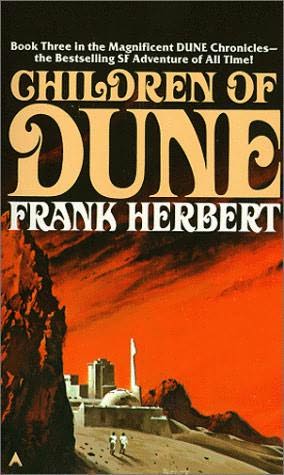
Let's head back to Arrakis shall we? There was very little in the way of literary analysis on the first book of Dune, mostly because I have very little to say about it beyond "this book is so cool and you should read it." To address that deficiancy, this post will analyze both the second and third books in the original dune sextology, and it will also be absolutely saturated with spoilers, so consider yourself forewarned. Last I left off, I was broaching a discussion of Children of Dune, having completely skipped over the second book in the series, Dune Messiah. This was not intentional, though frankly there isn't much to say about the second novel.

Unlike Star Wars, Indiana Jones and Batman, Dune lost some of it's rich complexity when translated to Lego.

I read Dune Messiah in the fall of last year, just a couple months after reading Dune, and it struck me as little more than an extended epilogue to the story which hand already unfolded. It didn't introduce any terribly compelling new characters or convincing threats (Sorry Scytale, you just aren't as cool as your name suggests). Herbert did introduce Ghola cloning technology to the series, but left the concept rather under-explored. That being said, the story does bring added closure to the original, and it brings it very well, beggining with the backlash to Paul's assendency and continuing on to his tragic fate.


I say Children of Dune is a proper sequel, because it runs counter to the first two books in almost every way. The energy dedicated to exploring Paul's ability to predict the future has been redistributed to his children's genetic total recall. Paul's heroic decision to die a mortal death and avert intergalactic Jihad is reconstrued as an act of selfish cowardice. It is revealed that Paul didn't even die at all when he walked off into the desert. Even though the plot twist initially excited me, (for it's hard not to get excited about characters coming back from the dead), I was it left me sad later on, because it's the sort of inorganic story telling Herbert never resorted to in his earlier novels. Admittedly, he does soften the effect of this revelation by repeatedly foreshadowing it and repeatedly stressing that Paul has become a different character, but it still feels like some sort of cheap trick.


Sadly, this is not the most preposterous plot point in Children of Dune. Characters who have been well established as intelligent and wise suddenly suffer from attacks of idiocy, only to display mind boggling insight moments later. Lady Jessica is a prime example. Even though Leto II (Paul's son and the new protagonist) makes her look like an idiot fool in conversation, she somehow mannaged to see past his elaborate feign death and trap him in the desert, even though he is presient and she is not. More messily developed characters like Alia and Duncan (or the Ghola formerly known as Hayt) spiral out of control destroying the few consistent threads of personality which had been previously established. These gaping holes in logic and continuity detract from the wonderfully density Herbert's world displayed in the first book. Even though we have lots of plots twisting around eachother and tangling together like sound trout, they never quite form a worm, or a god-emperor for that matter.

Fortunately, Herbert's philosophical musings remain poetic and potent, and conceptually he continues to engage. I resonate with the book's central message, assuming I correctly understand it to be the sentiment that people are far too eager to submit themselves to the will of heredity. At the same time the Golden Path, Leto II's infallible plan to ensure the survival of the human race, strikes me as an inherently evil concept because it is contingent upon the idea that man must submit to the rule of a single godly tyrant. Indeed, Paul deliberately avoided such a path in the first book for the same reason. Leto denounces this is cowardice, since Paul created a universe that looked for divine justice by becoming a messiah, only to deprive it of such guidence. While I'm willing to concede that Paul's suicide may not have been the best decision for his empire, Leto never provides a convincing explanation as to why tyranny is a better alternative.

In fact, the end of Children of Dune serves as a dark reflection of the original novel's conclusion; the main character storms into his enemies lair, laying waste to all resistance, and coerces the survivors into submission, though for some reason when Leto did it, I felt like evil had won. I think my primariy problem is a lack of motivation. Paul was finally attaining retribution against the Harkonens who had killed his father and brutalized the people of Arrakis, while Leto (who didn't feel human even before merging with worms) is simply killing his demented aunt. The fact that he claimed his sister for a wife and whored her out to his cousin doesn't sit well with me either.

On the pluse side, Leto is primed to be a brilliant villian in God Emperor of Dune, though I think it will be a good long while before I head back to Arrakis.

Sunday, August 30, 2009

Inglorious Basterdry

I can't really tell if I am really a fan of Quentin Tarantino.

Mostly it's a matter of connotation. He is a cult figure and as such, his fandom has certain cult-like qualities, including a level of devotion I cannot attest to. This devotion does not necessarily constitute unquestionable love and approval of his works, but rather an intense level of interest and auxiliary knowledge. Seeing movies are merely the tip of the cult iceberg, or better yet, they are the coke bottles that fall from the sky around which the fandoms form. The bulk of the cult experience lies in learning the lore of the filmmaker and the process which creates his movies. Their inspirations, references; all the little stuff casual audiences miss. I can't claim to that level of familiarity for Tarantino, even though I have seen Reservoir Dogs, Pulp Fiction, From Dusk Til Dawn, Jackie Brown, Kill Bill, Death Proof, and now Inglorious Basterds as well.

Consequently, I'm not sure I can say I am fan of Tarantino even when convoluted cult implications aren't an issue. I don't want to tell you that Basterds is a bad movie, because it isn't. It is extremely entertaining and mostly enjoyable while you watch it. But somewhere between the credits and the drive home, the experience knotted and twisted in my stomach, crystallizing into a bezoar that squelched up all the joy from my watching, and reminded me of everything that annoys me about the writer-director-auteur. And yet, the film has changed on me again; there is a sick brilliance to the whiplash the movie induces. It brings crass, violent pulp to a higher level while simultaneously sinking to new lows of tremendous vileness.

To be completely fair, my biggest complaint with Inglorious Basterds is a personal gripe: The actual film did not reflect the film I saw in the commercials and wanted to see in theaters: a faster paced, less poignaint, more character driven affair. After I saw the real thing, what I wanted became much clearer to me: a Magnificent Seven or even anime styled approach to the Basterds roster, with each member of the ensemble having a distinct over-the-top personality and combat speciality that would play off the others. There were hints of that movie in the one I saw, but somewhere along the lines, the Basterds team of about ten got whittled down to three personalities: Donny 'The Bear Jew' Donnowitz (Eli Roth); who kills nazis with a baseball bat, Hugo Stiglitz; a German officer turned Nazi killing psychopath, and Aldo Raine; the loud-mouthed, scalp-collecting, Tennessean leader of the Basterds, who is brilliantly played by Brad Pitt. Simply listening to him talk is a treat, and his lines are easily the best in the movie. The rest of the Basterds are entirely forgettable.


The movie has some other good characters, but only Christopher Waltz's Hans Landa "The Jewhunter" feels like he belongs in the same story, serving as the only adversary who feels adequately evil for the Basterd's brutality. Hitler seems more like a fussy man-child than an evil tyrant, while the rest of the upper Third Reich only get cameos. While Waltz does an excellent job at making Landa look menacing, his character's chilling presence does not stem from a unique personality or style (as is the case with truly memorable villains like Anton Chigur, Sephiroth, Darth Vader and The Joker) but rather from a series of impossibly tense yet ridiculously drawn out conversations. The film's opening scene, a confrontation between Landa and a dairy farmer hiding Jews under his floor boards; is a prime example. Tarantino stretches five minutes worth of dialogue into what feels like fifteen minutes with all sorts of artsy cuts and turns of phrase that aren't so much clever (no 'Royales with Cheese' or 'was that a miracle?'-caliber chats to be had here) as they are obnoxiously passive-aggressive ("Mind if I have a glass of milk?" "Mind if I smoke my pipe?" "Mind if I ask you eighty questions to which I already know the answer?"). It is effective at cultivating suspense, but I also got so impatient waiting for the climax that I started to get bored.


The entire film, which is divided into five chapters, follows a similar dramatic arc. Rather than focusing on the exploits and personalities of the Basterds, the movie builds toward a climatic showdown at the premiere of the German propaganda film 'pride of a nation.' This subplot is centered around the revenge of Shoshanna (Melanie Laurent) , a Jewish girl who escaped Landa's massacre of her family in the opening scene. Sometime after the deployment of the Basterds she has become a theater owner in Paris, and while changing the letters on the marquis one evening, she catches the eye of Schutze Fredrick Zoller; a young german war hero who just happens to be the star of the forthcoming propaganda film "A Nation's Pride." Hoping to score points with Shoshanna, Fredrick convinces propaganda minister Goebles to host the premiere at her theatre. From there, the movie details Shoshanna's and the Basterds independent plots to use the premiere as an ambush against the Nazi high command.

Both of these plots run concurrently to each other well enough, but I kept waiting for them to intersect, and for me that moment never happened. I was watching two entertaining, but very different movies. Melanie Laurent does a wonderful job of bringing real emotional force to Shoshanna's vengeful ambitions; so much so that it feels a bit too serious for the Basterd's brutal antics. On the plus side, Shoshanna may be the best female character Tarantino has ever rendered. But the emotional solemness of her revenge-turned tragic romance made it difficult for me to take the film as lightly as I'd like to. Diane Kruger also gives a noteworthy performance as Birdget Von Hammersmark, a turn-coat kraut movie-star who helps the Basterds get into the premiere, and fits right in with the film I expected; A superficial creature who speaks in slightly exaggerated German, seamlessly shifts gears between cunning, cruelty and charm, and shows up at the German premiere in a high healed leg cast.

Interestingly, the only common thread between these two different films represented by these two different women are little details reminiscent of fairy tails. Symbolic items like lost shows and glasses of milk, acts of medieval violence like bludgeoning and scalping, and ill-fated romances where both parties are beauty and beast. Yet these little subplots and details and minutiae driven dialogue produce an experience that feels thoroughly fussed about and fucked with. It is obvious that Tarantino does not want his self-proclaimed masterpiece to be summed up by a single emotion or trite moral message, but he seems so wary of such a fate that he fights against any interpretation at all save for his own. Ultimately, we are watching a mind consume itself with grandiose ambition through the lens of fiction.

In conclusion, I'm still not completely sure about how feel about Inglorious Basterds. It a holy grail for cult fans; a puzzle begging to be picked apart, argued about and reassembled endlessly. Casual audiences with a taste for blood and violence may also enjoy themselves if they can turn off their mental and emotional compasses, for they will not have the energy to navigate the maze of strange implication embedded within the narrative. If you are a casual fan of Tarantino's films, you owe it to yourself to check it out, Just don't hold it against me if you feel dirty afterwords.