Monday, April 6, 2009

Odd Omens

As promised, this post will bring some closure to my earlier discussion of Neil Gaiman. I realize the last entry was rather light on critical insight, and I have endeavored to compensate with this post, but I'm afraid there's still a fair bit about me in here as well.

Just as I was not initially taken with Sandman, Gaiman's status as literary idol is a far cry from my first impression of him, which was half-formed during my first attempt to read Good Omens.


I say half-formed because Gaiman was not the sole creator of Omens: It's a apocalyptic, comedic affair that was co-authored with Terry Pratchet of Disc World fame, and my fondness for that series was the angle I approached Omens from. For those unfamiliar with Disc World, I like to describe it as fantasy done Douglas Adams style. If you are unfamiliar with Adams and the Hichhiker series: Don't panic! Simply exit the blog in a calm yet expedient manner, read Hitchhiker's Guide to the Galaxy, and everything will remain mostly harmless. Otherwise I'll make with the Vogon poetry.

/End ADD.exe: Omen's was enjoyable enough to begin with, but it began to wear on me terribly. Comedy is much easier to digest intellectually than drama but it's also much easier to walk away from, especially when its presented in ~300 pages of text as opposed to a performance you can just watch. Even when the fate of the world is hanging in balance of plots outcome, as is the case with Good Omens, you still know everything will end in laughter. Without any kind of emotional risk, the novelty of the jokes are the only hook for readers. Admittedly, this is usually how comedy works, but considering how ripe religion is for ridicule, most of the gags used are 'easy' enough that they seem to write themselves.

So Gaiman and Pratchet try to keep things fresh by going absolutely nuts. It seems like they threw every absurd character and awkward scenario into the plot pot, producing a tangeled stew of tangential madness. I think it was all about the fun as opposed to the craft, which is actually a good way to approach craft. They knew that no editor on God's could stand a chance against their combined insanity. Reading the result is like trying to follow a conversation between school girls as it gets swept up by some verbal Speed Force and enters the realm of precognition, where one is already "Omigawding" at what the other is about to say. Anyone whose has participated in such an exchange knows they can be exhilarating just as well as everyone whose has tried to follow them from the outside knows they can be profoundly alienating. I trust that High School has provided most of us with both experiences.

I happened to read the book during those dark days of adolescence, where I was uniquely tormented and miserable just like everyone else, so finding that same cliquish atmosphere within the fiction was thoroughly frustrating. There is no clear evidence of such an exclusive agenda within the story, because it was not intentional. It was like the text was being haunted by some phantom in-crowd which existed beyond the margin. This reaction is as impressive as it is pathetic. Anyone can be ostracized by other people. Being rejected by your own imagination takes a rare gift.

The inside-joke I was missing is that Crowley the Demon is standing in for Gaiman, and Aziraphale the Angel is a proxy for Pratchet. An intelligent casual reader may guess that from the beginning, but actually appreciating the subtle interplay between the two needs requires one to have read enough of each author's work in order to be familiar with the people behind the prose. Once you've reached that level of understanding, the conversational nature is a boon to the story because you feel like you could participate in it if the opportunity presented itself. You're one of the cool kids. Such familiarity also provides the reader with additional incentive to see the story all the way through. Who care's if there's nothing at risk? You know the guys involved!

This "inside crowd" sort of fiction is always a double-edged sword, and from an analytical standpoint, it's a very interesting variation on the Casual vs. Dedicated reader dialectic. In earlier posts, I've expressed, or at least implied the opinion that keeping things casual and inclusive is generally the best course of action. I know that probably seems hypocritical in the context of a blog post riddled with links to obscure references, but you'll notice that I also link to many relevant wikipedia articles that will help clarify my ravings. Furthermore, I frequently indulge in such hypocrisy because it's the only way I can deal with the unique strain my gift exerts on my mind.

A blog also differs from a book in many important ways. Conceptually, the act of publishing a story can be considered an invitation of sorts. If you approach the book with that sort of expectation, only to be confronted with some sort of exclusion, it's supremely off-putting. Many genres of polemic fiction defeat themselves in such a way. The author intends to solve one of the world's great problems by inspiring people with their words...only to alienate readers by condemning them as the root of the problem.

I understand that Good Omens was very well received as books go, and I believe this was because it was entertaining on two different levels. As the Simpson's has proven from over a decade now, easy and plentiful is a safe and profitable approach to humor, and Good Omen's follows the formula to produce a comparable level of appeal. On the other end of the spectrum, diehard fans have the satisfaction of watching their favorite author's bicker as angel and demon, producing a buddy comedy that plays out like an extended good angel bad angel sketch. Since I skewed in the middle of these two intended audiences, I was left out in the cold.

Now that I am more familair with the creatores, lots of little gags have come back to me, and one scene in particular captures the spirit of their duality effectively well. At one point, the pair needs to cover some ground, so Crowley conjures a sleek looking sports car (an act of superficiality suitable for a preening demon and astheticist dreamlord alike), only to have Aziraphael adorn it with hideous tartan luggage straps; a representation of humble functionality befittingan angel that also hints at Pratchet's fetish for luggage.

The reason that I bring this up with regards to Gaiman is that all of his stories have this semi-metafictional mutlilayered quality to them. Sandman is particularly appealing to writers because it is a collection of stories about stories. An epic about epics. The same is true of American Gods and to a lesser extent, Stardust as well. The Graveyard Book is enjoyable by itself, but all the more richer when one realizes it's a variation on Kipling's Jungle Book. I haven't read or seen Coraline yet (both movie and book are on my fictional to-do list), but from what I hear, it's engaging to children and absolutely terrifying for parents.

Ultimately, story-tellers are Gaiman's intended in-crowd. According to the writing workshops I've had in college, neither critics nor audiences are supposed to enjoy stories about stories, though you wouldn't know it from the opulent introductions penned by respected authors that preface each volume of Sandman. I'm not sure if that says more about the teachers I've had, or Gaiman's writing, but one day, I hope to beat the same odds.

Mr. Sandman

Frequent readers have probably realized this already, and if not, now is as good a time as any to come clean: I am an arrogant bastard. I mean here I am, starting a post about somebody else with a paragraph about myself. Again. With respect to most things I am insecure, but I have tremendous confidence in my creative abilities. It is the very core of my ego, and it has given rise to a terrible involuntary tendency: I immediately deconstruct every story I encounter down to its base premise, and if I find its ingenuity wanting, I am dismissive of it. Even worse, when I encounter works of fiction that genuinely impress, the voices within shriek "If only we thought of this first so you could do it better!" rather than acknowledging obvious virtues and striving to learn from them. Such is the cost of conceit: arrogance preserving ignorance and pride crippling pursuits to realize potential.

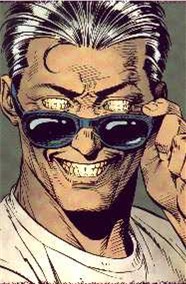
The various works of Neil Gaiman have all profoundly invoked this latter response in me. One story in particular filled me with so much covetous energy that my pride finally collapsed under its weight, forcing the revelation that I could learn a lot by earnestly examining what he did differently than I would and why. In every respect, this has been my way with the world; arriving at the simplest solution after walking the weirdest road to get there. The work which led me to this non-epiphany was none other than Gaiman's comic masterpiece: Sandman. I found a phantom mentor in the details of Morpheus's dark odyssey and by the end of the epic, Gaiman had established himself as one of my literary idols. That's him to the right. Isn't he dreamy? Do, do you get it? Because Morpheus is lord of dreams and... God I really should be shot for that one.

My girlfriend Grace has a truly awe-inspiring gift. She can finding missing pieces of peoples' souls in stories they have not read yet. The first volume of Sandman was just one of many life-altering works of fiction she introduced me to.

Unlike most of the stories she showed me, I did not like Sandman at first. Despite forwards and prologues intended to ease readers into the experience, the plot felt disconcertingly vague. Though far from straightforward, the first story arc, where Morpheus Lord of Dreams (left) is freed from decades of imprisonment and attempts to recover his tools is conceptually simple enough, yet I found myself re-reading passages to make sure I got them 'right' as if I would be tested on them. With saintly patience, Grace urged me on to the second volume, and once I hit the 'cereal convention' I was hooked. I finished the remaining nine volumes in a month and a couple associated spin-offs since the summer as well.

Season of Mists (volume four) was where I really went rabid about the series. If you plan on reading the series, I'd suggest you skip this paragraph, because I consider the premise of this volume to be a tremendous spoiler, but if you're planning on giving the series a pass, hopefully the example will change your mind: Circumstances force Morpheus to ask Lucifer for a favor, even though the former had gravely insulted the latter earlier in the story. So Lucifer literally gives him Hell. He releases all the souls imprisoned, and relieves his demonic legions from duty, and leaves Morpehus to deal with a parade of deities and cosmic entities who all want to stake their claim on the underworld. Mythologies from all over the world intertwine at the afterlife, and they all make different case
s for ownership through threats, bribes and appeals for mercy.

The overarching narrative almost always features this sort of blending. Mortals cross into the realm of dreams, and dreams stride into reality. Morpheus frequently meets with his siblings; all personifications of universal constants like Death, Desire and Destiny, (there's a theme here) known as Endless. And these are all based on the primary plot-arc, which Gaiman frequently suspends to indulges his tangential whims. These little detours are exceedingly bizzaire, describing the death-wish of a forgotten DC Comic character who was obscure to begin with, or offering visions of what the world would be like if humans were ruled by cats. Usually these diversions are interesting and breif enough that they don't disturb the story line, though the arc in 'A Game of You' (volume five); where Gaiman tries to make a thoroughly uninteresting character more interesting through casual psychoanalysis and feminist mysticism; is pretty terrible. It's a crystalization of his worst qualities: pretention, thematic vagueness, and strangeness for the sake of strangeness. I know a few of the collected volumes are arranged differently than their publishing order, so that may be a factor.

Once again, the natural fractures of the comic form makes it the perfect media to convey long, complicated, and involving stories. The episodic release schedule makes the narrative breaks seem less arbitrary, and it also slows the pace, creating a greater sense of scale and allowing readers to consider each aspect of the plot more carefully. Even though I consumed the series all at once, my experience of it continues and grows richer
as I discover all the different aspects of folk lore it incorporated. For instance, I had no idea that Gaiman's Corinthian was based on an actual legend about a dream god's eating peoples eyes, but I learned as much through a folklore class the following quarter.


Comics also have pictures, and they play an important part in Sandman. For starters, a lot things which happen in the story simply translate better through visual channels. And while most graphic novels are drawn by a single artist, Morpheus and co. have been drawn by a number of different talents, each bringing their unique touch and art style to the experience. Volumes 9 & 10 display the most impressive range of variation, moving from sharp, almost cubist aesthetics, to detailed watercolor-like style, to traditional comic styles. You might think this would be visually exhausting, but the art remains consistent for a given chapter or story, so it's easy enough to follow. I frequently found myself wondering what interpretations from other artists might look like. All the change also serves to emphasize the elements which remain constant, like character specific speech bubbles. Dream always speaks in white text against a black bubble, fitting for a nocturnal figure, while Delirium's text is squigly and adorned with rainbows.

As much as I want to be the Daniel to Gaiman's Morpheus (alternate links I considered for that were "Psuedo-spoiler", and "Things That Sound Gay"), I can't say I love Gaiman's writing without saying I hate it as well. Part of it is that damn pride I began with. Part of it is that his approach to story telling seems so similar to that I wish to develop, that the difference which remains has been compressed to a needle sharp kernal of not-exactly rightness. It's like an OCD person being confronted with a row of pictures that are all perfectly straight save one, and then telling them they can't correct it. There's more to it than that, but I've left it for the next post. Look back for it soon.

Thursday, March 5, 2009

Watching the Watchmen

It has been forever and I apologize, but a new post has finally arrived, along with some general changes to the Sarcasmancy banner. I will strive to post more consistently in this coming quarter, even in the face of academic trials and personal crises. You also may notice a few more pictures in future posts, like this one here:


On March 5th, at the Steven Jay Ross theater I had the privilege of attending a preview for a little flick called Watchman. You probably don't believe me, and I can't blame you seeing how the movie's been out for weeks and I'm just talking about it now. The intermingling days have been a deluge of deadlines, examinations and group projects on WoW which required extensive study.

The production values at work in this film are flat-out amazing. Every major character, and most of the minor ones as well (like newstand guy and comic book kid), are attired according to the comic book's odd orange, purple, green color scheme down to their last button. Some people have groused over the changes to Night Owl II and Silk Spectre II costumes, but they both look sexier and more practical on screen than they did in the ink.

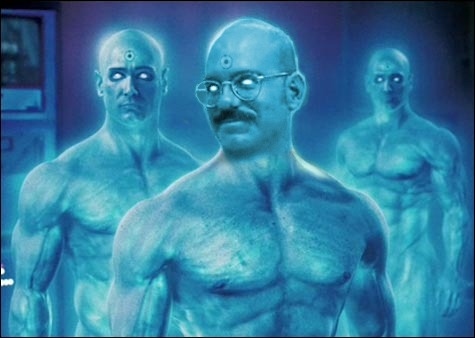
The casting is mostly strong. Edward Blake is amazing as The Comedian, and Carla Gugino displayed an impressive range as Sally Jupiter. Malin Ackerman was stretched more than a little too thin playing Laurie Jupiter, though the character sort of begs for over-acting, and she looks great naked, (though the sex scene is still ridiculously awkward). I personally loved Billy Crudup's take on Doc Manhattan. His soft spoken nature made him far more impressive than the deep, cold monotone the comic led everyone to expect. I can see how some people might feel that it made him too sympathetic, or even too vulnerable for the role, but honestly things could have been much worse:


I find it kinda funny, that lots of critics are criticizing Synder's adaptation for being too faithful to the graphic novel even though many of them backed up Alan Moore's claims of it being 'unfilmable'. Their complaints do not prescribe stylistic adjustments either, but outright objections about the source material. Some complain that politics are adolescent and tediously exaggerated. Others feel the plot is pretentious and needlessly convoluted. Guess what folks? Allan Moore has done this before. Snyder could have afforded to be a little bolder here and there, but the idea of a domesticated, mass-marketable Watchmen is a frightening prospect to a lot of people, and for good reason.

I think William Hoy and Zack Snyder recieved too little credit where editting is concerned. They mannaged to trim most of the fluff from the story and tremendously simplified its ending, which involved a green, tencacled, vagina-eyed monstrousity; a device I always suspected Moore implemented just to poke fun at the way comics escalate. In each volume, plots tend to become more convoluted, bizaire in correspondence with their broadening scale. At first you're saving banks from thugs, then nations from nazis, then planets from aliens, then universes from trans-dimensional disasters that encroach upon the metafictional.

Anyway, instead of whining about how each scene copies those in the comic, or tittering at how much screen time Doctor Manhattan's big blue dong has, it would be nice to see more critics addressing the absurd amount of superfluous violence Snyder injects into the presentation.

Much as I hate to admit it, The Batman may be to blame for this one. Dark Knight was violent. Where PG-13 ratings are concerned it pushed some serious boundaries, and I walked out of the theater predicting a parental backlash. I was relieved to be wrong, because everything between Ledger's pencil trick and Glasgow Smile served a purpose; developing Nollan's darker and more realistic take on Bats. It was also done with intelligence and decency, honoring one of the oldest traditions in the comic industry: It left the blood in the gutter. This practice exiles gruesome acts to the spaces between the pictures, allowing audiences to come up with their own explanations and interpretations of the macabre. I learned all this from Scott McCloud, and you can too if you pick up his excellent book, Understanding Comics, which is one of the few works of contemporary comic-theory available, and the best I have read to date.

Funny thing is, while Watchman is also all about making superhero vigilantism realistic, the spectacular and explicit presentation of it's violence (rife with slick slow-mo and over the top sound effects) serves to establish the exact opposite effect. The ridiculously violent fights feel more like those found in Marvel's flicks and that surreality distances audiences from the heavy themes at work in the script, despite it's relentlessly dark posturing.

Once again, it's a matter of fracture. The tendency in film, by design, is to present audiences with an experience that is as fluid and streamlined as possible, while comics bombard audiences with fractures; from issue, to page, to pannel, to text box or speach bubble, few media are as inherently fragmented as comics. This gives artists a number of channels to choose from when engaging their audience. Watchman was celebrated as a graphic novel, and is favorably compared to it's cinema counterpart for it's ability to pair grim suggestion with stark images of violence. And just as rain water renders war memorials unintelligible by filling in their inscriptions, Snyder wipes away the visual subtlety of Watchman's story by smearing Gibbon's carefully drawn lines with extra blood. Great, now I sound like a page out of Rorschach's journal. And possibly an alarmist to boot.

Understand, that I am a hotblooded young man who likes his steaks bloody, his entertainment violent and his freedom of speech loud. The mantel of Schoolmarm is not one I am eager to adopt. It's rather at odds with the rebellious artist persona I'm trying to cultivate here. Though in all honestly, the movie is too fucking violent. It's like Snyder found the laziest possible way to make the movie as 'challenging' to watch as the comic was to read, except one's stomach is tried as opposed to his intellect. Just a few cuts here (Buzzsaw. Prison Cell.) and there (Rorschach. Pedophile. Cleaver.) would have made it much easier to watch and nobody would have gone wanting for blood at the end of the day.

In closing, I would like to mention I have joined the ranks of the Biased Video Gamer Blog, an up-and-coming site featuring all sorts of gaming goodness, including links to amusing game videos and reviews including a piece on FEAR 2 written by yours-truly. There will be more where that came from as well! I will also continue to cover games here at Sarcasmancy on a fairly regular basis. The next post will be sooner coming than this one was, I promise you.

Thursday, February 26, 2009

A New Challenger Approaches!

Throughout the past couple of posts, I've been going on and on about the immersive potential of structurally fractured narratives, yet I haven't directly discussed any serialized media. As much as I love me some irony, this is an oversight which cannot stand. The next few posts are going to be about comics, television (including manga and anime respectively), and maybe some web series' as well. Lots of exciting things happening in these regions, and they need to be talked about.

Before we venture to these new and exciting regions, I'd like to offer my thoughts on Street Fighter IV, as it provides us with a topical opportunity to discuss the most serialized genre of video games: The 2D fighter. I haven't talked much about the potential pitfalls of narrative fractures and I can't think of a better example to prove my point. Let's begin with a personal history.

I became a serious gamer a bit later than most of my millenial contemporaries, (about 9 or 10 as opposed to 5 or 6) on account of good parenting. You see, I still hadn't figured out the whole "how to read" thing, and Mom and Dad didn't see how sitting in front of a television screen for hours on end would help matters. They already had to limit my time with the Gameboy Grandma gave me when I was 7. Ironically, I really began to blossom as a reader around the same time they caved and got me a Super Nintendo for Christmas. Whether there's a correlation is a matter for another post. Seriously. Remind me.

Anyway, my delay came with one grave cost: I missed the early-to-mid 90's fighting game boom, and I started too late to develop the insane hand eye coordination necessary to be competitive in the genre. Somehow I've managed to live on. This was part of my parent's plan of course. The media was rife with the horrors of Mortal Kombat; GTA of its day, though I never found it that appealing to begin with. My reading skills were still too feeble to appreciate the edginess of spelling 'Combat' with a 'K'.

I was always firmly in the Street Fighter II camp, allured by its anime-aesthetic, and the most iconic videogame attack of all time. I'd always beg for a turn at friends' houses, only to be laid to waste in a matter of seconds. By the time I had a SNES of my own, the entire 2-d fighting game scene was dwindling with the emergence of consoles with 3D capabilities, and Street Fighter II had lost most of it's mainstream appeal since Capcom saturated the market with a host of different editions of the game. They tried to revive interest in the series by introducing a new roster of characters in Street Fighter 3, but this pissed off players who had spent years training with the original characters, the vast majority of which were inexplicably cut. Capcom attempted to make amends by returning some of the cut characters with two more editions of SFIII. It didn't really work. The Street Fighter Alpha series found a small but dedicated following, though most mainstream fighter's got their fix with Capcom's cross over games, which really are incredible.

The age of street fighter seemed to have ended. Then this emerged.

I recognized it for what it is, but I still can't remember the last time I had been more excited about a sequel. Oh wait, yeah I can. Anyway, as much as I hoped the game would have the trailer's painted look I was afraid they would try to take the series to 3D again like they did with SF EX (which isn't even worth linking). Fortunately, Capcom decided to stick with 2D gameplay, while giving the characters and backgrounds detailed 3D characters models. The result is pretty, but it also looks a lot like SF2 updated with modern animation and HD graphics, which is funny because that already happened.

So how does it play? The phrase "returning the series to its roots" was thrown around a lot during the previews, and it's consistent with my experiences, right down to the old school throw-your-controller-against-the-wall difficulty. The CPU routinely kicks my ass on "Easy." Granted, I was trained in the weakest style of arcade kung fu, and just recently graduated to a style which is only slightly less embarassing. Still, there may be hope for me yet in the form of Focus Attacks; one of the two new mechanics Capcom introduced to the gameplay. Simply explained, Focus Attacks are easy to use all-purpose counter attacks. The other feature, known as the Revenge Gauge, seems to be a more technical version of the Special Attack Gauge (which is also still present), but I have yet to make heads or tails of it.

"But what of the story!?" you ask? I give you a flat stare and reply dryly, "What indeed."

Like every other game in the series, (hell pretty much every game in the genre), Street Fighter IV is centered around an international fighting tournament. Chronologically, I believe it occurs after SFII and before SFIII but I'm not sure. When I combed wikipedia for answers, I got a headache. The former's story has been told so many times, I don't know which one to go on. Normally I'd go with what's in the game, but to my knowledge, the only story telling that occurs in game are the quips your character makes to defeated opponents. Yet I know there is all this stuff about some evil organization with, and fighters harnessing dark energy floating somewhere in the periphery. Maybe it was in the game's manual somewhere? SFIV is slightly better. Each run through arcade mode begins and ends with these really nicely drawn anime scenes, but out of context, they make no damn sense. The scene that begins Abel's 'campaign' is a perfect example. This guy is brand new to the game, and not only does he have a huge amount of history, he's found a way to forget all of it! Are we supposed to have some idea who he is? How does he know Chun Li?

Even if there weren't so many different versions of the over-arching story, Street Fighter IV would still have to make sense of the fighting game's fundamental fracture: The Character Select Screen. Like all fractures, there's a lot of potential there, and Capcom even realizes some of it. Each character has a different reason for entering in the tournament, and a specific rival to take out. But for some reason, every character ends up in the same final boute against a semi-nude genetic monstrosity with a ying yang orb for an abdomen in a secret lab. Um. What? Is this still part of the tournament? Are the judges there with the evil scientists? I mean, SFII had the same nonsensically bottle-necked final fight, but at least M. Bison looked human. By the way, why is nobody surprised to find him back from the dead?

Look, I know it's a video game where people throw fire balls with their bare hands, and Yoga teaches you how to stretch your arms like Mr. Fantastic, but that doesn't mean you can't be coherent. I can suspend disbelief and ignore logic only so much, and Street Fighter IV crosses that line left and right. But if you're looking for a hardcore fighting game, you won't walk away disappointed.

Tuesday, February 24, 2009

It is Written

I originally intended to have this up before Oscar night, but as usual, I'm behind schedule.

Slumdog Millionaire is a romance about a boy who goes on Who Wants To Be A Millionaire? in India. It also won several academy awards this past weekend, including a well deserved Best Picture of the Year. If you haven't seen the movie yet, this is your stop. Seriously, thanks for reading and see you next post. You already know more about the film than I did when I saw it, and learning more will only diminish your experience of it. The film's best quality, in true underdog fashion, is how it comes out of nowhere and wins you over before you know what happened. And oh yeah, there is also information some would consider spoilers.

As a rule, I despise modern romances because they tend to embrace the story teller's greatest most loathsome foe: The Formula. Every story has a structure, and there are only so many narrative structures one can take, so the true virtue of the craft lies in the telling as opposed to what is told. Therefore in an inherently predictable genre like the romance (which almost always sticks to the first of two traditional endings: A) They hook up or B) they don't) a writer should constantly strive for innovation and take risks to keep the audience interested. The Formula supplants such noble endeavors in the interest of holding on to the most profitable common denominator, giving rise to an industry where "Wow, I'm a cute guy who still lives at home in his 30s" is a premise that warrants a remake.

Like Love Actually and 50 First Dates, two fine romances that mannage to escape The Grim Fate of the Formula, Slumdog Millionaire is actually a collection of stories by design. Instead of being told the story of how Jamal found love and came away a millionaire, you are given the story behind each answer leading to his ultimate triumph.

As Jamal bounces between his past, the game show and his trial in the inspector's office, we are kept guessing about what will happen next, and more importantly what will happen in between. Even more than in The Dark Knight, the fractures in the film's presentation serve to bring us deeper into the movie, by comparing Jamal's experiences with our own. If you were to 'unwind' the plot according to it's strict chronology, it's structure would be far more predictable and this engaging speculative element would be lost completely. This trick of scrambling the sequence of events is hardly new, but very few films have used it to such great effect. We would simply assume, as we do with all straightforward but pre-edited, narratives, that what happens between one scene and another is edited because it is unimportant; it is the time the characters' spend riding buses or in the bathroom. Then again, one of the movies most memorable vignettes takes place in a bathroom of sorts. The net effect is that we assume there is much more to know about Jamal's life, but understand that for brevity's sake, he is only giving us the most crucial details.

By the time the plot arc becomes apparent, (which for me was around the time Jamal and Salim took the skyscraper dive), it has already swept you along like a wave, depositing you amongst Jamal's cheering fans in the Millionaire stadium (who are all curiously absent after the show's over when he's waiting for Latika in the station). That being said, some may be put off by the "happily ever after" when it finally arrives. When Contrasted against some of the film's earlier harsh sequences, it can feel particularly manufactured, simply because real life doesn't spike between those poles so drastically, except in the most extraordinary circumstances. Then again, those exceptions are the ones people tell stories about, and Slumdog Millionaire tells a story about those stories.

Despite my tirade against the derivative evil of formulas, I am something of a traditionalist, and as much as I hate modern romances, I must confess that my favorite movies are classic romances. Movies that move you through tears to laughter and back again, with violence and tenderness interspersed, finally arriving at a finish appropriate for the tale told. And though it might be simple, what ending could be more appropriate for Jamal's experiences than a happy one?

Since only those of you who have seen the movie should be reading this, I don't need to tell you how fantastic the cinematography, the soundtrack and acting are, though I was especially fond of the shots of the kids running through the shanty town, the use of MIA's Paper Planes on the train, and Freida Pinto's portrayal of Latika in the film respectively.

Monday, February 16, 2009

A Dark Knight Indeed pt. 2

As promised, here is the second half of The Dark Knight. Be warned, it’s another long one despite my best efforts.

To understand why the Dark Knight is so important, we have to return to the concept of breakage, and its significance in the comic medium. The fragmented presentation of comic books: the gaps between boxes on a page, the disjuncture between text and pictures, between each issue in a series: is it’s greatest point of potential. The breakages allows readers to fill in the gaps on their own terms, drawing them into the world more deeply than other media, for while Film utilizes the same sort of closure, the transition between one cell to the other happens too quickly and purposefully for us to be consciously aware of it.

To a limited extent, The Dark Knight translates this same fractured quality into the film medium. Indeed, the structure of TDK’s plot shares more in common with a typical limited series than it does with other comic book movies, including Batman Begins. Further more, the short quick cuts in fight sequences resemble the blow by box composition of a comic book fight. And do you remember that huge panorama as Bats prepared to jump off the skyscraper in Hong Kong? That was totally a centerfold. I believe this sort of fractured presentation will become increasingly popular in the future, (especially when you consider that the internet features a comparable type of fracture to comics, with its windows and mix of text and images) and given the widespread popularity of The Dark Knight, it will serve as the most effective vehicle to influence other film-makers

In addition to its technical aspects, both the acting and the casting in The Dark Knight are superb. Michael Caine, Morgan Freeman and Gary Oldman don’t break new ground but they give great performances. Maggie Gyllenhall is every ounce the ‘Rachael Dawes’ Katie Holmes was and more. I wish Nolan and Goyer knew how to write women better so she could have had more screen time, and more interesting things to do than falling out of windows. Aaron Eckhart is also at the top of his game, and he really brings a new level of depth and significance to the Harvey Dent/Two-Face character. It’s a shame that his performance has been so over-shadowed, and that he spent the second half of the film with that ridiculous make-up which was more ‘Pirates of the Caribbean’ than it was horrifying psychopath.

My critique of Bale’s Batman can be summed up best by this video clip. Before the next movie roles around, (and you all know it will), I really hope Good Sir Gravelthroat has a chance to hear Kevin Conroy’s voice acting in Batman: The Animated Series. Nobody else will ever balance growl, bellow and brood so beautifully.

Then there is Heath Ledger’s Joker.

Like all great character performances, Ledger makes The Joker instantly familiar and distinctive. His drawn out, strangely affected pronunciation, fraught with cheek licks and lip smacks is as chilling distinctive as Hannible Lecter’s reptilian mannerisms, or even Darth Vader’s asthmatic deep breathing. But what really makes him impressive is how he evolved the character. The ever-changing “let’s put a smile on that face” story is a brilliant homage to the character’s inconsistent origin in the comics.

In short, Ledger gave the most memorable and influential performance of the year, and he should be up for Best Actor as opposed to Best Supporting. I realize that the full title of the awards is “Best Actor in a Leading Role” and “Best Actor in A Supporting Role,” but that is not how people refer to them, or how they are thought of. Best Actor is considered the most powerful male performance of the season. By contrast, Best Supporting Actor is thought of as the best nonessential role that elevates quality of the film. And I actually believe that this arrangement is completely appropriate.

The problem is that the Academy is developing a habit of mislabeling antagonists as ‘Supporting Roles’ when they want to honor two leading performances. In some cases, this is an appropriate classification. But can there be any doubt as to whether Anton Chigurh was a leading role, or if The Dark Knight was as much about The Joker as it was about the titular hero? The academy does it do avoid controversy. It is a lazy, half-assed attempt to appease audiences who would cry foul if their candidate walked away empty-handed and it compromises the critical integrity of the Oscars. Best Supporting is effectively reduced to a runner-up ribbon that cheapens the performances of its recipients, and the guy who walks off with the Best Actor Oscar should be humbled knowing he was spared some of the stiffest competition. Worst of all, actual supporting roles worthy of merit now have no hope of taking home an Oscar.

Then there is the lack of a best picture nom. Honestly, if a movie featuring so much technical innovation, an all star cast and one of the most memorable and influential performances in years can’t even contend, what does it take? From what I have observed in the past, winning a best picture boiled down to two main criteria:
1: You have to be a big budget production that employs half of Hollywood.
2: You have to be a timeless story with universal appeal.

In the past few years however, a few international and independent films have taken home top honors. Films with minimal budget’s and star power which manage to become critics’ darlings, because they prove that film can be more than literature made easy. Consequently they tend to be ‘harder’ to watch and less popular. Don’t worry I’m moving on. Films whose stories fall within the realms of para-literature, (Comic books, Science Fiction, Horror, Fantasy; you know, nerdy shit) straddle these two approaches to Best-Picturedom. Though their themes are broadly accessible, their obscure trappings prevent universal appeal, and they are usually too commercial for the critics to enjoy. Therefore they must satisfy themselves with make-up and special effect awards.

The academy made an exception for The Lord of the Rings Trilogy because A) Tolkien’s work is regarded as the highest example of the fantasy genre and B) the movies’ cast and production values fulfilled criteria 1 several times over. The original Superman movie also managed to take home best picture, because it was the first superhero movie, based on the first super hero. Being the first is worth quite a bit. Having the one of the most memorable score from Hollywood’s best beloved composer didn’t hurt either. Interestingly, I have to admit that music was one area where Dark Knight fell rather flat for me.

Despite that shortcoming though, I couldn’t help but feel that Batman deserved to compete for best picture. Then again, even if he did, I would not want to see him win. You see, Slumdog Millionaire, is the best picture of the year. But I’ll talk about that next time

Monday, February 9, 2009

A Dark Knight Indeed pt. 1

In the interest of full disclosure, I must confess that I believe Batman to be the best superhero ever. As a child I collected his toys, tore around the backyard in a black cape, and occasionally referred to myself as Bruce Wayne. My affection for the character has grown slightly more discrete with age, but it has also grown deeper as I've come to understand him better. Instead of super powers, Batman has serious mental problems. He is not a superior man but a broken one, yet he uses that breakage as a point to draw in strength normal people could not use. Some nitpickers say that doesn't count as a superpower, and that Batman is consequently not a real superhero. But whenever somebody says superhero, the bat symbol comes to mind pretty quick.

That acknowledged, The Dark Knight is the most important superhero movie made so far.

To those who witnessed the release of the original Batman movie, or even the first Spider-man movie, I'm sure this seems like hyperbole. After all, they both broke box office records and made nerdy fanboys out of 'mainstream audiences.' Hell, even Iron Man managed the same trick earlier in the summer: making a well-known 'comicbook character’ into a well-known character, period. Hell of a trick it was too. Tony Stark’s steal alter-ego had grown considerably rusty since his Cold War origins, and Marvel did a bang up job of polishing him into a shiny chrome champion hip to today’s sensibilities. But even after the credits rolled, and Samuel L. Jackson’s Avengers epilogue made all the sidewalk sitters squeal with schoolgirl glee, it was still just a popcorn flick.

The Dark Knight strives to do more with the concept of superhero film. As implied by the new bat-symbol, we are returning to the broken Batman. In fact, the concept of “breakage” is central to the movie’s composition. The story presents us with a number of instances of division by mirror image. To begin with, superheroes are characters fundamentally divided between crime-fighter and alter ego. Bruce Wayne, a shallow cover for the dark knight, is the inverted reflection of Harvey Dent, a white knight who publicly fights crime. Batman the crime-fighter can be similarly contrasted against the Joker, as both are anonymous rule breakers serving opposing interests. This creeping fissure model continues with Harvey’s eventual transformation into Two-Face. This kind of comparison opens the door to a lot of complicated character analysis and some pretty heavy themes.

Naturally, not everybody will like it. Needless to say, those yearning for the whimsy of the Golden Age Batman comics are better off watching the Adam West series: There be no bat-puns or “Holy___’s Batman!” here. But even those who like their caped crusaders fairly hardboiled may be put off by the film’s relentlessly somber tone, as Nolan doesn’t let a minute pass without reminding you how Dark his world is. He never succumbs to the juvenile Underworld-brand of angst that Hot Topic peddles. It’s all genuinely grim, and it can wear you out as a result.

Authentic as the presentation is, the actual message being delivered is rather unsettling. A mainstream movie has never preyed on the fears of terrorism harder. Hell, it’s even in the advertisements.
Fortunately, the Joker is a thoroughly original villain and a refreshing departure from the terrorist archetype. In fact, he’s more like something thought up on /B/ and brought to life: a prospect infinitely more loathesome and terrifying than any islamic extremists. Hell, you could even consider his anonymity to be his super villain power: Batman only manages to beat him by using technology that invades people’s privacy. For me, the “just this once” argument for using the cell-phone sonar was the most chilling scene in the entire movie (though the white-eyed effect was a great homage to the comics). The ending speech about lying to Gotham’s people so they would still have something to believe in gave me a shiver too. The inevitable impotence and corruption of diplomacy, symbolized by Harvey Dent’s transformation to Two-Face, was also a downer. The movie isn’t blatant propaganda though. One walks away with the sense that things are not right, and that the heroes were acting in true desperation as opposed to nationalistic machoism. It bears repeating.

All that writing and I still haven't explained why The Dark Knight is so important. You have to set the stage for these things though. If you bear with me for just one more post- no Dan Brown bullshit- I promise you, I'll get to the point. I'll also offer a general discussion on the academy award, a funny youtube clip embedded right in the blog. No clicking required! Though there will be funny links for the clicking inclined too.