Showing posts with label Fandoms. Show all posts

Sunday, August 30, 2009

Inglorious Basterdry

I can't really tell if I am really a fan of Quentin Tarantino.

Mostly it's a matter of connotation. He is a cult figure and as such, his fandom has certain cult-like qualities, including a level of devotion I cannot attest to. This devotion does not necessarily constitute unquestionable love and approval of his works, but rather an intense level of interest and auxiliary knowledge. Seeing movies are merely the tip of the cult iceberg, or better yet, they are the coke bottles that fall from the sky around which the fandoms form. The bulk of the cult experience lies in learning the lore of the filmmaker and the process which creates his movies. Their inspirations, references; all the little stuff casual audiences miss. I can't claim to that level of familiarity for Tarantino, even though I have seen Reservoir Dogs, Pulp Fiction, From Dusk Til Dawn, Jackie Brown, Kill Bill, Death Proof, and now Inglorious Basterds as well.

Consequently, I'm not sure I can say I am fan of Tarantino even when convoluted cult implications aren't an issue. I don't want to tell you that Basterds is a bad movie, because it isn't. It is extremely entertaining and mostly enjoyable while you watch it. But somewhere between the credits and the drive home, the experience knotted and twisted in my stomach, crystallizing into a bezoar that squelched up all the joy from my watching, and reminded me of everything that annoys me about the writer-director-auteur. And yet, the film has changed on me again; there is a sick brilliance to the whiplash the movie induces. It brings crass, violent pulp to a higher level while simultaneously sinking to new lows of tremendous vileness.

To be completely fair, my biggest complaint with Inglorious Basterds is a personal gripe: The actual film did not reflect the film I saw in the commercials and wanted to see in theaters: a faster paced, less poignaint, more character driven affair. After I saw the real thing, what I wanted became much clearer to me: a Magnificent Seven or even anime styled approach to the Basterds roster, with each member of the ensemble having a distinct over-the-top personality and combat speciality that would play off the others. There were hints of that movie in the one I saw, but somewhere along the lines, the Basterds team of about ten got whittled down to three personalities: Donny 'The Bear Jew' Donnowitz (Eli Roth); who kills nazis with a baseball bat, Hugo Stiglitz; a German officer turned Nazi killing psychopath, and Aldo Raine; the loud-mouthed, scalp-collecting, Tennessean leader of the Basterds, who is brilliantly played by Brad Pitt. Simply listening to him talk is a treat, and his lines are easily the best in the movie. The rest of the Basterds are entirely forgettable.


The movie has some other good characters, but only Christopher Waltz's Hans Landa "The Jewhunter" feels like he belongs in the same story, serving as the only adversary who feels adequately evil for the Basterd's brutality. Hitler seems more like a fussy man-child than an evil tyrant, while the rest of the upper Third Reich only get cameos. While Waltz does an excellent job at making Landa look menacing, his character's chilling presence does not stem from a unique personality or style (as is the case with truly memorable villains like Anton Chigur, Sephiroth, Darth Vader and The Joker) but rather from a series of impossibly tense yet ridiculously drawn out conversations. The film's opening scene, a confrontation between Landa and a dairy farmer hiding Jews under his floor boards; is a prime example. Tarantino stretches five minutes worth of dialogue into what feels like fifteen minutes with all sorts of artsy cuts and turns of phrase that aren't so much clever (no 'Royales with Cheese' or 'was that a miracle?'-caliber chats to be had here) as they are obnoxiously passive-aggressive ("Mind if I have a glass of milk?" "Mind if I smoke my pipe?" "Mind if I ask you eighty questions to which I already know the answer?"). It is effective at cultivating suspense, but I also got so impatient waiting for the climax that I started to get bored.


The entire film, which is divided into five chapters, follows a similar dramatic arc. Rather than focusing on the exploits and personalities of the Basterds, the movie builds toward a climatic showdown at the premiere of the German propaganda film 'pride of a nation.' This subplot is centered around the revenge of Shoshanna (Melanie Laurent) , a Jewish girl who escaped Landa's massacre of her family in the opening scene. Sometime after the deployment of the Basterds she has become a theater owner in Paris, and while changing the letters on the marquis one evening, she catches the eye of Schutze Fredrick Zoller; a young german war hero who just happens to be the star of the forthcoming propaganda film "A Nation's Pride." Hoping to score points with Shoshanna, Fredrick convinces propaganda minister Goebles to host the premiere at her theatre. From there, the movie details Shoshanna's and the Basterds independent plots to use the premiere as an ambush against the Nazi high command.

Both of these plots run concurrently to each other well enough, but I kept waiting for them to intersect, and for me that moment never happened. I was watching two entertaining, but very different movies. Melanie Laurent does a wonderful job of bringing real emotional force to Shoshanna's vengeful ambitions; so much so that it feels a bit too serious for the Basterd's brutal antics. On the plus side, Shoshanna may be the best female character Tarantino has ever rendered. But the emotional solemness of her revenge-turned tragic romance made it difficult for me to take the film as lightly as I'd like to. Diane Kruger also gives a noteworthy performance as Birdget Von Hammersmark, a turn-coat kraut movie-star who helps the Basterds get into the premiere, and fits right in with the film I expected; A superficial creature who speaks in slightly exaggerated German, seamlessly shifts gears between cunning, cruelty and charm, and shows up at the German premiere in a high healed leg cast.

Interestingly, the only common thread between these two different films represented by these two different women are little details reminiscent of fairy tails. Symbolic items like lost shows and glasses of milk, acts of medieval violence like bludgeoning and scalping, and ill-fated romances where both parties are beauty and beast. Yet these little subplots and details and minutiae driven dialogue produce an experience that feels thoroughly fussed about and fucked with. It is obvious that Tarantino does not want his self-proclaimed masterpiece to be summed up by a single emotion or trite moral message, but he seems so wary of such a fate that he fights against any interpretation at all save for his own. Ultimately, we are watching a mind consume itself with grandiose ambition through the lens of fiction.

In conclusion, I'm still not completely sure about how feel about Inglorious Basterds. It a holy grail for cult fans; a puzzle begging to be picked apart, argued about and reassembled endlessly. Casual audiences with a taste for blood and violence may also enjoy themselves if they can turn off their mental and emotional compasses, for they will not have the energy to navigate the maze of strange implication embedded within the narrative. If you are a casual fan of Tarantino's films, you owe it to yourself to check it out, Just don't hold it against me if you feel dirty afterwords.

Monday, May 18, 2009

Bold Going

As usual, I must apologize for my lack of updates. It turns out school requires work and study. I know I keep promising to post on Y: The Last Man but sadly I just haven't had the juice to finish reading it. It's not that the series has turned sour, in fact it has proven itself to be resilient against the strain of incoherence that tends to haunt long running serials, and I have high hopes that it will deliver a strong conclusion, which I would like to discuss with you. Furthermore, I'm afraid I have to revise my promise of weekly Japan's Finest! posts to a monthly model. As much as I love anime and manga, there are other things I want to talk about, and until I can get into better update groove, I'm just going to write on whatever strikes my fancy.

Today I would like to talk about a little film I've managed to see twice over the past week.

It's the best movie I've seen all year, though that's hardly a badge to boast about considering Wolverine is the only other flick I've seen. Some critics are referring to it as "This year's Ironman," which is a more suitable and accurate marvel-based point of reference in terms of both quality and composition. Both films have lots of action, quick dialogue, a sexy technology from the future aesthetic, impressive SFX and excellent casting. At the end of the day, Star Trek beats out Tony Stark because it has a richer cultural legacy to draw on. Don't get me wrong: Ironman is a great superhero and a rich comic anthology, but it really can't compare to Star Trek in terms of cultural impact.

Like most ought-era twenty-somethings, I've seen more of Star Trek: The Next Generation than The Original Series, but I still have a general feel for it thanks to all the pop cultural lint my brain has collected over the years. Most of the time these catch phrases and inside jokes clog practical thought or dissolve my attention span, but whenever Hollywood decides to resurrect a franchise I have no business being familiar with, this minutiae serves as an almost magical link that lets me share in the reboot buzz. I love the drama of that seems to arise in these reawakened fandoms. On the one side, you have an army of cynics and elitists, fearing that what they loved about the show will be lost or tarnished, and in the other corner you have cautious-optimists who are glad to share the experience with a younger generation.

In Star Trek's case, most of this drama was wrapped up in casting concerns. Almost all of my precious little knowledge of The Original Series concerns the characters of the show; a collection of personas, which, through decades of self-deprecation and jokey skits, have become inextricable from the actors that first played them. "The Shat" is a prime example. Then again, by the time I was old enough to start recognizing celebrities and Hollywood personalities, he had already become thoroughly ironic icon; the good humored has-been. In fact, it's hard to imagine it being any other way.


Whatever the past held, the present cast of USS Enterprise is a blend of charisma, chemistry and talent that is a joy to watch. I started getting excited about the movie when I heard that John Cho would be playing Sulu and Simon Pegg would be Scotty. They certainly live up to my hopes, though they could use a bit more screen time in the sequels. I'd never heard of Anton Yelchin but his eager, bright-eyed take on Chekov is relentless charming, even if the Russian w/v gag is a little over-done. My personal favorite was McCoy. Karl Urban does a brilliant job of capturing Bone's warmhearted cynicism and he has some of the best lines in the film. I always thought Zach Quinto was a great villain on Heroes, but he makes an even better Spock. The traditional Vulcan farewell "live long and prosper" has never sounded more like "Fuck you," and when you see the scene you'll understand how that's a good thing. He also has surprisingly potent chemistry with Zoe Saldana's Uhura, whose character is sadly a touch under-realized. Of course, James Tiberius Kirk is the central figure of the story and he gets the best character introduction since Johnny Depp rode a sinking ship into Port Royal.


To be honest I'm a little bit hesitant to examine the plot carefully, because it really was not crafted with close-reading in mind. Like Ironman, the pacing is so tight and quick that one can't escape the sense that something valuable must have been edited out or glossed over in the interest of presenting viewers with a fun easy to understand experience. Such streamlining is essential for crafting fiction, and even more so for popular fiction, but when taken to excess, the plot can end up feeling lifeless and plastic.

Manufactured plots are sadly familiar to Science Fiction. Hypothesis is the heart of the genre, and writers set out to answer questions about our society by altering it in impossible ways. Unlike researchers though, whose conclusions must conform to the results of their experiments to remain ethically and practically viable, authors are free to change or invent any element they like to adjust the final message of their story. Good authors try to make their additions as reasonably logical as possible so their story can remain relevant and valuable to society. The result are incredibly engineered worlds, crowded with specific jargon and complex explanations.

Star Trek, being a modern mythology, follows the classic heroic template, but rather than complicating the Science Fiction, it makes things simpler. Technology is treated like magic, and the emphasis is placed on two men trying to find their path in the world. It is a timeless universal theme, though the plot escapes the stagnation of classic conventions by trading it for the more complex, engineered Sci-fi approach to structure, creating a story that is grand in scale but laser sharp in terms of pacing. The story begins with what could be considered a prologue, followed by time skip and character introduction scene, followed by a second time skip and character introduction, followed by yet another introduction and time skip scene, before finally settling on the main plot arc which only takes about a day or two to reach a resolution.

This kind of chronological hopscotch is risky business, especially when the main plot is based on time travel, because it invites all kinds of plot holes and can hamper character development. Despite a few absurdly convenient plot elements, nothing crucial has been ignored or explained away, and the story survives the vacuum of space. Most impressive though, is the way the film carves it's niche in the greater Star Trek universe. The temporal twist provides a canonically sound and blissfully simple explanation for the reboot through the concept of alternate universes.

I'm happy to hear that the Enterprise's new crew is signed on for two more films. I realize that's standard procedure these days; every film is a potential franchise, but usually this is a detrimental trend. Some films that should simply be left alone suffer multiple sequels in the interest of turning a profit. Star Trek has always been a fictional universe as opposed to an isolated story however, and the end of the film begs for further exploration. There are no cliffhangers or loose threads here, just more fun to be had.

Sunday, April 19, 2009

Japan's Finest: Monster Plagues

Dear readers I have failed you. Despite my promises of weekly anime and manga commentary, there was none to be had. I will endeavor to correct this error with an extra post this week, but the quarter is getting busier, and putting out two posts a week may be a tad over-optimistic. Now I shall address another oversight:

While I initially intended to discuss the difference between Shonen and Shoujo art styles, I realized my last post missed a rather important chapter of anime's assimilation into America's cultural consciousness: The Monster Plagues. From 1998 to around 2003, America was wracked by Japanese monster collecting franchises. Nobody knows advertising and merchandising like the 日本人, particularly because there is a social element to it. Popular fiction is designed with a sort of brand recognition in mind, blending consumerism and cultural consciousness in a way that would send George Lucas to the Sepuku Mat with shame. America's youth got a taste of this with the Power Ranger craze that came in the mid 90's, although the franchise was rebuilt from scratch in the USA for the USA, and merely based on the Japanese concept of Sentai. Even earlier than that, Transformers demonstrated the lucrative potential of using a cartoon to market toys.

You used the Multimedia stone! What...!? Mickey is evolving!


Congratulations! Your Mickey evolved to Pikachu!

The monster plagues are significant because they represent the first time foreign fictional universes were marketed towards children across a broad spectrum of socially interactive media. Disney has been doing cross-marketting for years, threading Saturday morning cartoons through coloring books, breakfast cereals and happy meals, but they were completely out-classed by the monster collecting menaces which emphasized fan interactivity at every corner. The card and video games were set up to require trading while the manga and anime brought the world behind the games to life.

The First Plague

I first learned about 'Pocket Monsters', or pokemon (lower case refers to the critters, uppercase refers to the franchise.) through an advertising video which arrived on my doorstep. I'm not sure if it was connected to my Nintendo Power subscription, or dropped off by some shady division of the JSDF which had profiled me as an easy target, but the tape captivated me immediately, introducing a bright and friendly world populated with adorable, elementally powered creatures just waiting to be collected in shiny metal balls.

I faithfully watched the anime when it came out, which furthered my indoctrination with insidiously catchy marketing jingles that taught me to memorize each one of the 150 critters names. The Anime, which is apparently still running to my great astonishment and slight horror, follows the adventures of Ash Ketchum and series mascot pikachu as they casually foil the plans of incompetent villains known as team rocket, try to catch 'em all and aspire to be "the very best, like no one ever was," (Click at your own risk, there is more singing).

This was all a preamble to the video game of course, which I pre-ordered and devoured upon arrival, eager to show off all my cartoon gained knowledge. The true evil genius behind the pokemon marketing strategy is that a player couldn't catch all the monsters by playing just a single version of the game. Rather, all the games critters were divided between a two versions of the game, and players were required to trade in order to collect all the creatures. Fortunately, a friend in grade school picked out the blue version to my red version, and we slowly mannaged to fill out our entire pokedex.


It was going to see the movie which really did in my parents' patience, prompting my father to point out "This is really sick." And so it is. Beneath the bright colors and adorable creature designs, Pokemon is really quite dark. You play the role of a pre-adolescent delinquent who wanders around assaulting, abducting and brainwashing animals that pose no apparent threat to society, all for the sake of casually pitting them against each other in gladiatorial combat. It was a truth I rejected when my parents first presented it to me, using dog fighting as the real world analogy. It seemed like hyperbolic comparison, but back then I could not articulate where they were crossing the line.

The trouble is, there is no real world reference for Pokemon, because it is a completely fabricated experience. In the real world, you can't transform something evil into something good or even something acceptable through presentation alone. In fact, trying to dress up the facts in a misleading way tends to compound its evil, especially in fields of Law (Hi Mom!) and Science (Hi Dad!). But video games are not reality.

Presentation establishes the laws of fictional universes. Series creator Satoshi Tajiri-Oniwa did not design Pokemon with animal duels in mind, but rather his hobby of collecting insects. Unfortunately, bug collecting is fairly uninteresting as a game because the only possible outcomes would be "You catch the bug!" and "The Bug got away!" In order to spice things up a bit, a rock-paper-scissors style combat system was implemented to add some depth to the creatures being collected, and the game play itself. The game is actually designed very specifically to punish excessive force (If you knock out the pokemon while trying to weaken it, you can't capture it), and to render violence inconsequential through healing items. It's not a formula which would work in real life, which is why its so pleasing as a game.

Fact vs. Fiction


The idea of inconsequential violence is alarming to a lot of people and for good reason: It's a concept which cannot exist in reality. The great fear is that players will start applying their experiences of these fictional places as if they were life lessons. It is not a baseless concern, though it is one that is frequently exaggerated when it can just as easily be overcome with some guidance and self restraint. My parent's realized this, so they let me keep playing but made sure I did other more necessary things at the same time.

My interest in Pokemon waned quickly however, mostly because I exhausted myself trying to navigate an untranslated import copy of Pokemon Gold after catching all 151 of the Red and Blue bastards, but also because I was bothered by the real world parallel that had been drawn between my favorite past-time and animal abuse. I knew bloodlust was not the driving force behind my monster collecting endeavors, but at the same time I didn't know what was. Looking back, I think the potential for discovery was another element in pokemon I found deeply appealing. Recess and afternoons playing in the back yard frequently meant pretending I was a pokemon trainer, though rather than imagining battles, I spent a great deal of time filling in the gaps of the game's world. How do Pokeballs work exactly? Are all animals in the Pokemon world pokemon? Are ghost-type pokemon born from dead people or dead pokemon? These are the sort of mundane details I am loathe to learn about reality, but utterly fascinated by when they pertain to a completely fabricated universe. Sadly, Pokemon simply walked away from all these questions.

Another huge element of appeal for Pokemon, and all the other monster combat collection series out there is the sense of having some secret knowledge. Considering how many things adults have mastery over, (Sex, Money, Cultural References, Professional knowledge) knowing about something parents have no hope of understanding is absolute bliss. It's even better when your friends don't know about it either. And for a good year or two, Pokemon was a fairly silent phenomenon. Once it was busted wide open, the appeal started to fade.

The Second Plague

Consequently, I shifted my focus toward Digimon, the next monster based anime card/video game property to hit the states. When I first heard of it, I was a rabid pokemaniac and I condemned it as a blatant ripoff based on the title, which is supposed to be short for 'Digital Monsters'. Apparently, most other kids drew the same conclusion and paid no further head to Bandai's take on monster collection. Digmon was never as popular as pokemon, which is sad, because its stories were a great deal more interesting.

I realized this when I actually watched the show and discovered it delved into many of Pokemon's disregarded questions. The story in the first season is still totally formulaic, but it actually bothers to explain how and why a bunch of brats are wandering through a dangerous world filled with monsters instead of attending school; a persistent logical blackhole in Pokemon's narrative. Another narrative boon is that the monsters are capable of human speech, unlike pokemon who can only say their names: a cute gimmick to begin with, but one that wears thin quickly. Furthermore, battles between digimon were generally necessary for survival as opposed to electively enslaving innocent creatures. Finally digital monsters had a much wider aesthetic range than psuedo-Sanrio appearance of pokemon, and occasionally managed to look somewhat bad ass.


Things really got interesting in the show's third season when it went all meta on itself, placing the story in the real world and referring to the events of the first two seasons as a TV show. Even though this shift was primarily intended to accommodate the new card game aspect of the franchise and advertise it to viewers, it was also a sound move narrative. The heroes had already saved the digital world (in the first season) and the real world (second season) so the change of pace was welcome. The question it posed to young viewers, "What if your favorite cartoon franchise became real?" invites an awesome story, though I honestly have no idea how it turned out. I had finally built up an immunity to all Mon-suffixed strains of monster plagues. It's worth mentioning that Digimon's video game properties, at least the ones I played, were inferior to the Pokemon franchise in terms of presentation and actual enjoyable game play.

The Third Plague

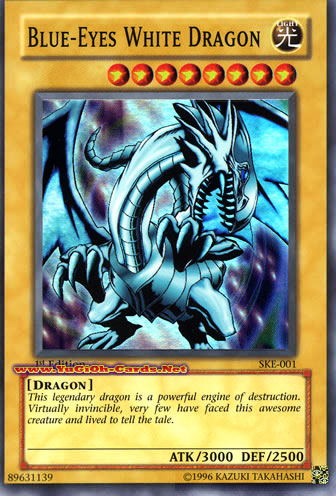
At some point, I was fascinated by YuGiOh! which was the first trend I ever predicted. When I inquired about an untranslated manga a thai classmate of mine was reading, he explained it was a "Card game comic book" and let me take a look. The monster designs alone told me it would be a hit: even more than Digimon, the monsters actually looked monstrous. About two years later, Kids WB brought the anime over, and the TCG (trading card game) started popping up on local shelves.

I dove into the card game excitedly, hoping to fill the card-game void within my heart that neither Magic: The Gathering, or The Pokemon TCG had been able to fill. It was then that I concluded card games are inherently evil. They are a bastion of hope for kids who can't afford to play video games, as a starter pack costs about half as much as a new top shelf console title, and the booster packs are just the right price for blowing one's allowance on, though ultimately, you end up spending about as much money on the cards as you would on a gaming system and a couple of titles. What's worse, the cards are next to useless unless you know somebody else who plays the game. If you do know somebody, it's even odds that he's an expert, or that they're just as clueless as you are. Even if you do get a feel for the game, and build a deck you're satisfied with, it will probably be rendered useless by the next batch of cards which come out. Then again, the cards do feature some very nice artwork, with creatures whose detail surpasses any pokemon or digimon I've ever seen.


The narrative frame for YuGiOh! presents the card game as a modern take on an ancient game played by the Pharoahs of Egypt, though Wikipedia can probably tell you more than I can. I only caught the show a couple of times, and then only in it's first iteration. Like Dragon Ball, YuGiOh! has spawned an alphabet soup of other series set after it. From what I saw of the first version, the main character, Yugi, wears a magic puzzle around his neck which essentially puts him through puberty when he solves it, and has a ridiculously powerful five-carded monster that results in automatic victory if he draws it and...that's pretty much it. The character designs struck me as an awkward mix of too much style and not enough complexity, and even more than pokemon, the story is relentlessly faithful to the flow of the game battles.

When I concluded my last post, I mentioned that there was some debate about what constitutes anime, and whether it has gone mainstream as an art form. I have heard fellow anime fans argue, that series like Pokemon, YuGiOh and Digimon do not count as anime series at all, because they were series designed with globalization in mind from the start. It's an interesting position, but a weak one, since the shows all follow a decidedly Japanese aesthetic (picture below explains what I mean), and served as the gateway anime to many a young viewer. Not everybody was lucky enough to catch Toonami after all. The series may be heavily edited by localization, but there are occassionaly some good reasons for such cuts. (Again see below.)


Various strains and mutations of the Monster Plagues still exist to this day, and I suspect that they shall endure for many generations to come, as poxes tend to do.

Thursday, February 26, 2009

A New Challenger Approaches!

Throughout the past couple of posts, I've been going on and on about the immersive potential of structurally fractured narratives, yet I haven't directly discussed any serialized media. As much as I love me some irony, this is an oversight which cannot stand. The next few posts are going to be about comics, television (including manga and anime respectively), and maybe some web series' as well. Lots of exciting things happening in these regions, and they need to be talked about.

Before we venture to these new and exciting regions, I'd like to offer my thoughts on Street Fighter IV, as it provides us with a topical opportunity to discuss the most serialized genre of video games: The 2D fighter. I haven't talked much about the potential pitfalls of narrative fractures and I can't think of a better example to prove my point. Let's begin with a personal history.

I became a serious gamer a bit later than most of my millenial contemporaries, (about 9 or 10 as opposed to 5 or 6) on account of good parenting. You see, I still hadn't figured out the whole "how to read" thing, and Mom and Dad didn't see how sitting in front of a television screen for hours on end would help matters. They already had to limit my time with the Gameboy Grandma gave me when I was 7. Ironically, I really began to blossom as a reader around the same time they caved and got me a Super Nintendo for Christmas. Whether there's a correlation is a matter for another post. Seriously. Remind me.

Anyway, my delay came with one grave cost: I missed the early-to-mid 90's fighting game boom, and I started too late to develop the insane hand eye coordination necessary to be competitive in the genre. Somehow I've managed to live on. This was part of my parent's plan of course. The media was rife with the horrors of Mortal Kombat; GTA of its day, though I never found it that appealing to begin with. My reading skills were still too feeble to appreciate the edginess of spelling 'Combat' with a 'K'.

I was always firmly in the Street Fighter II camp, allured by its anime-aesthetic, and the most iconic videogame attack of all time. I'd always beg for a turn at friends' houses, only to be laid to waste in a matter of seconds. By the time I had a SNES of my own, the entire 2-d fighting game scene was dwindling with the emergence of consoles with 3D capabilities, and Street Fighter II had lost most of it's mainstream appeal since Capcom saturated the market with a host of different editions of the game. They tried to revive interest in the series by introducing a new roster of characters in Street Fighter 3, but this pissed off players who had spent years training with the original characters, the vast majority of which were inexplicably cut. Capcom attempted to make amends by returning some of the cut characters with two more editions of SFIII. It didn't really work. The Street Fighter Alpha series found a small but dedicated following, though most mainstream fighter's got their fix with Capcom's cross over games, which really are incredible.

The age of street fighter seemed to have ended. Then this emerged.

I recognized it for what it is, but I still can't remember the last time I had been more excited about a sequel. Oh wait, yeah I can. Anyway, as much as I hoped the game would have the trailer's painted look I was afraid they would try to take the series to 3D again like they did with SF EX (which isn't even worth linking). Fortunately, Capcom decided to stick with 2D gameplay, while giving the characters and backgrounds detailed 3D characters models. The result is pretty, but it also looks a lot like SF2 updated with modern animation and HD graphics, which is funny because that already happened.

So how does it play? The phrase "returning the series to its roots" was thrown around a lot during the previews, and it's consistent with my experiences, right down to the old school throw-your-controller-against-the-wall difficulty. The CPU routinely kicks my ass on "Easy." Granted, I was trained in the weakest style of arcade kung fu, and just recently graduated to a style which is only slightly less embarassing. Still, there may be hope for me yet in the form of Focus Attacks; one of the two new mechanics Capcom introduced to the gameplay. Simply explained, Focus Attacks are easy to use all-purpose counter attacks. The other feature, known as the Revenge Gauge, seems to be a more technical version of the Special Attack Gauge (which is also still present), but I have yet to make heads or tails of it.

"But what of the story!?" you ask? I give you a flat stare and reply dryly, "What indeed."

Like every other game in the series, (hell pretty much every game in the genre), Street Fighter IV is centered around an international fighting tournament. Chronologically, I believe it occurs after SFII and before SFIII but I'm not sure. When I combed wikipedia for answers, I got a headache. The former's story has been told so many times, I don't know which one to go on. Normally I'd go with what's in the game, but to my knowledge, the only story telling that occurs in game are the quips your character makes to defeated opponents. Yet I know there is all this stuff about some evil organization with, and fighters harnessing dark energy floating somewhere in the periphery. Maybe it was in the game's manual somewhere? SFIV is slightly better. Each run through arcade mode begins and ends with these really nicely drawn anime scenes, but out of context, they make no damn sense. The scene that begins Abel's 'campaign' is a perfect example. This guy is brand new to the game, and not only does he have a huge amount of history, he's found a way to forget all of it! Are we supposed to have some idea who he is? How does he know Chun Li?

Even if there weren't so many different versions of the over-arching story, Street Fighter IV would still have to make sense of the fighting game's fundamental fracture: The Character Select Screen. Like all fractures, there's a lot of potential there, and Capcom even realizes some of it. Each character has a different reason for entering in the tournament, and a specific rival to take out. But for some reason, every character ends up in the same final boute against a semi-nude genetic monstrosity with a ying yang orb for an abdomen in a secret lab. Um. What? Is this still part of the tournament? Are the judges there with the evil scientists? I mean, SFII had the same nonsensically bottle-necked final fight, but at least M. Bison looked human. By the way, why is nobody surprised to find him back from the dead?

Look, I know it's a video game where people throw fire balls with their bare hands, and Yoga teaches you how to stretch your arms like Mr. Fantastic, but that doesn't mean you can't be coherent. I can suspend disbelief and ignore logic only so much, and Street Fighter IV crosses that line left and right. But if you're looking for a hardcore fighting game, you won't walk away disappointed.