Showing posts with label Genre Studies. Show all posts

Wednesday, April 28, 2010

Life After Hogwarts

I know I'm not the only one who misses Hogwarts. Horrible epilogue be damned, I wanted to know what happened after Harry and company 'graduated' and went on with their lives. In fact, I think the reason that so many readers were pissed off by Rowling's implied "happily ever after" is that we knew there was more growing up to be done. What happens after you finish your fantastic adolescent journey and find yourself faced with the less magickal world of adult responsibility? What happens when people with godlike powers start getting drunk and screwing other non-adults wielding godlike power? If you've had these questions, boy do I have a book for you.


Lev Grossman's The Magicians is a work of astonishing, and thoroughly refreshing cynicism in the fantasy coming of age genre. There is hope at its heart, and a thin thread of optimism underlying the narrative, but the pervading tone is sullen and its message is intended to be sobering. Despite my inevitable Harry Potter comparison, Lewis' Narnia series is a stronger influence than Rowling, but the book addresses issues that haunt both series and others like them. In fact, it presents a bold but compelling thesis about the deficiencies of fantastic coming of age novels: Fondness for fantasy ultimately stems from a dissatisfaction with the world we are given, and by extension, people who yearn for magical power are not merely harmless escapists, but those who are determined to warp and change the world beyond normal means. Like I said: cynical.

Harry Potter was occasionally very sad, but I never found it truly heartbreaking. All things considered, death is a fairly neat and clean fate for a character, especially when it is construed as 'noble' or 'heroic.' Grossman is crueler to his characters. He has them make the sort of mistakes that haunt and scar you for life. The book may not be more honest than other fantasy novels, because I believe there are important truths to be found in those sunnier texts, but Lev Grossman is certainly wields his truth more aggressively. And frankly, I think that is what I love most about his prose. Every word is edged with a type of tension, or grim humor. Even the celebratory scenes are tempered by recklessness and risk; this sense that things could get very bad and very out of control at the drop of a dime.

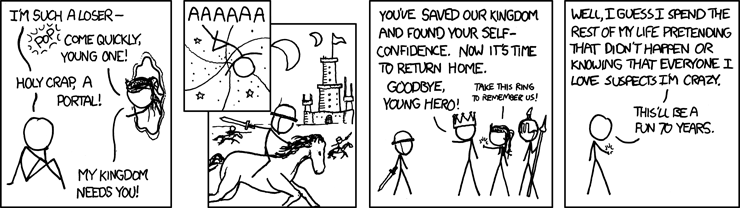
Stolen from xkcd.

In addition to being a criticism of genre, The Magicians is a serious critique on modern society as well. Grossman's fictional Magician class is a wonderful metaphor for over-privileged, self-interested, upper-middle class America. Main character Quentin Coldwater is a genius living a charmed life that grows more enchanted with every passing second. Yet he is unhappy and unsatisfied, even when he is accepted into Brakebills (think Hogwarts on the coast of the Hudson River) and he starts to master the awesome powers of magic. Even when he finds a place with the powerful "Physical Kids" clique. He can't escape the feeling that he was meant for something bigger and better, like the adventures in the Fillory and Further books he read while growing up.

I want to write more, but I don't want to give anything away. Honestly, I think the book's website and jacket give away too much of the plot. It's solid gold. Though to be honest, a disclaimer is in order. I am a 22-year-old, soon-to-be college graduate with a borderline Peter-pan complex. This book was written for me. Your millage may vary. But if you're a fan of Potter, or Narnia, or D&D, or World of Warcraft, or anything along those lines, you should pick up The Magicians.

Friday, February 12, 2010

The Summer Effect

This last Thursday, one of my best friends came over to my apartment and presented me with a choice: Watch 500 Days of Summer for the first time or watch Zombie Land again. For most guys, this is a no-brainer. Through the twisted magic of monogamy, (with my fiancee, not my friend) we ended up settling on the former. Here's the shocking part: It was the right choice. I don't mean to say it is a better movie than Zombie Land on the whole, such a thing borderlines blasphemy and is difficult to fathom, but it is an excellent enough film that you should see it at least once, regardless of who you are, even when presented with other fine options of entertainment. In fact, I would go so far as to call it the best romance since Love Actually.

It's a damn good movie, but the aesthetic is so Indie it stings at times.

Each scene or couple of scenes are excerpted days from a romance, all shuffled and played out of order in a way that is far more powerful than a traditional telling. Just like love actually interviews numerous different narratives of love together, Summer presents readers with a number of shifting currents at work in the relationship. This cutting allows the movie to tell a much deeper and far more honest love story than Hollywood's Meg Ryan meets Tom Hanks model. It even sets it apart from other Indie boy meets girl stories. Though, before proceeding, it may be prudent to provide a brief explanation of what I mean by indie.

In the beginning, the phrase stood for Independent Music, meaning music that was not published by a major record label. Hipsters, the metric unit of the indie subculture, will claim that said music is independently published because it's too cool or sophisticated for us mere sheeple to appreciate. Translation: not enough people would want to buy the music to motivate a major record label to sell it. That's a broad statement and a crude summary of the politics in play behind the music, but it's a useful enough explanation to help you understand where the greater Indie aesthetic is coming from. Like many counter-cultures it is a rejection of the mainstream, and it's particular interest lies where commercialism and artistic taste intersect, particularly where music is concerned. Like many other counter cultures however, the demographic has been identified (2o something college grads) and the market has been branded, and there is a specific sort of fiction and a specific style of dress associated with the aesthetic. One can consider the indie movement as the baroque movement of the post .com period, and Hipsters celebrate their awkwardness through ironic self-deprecation.

500 Days of Summer is that sort of movie; a celebration of being strange, and of not putting up with consumerism's exploitative bullshit. As such, it can come across as preachy in a roundabout way, but like most things indie, the hipster self-deprecation mutes it's own activism. Psychologists and pop cultural scholars scratching their heads over where a social movement comes into it's own should take a look at Summer just to see how everything conforms to this movement. Everything in the movie from the wardrobe, to the soundtrack, to the little animations that separate each day in the relationship, to the lead Zoey Deschanel's alluring yet awkward good looks is all decidedly 'Indien.'

Pic swiped from Starpulse via Google. Here she just looks pretty. The awkward comes through in the trailer however.


So how does all this awkwardness tie in to the plot? Aside from shuffling the chronology, the story flips the dynamics of boy meeting girl. Tom is the "new" sort of boy, the kind of leading man that would give Hemingway another excuse to drink. He falls for girls hard, talks about his feelings with his friends, and cares about his appearance enough to feel insecure about it. Meanwhile, the titular Summer is an old-fashioned guy. She is non-committal fiercely sexual, and very guarded about her emotions. This gender-reversal is nothing new, but the delivery here is nuanced and authentic to the times we live in.


If you're a person like me, who has come to despise Hollywood's formulaic approach to romance, or a person like either of the movies protagonists, you will love it. Fans of more conventional fair will probably enjoy it too because there is real, legitimate romance happening here. It may even be an sobering experience of sorts. So if you're searching for a movie to watch this valentide, give 500 Days of Summer a shot.

Monday, July 27, 2009

Japan's Finest! Space Cowboys and Hiphop Samurai!

Howdy Amigos. As promised last time, we're heading back to the Old West in space via the Far East on Earth. Our mission? To examine one of the finest anime ever produced: Cowboy Bebop. If you get tired of my palaverin' on about intergalactic cowboying, just click the links to the awesome tunes, and check out the amusing embedded video (!). If you make it all the way to the end, I have some words about the hip-hop swordplay of Samurai Champloo too. If that don't satisfy, I dunno what to tell ya, there's just no pleasing some folk.


Premise-wise, Cowboy Bebop probably sounds very similar to Firefly. In both cases you've got a crew of lovable misfits drifting around a loosely policed galaxy looking for enough work to pay the repair bills and keep food on the table. The Bebop's Crew is smaller, and they work as bounty hunters (called "Cowboys" in the series) instead of outlaws, but the real distinction between the two shows is a matter of style. While Firefly is solely a western within it's sci-fi trappings, Bebop is by turns, a Hong Kong Kung-Fu flick, a film noir, and a Jazz Odyssey.

In fact, it's the music that makes the show. Series director Shinchiro Watanabe is as renowned for awesome music as Joss Whedon is for witty dialogue, and Yoko Kanno, who might be considered the John Williams of anime, penned the score. Listening to the opening and closing themes will do your ears good and give you a feel for the general poles of the show (funky and frenetic vs. soulful melancholy) , but there is so much more to hear before you can really appreciate the incredible range of the soundtrack (and what I've linked here just tips the 'berg). Musicality is a general theme for the show, with episodes referred to as sessions and named after record titles or various pieces of music.


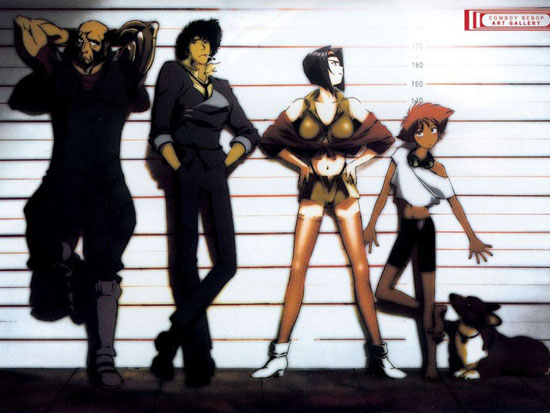
Meet the cast and crew of the Bebop. From left to right we've got ex-cop Jet Black, ex-triad Spike Spiegal, femme fatale Faye Valentine, crazy girl Ed, and Ein the data dog.

The eclectic nature of the music reflects on the quality of the writing. There is the eastern emphasis on the journey as opposed to the ending, but unlike so many other anime and manga, the narrative does come to a coherent and decisive conclusion. There aren't any plot holes either, at least, not in the sense of incoherence, though it does suffer from cavernous blind spots which move beyond titillation and into exasperation; a distinction I measure by the moment viewers stop thinking "I wonder what happened there..." and start wondering "Did the writers even bother?" In this case, I am referring to the "main plot" of the series that focuses on Spike's history with the criminal element and his missing lady-love Julia. What little we learn of it is compelling enough to move you along with the story, but when looking back at it you can't help feel that something significant was left unsaid. Part of the problem may be that I love the enigmatic (if shallow) main bad-ass, Vicious too much; possibly because he reminds me of another ruthless, effiminate silver-haired swordsmen.

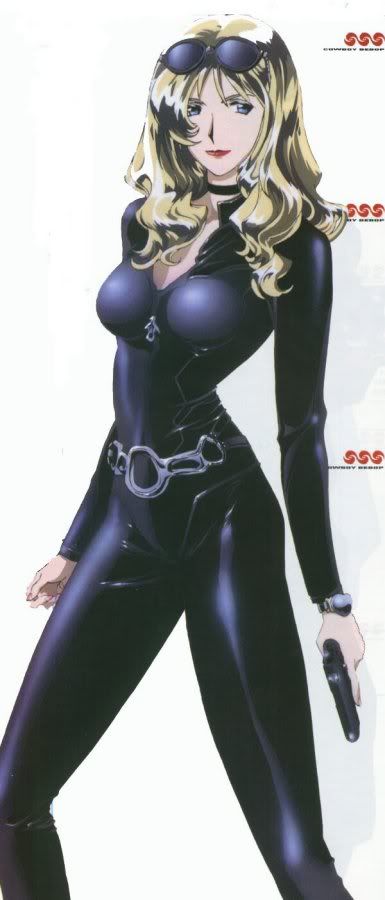
Before bidding a fair well to space westerns for the foreseeable future, I must acknowledge that Cowboy Bebop is not the only anime to do space cowboys, and some may dispute my claim that it does them best; namely Trigun fans. I'd be lying if I tried to tell you I enjoyed Trigun as much as Bebop, but before you decide to nail me to your cosplayed crucifix cannons (officially my strangest alliteration ever), allow me to qualify my decision: Trigun is a better Western, but a worse Space Western because the space aspect of the show is restricted to just a couple of episodes. Mostly it's just Vash The Stampede wandering around a barren desert planet, shooting at folk without killing them, devouring doughnuts and shouting "Love and Peace!". In case you ever wondered who would win a shoot out between Vash and Spike, allow me to present you with the following hypothetical:


For those wondering why the Japanese have such a yen (or should I say Zen?) for Westerns, the simple answer is that they are trying to get back at John Sturges for stealing the plot of Akira Kurosawa's Seven Samurai to make The Magnificent Seven. Feeble jokes aside, our romanticization of the gunslinger parallels Japan's treatment of Samurai, and I believe it accounts for much of the cross cultural genre bending.

Interestingly enough, Shichiro Watanabe's other genre blending masterpiece is about swordsman in the Edo period; Samurai Champloo. As I mentioned earlier, Watanabe is renown for musical shows, and Champloo happens to be Hip-hop flavored, which means it's about as historically accurate as Cowboy Bebop is historically predictive. Fortunately, it's also just as entertaining, and frequently entertaining in the same ways. Once again, we've got a two guy one girl set up, (though we've ditched the dog and the kid who were included in Bebop to lighten up the show's blueszy atmosphere) and we follow the trio through a trail of odd jobs as they seek out "The Samurai who Smells of Sunflowers". Unlike Bebop, the story telling is completely rooted in the eastern school of the journey, with the plot mounting up to a final duel between the two guys that never ends up happening.

Jin, Mugen and Fuu, just chillin'

Yoko Kanno doesn't come around again, presumbly because hip hop ain't her thang, but the music continues to impress anyway, and in closing, I present you with this link to Samurai Champloo's closing theme. Til next time, See You Space Cowboy.

Thursday, July 23, 2009

My Kind of Folk

Even though I love the arcane trappings of magic and the raw symbolic power that pervades the fantasy genre, I am a science fiction man at heart. The reason is very simple really. While Fantasy draws its power from heritage and whimsy, Science Fiction is all about addressing change and exploring possibility. Essentially, one is nostalgic and the other is forward thinking.
So consider yourself forewarned: When Nerdmagedon commences, and battle lines are drawn to determine whether sci-fi or fantasy shall reign supreme, I will stand tall beside the Klingons, Jedi and Cylons against the elves, dragons and fairies.

Believe it or not this post was not inspired by Comicon, which I still have yet to attend. Rather, it stems from the sci-fi genre-bender binge I've been on the whole summer. I'm currently reading a tech-noire with heavy military undertones, playing a space survival horror game, and on the weekends, I get together with friends to re-watch the finest Space Western the world has to yet to see: Joss Whedon's Firefly.


Depending on who you are, that may sound like small praise or blasphemous hyperbole. The space western is still a pretty young sub-genre of science fiction, but what's there is good stuff. The earliest and most prominent example I am aware of is Star Wars, and while the work is too broad to be wholly classified as western, there is no doubt in my mind that it's lawless, frontier atmosphere is what allowed it to stand apart from Star Trek's universe, whose federation of planets seems insufferably tame and preachy by comparison. Another fine piece of fiction to work with the space cowboy concept is the anime Cowboy Bebop, which I shall discuss in detail next post.

The thing that sets Firefly above the above-mentioned series, is that it is a western first and foremost, with just a little bit of science fiction thrown in for flavor. Almost every character in the cast is based on a classic western archetype. You've got the wise old preacher, the hooker with heart of gold, the crass and crude mercenary brawler, the fancy doctor, and the confederates (Browncoats) who have turned to outlawin' following their defeat in the Civil War (The Unification). The only recurring characters who break the theme are crazy psychic girl, perky mechanic girl, and sarcastic ship pilot. Even the reavers(!), the series reoccurring bogeymen, conform to the old western stereotypes of Indians, in that they are also people, though frightening violent people who have a tendency for scalping and cannot be communicated with.

Now, I love a good western as much as the next sumbitch, but I couldn't rightly tell you that it's one of my favorite genres. By and large, there tends to be a little too much talk of land for my tastes and the folksy atmosphere, where men are supposed to be strong creatures of few words well versed in farming, firearms, and mechanics is hardly hospitable to my nerdy nature and suburban upbringing. The patriotic undertones and lack of cultural diversity also tend to bother me. Seeing how I am an average sample of Whedon's fan base, it is easy to see how he had trouble marketing this series and why Fox decided to pull the plug. Like most other people, I only discovered the show after it had been canceled, and realized that the sci-fi elements addressed all my country western anxieties.
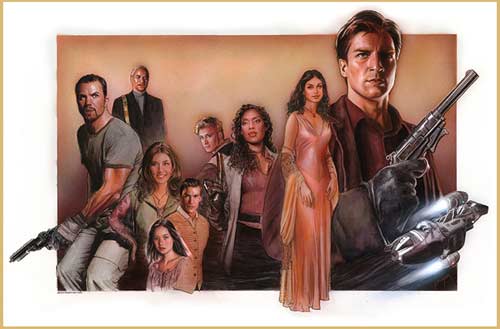

Setting the series in a spaceship, as opposed to a town or a farm gives the series a sense of home (which is essential for the Western) without rendering it sedentary. To inject some cultural diversity into the mix, Whedon sprinkles Chinese throughout the script and refers to his personal take on the evil galactic empire as The Sino-Asian Alliance, acknowledging China and America as the two superpowers most likely to seize control over human society. The cast also has more color than typical American television, let alone a typical western, featuring two black actors, and a Brazilian as well. The real thing which translates the folksiness of Firefly into something nerds can appreciate however is the dialogue. Whedon manages to unite the witticisms of nerd culture with folksome earthiness by relying on plainspoken wit and blunt understatement instead of references to folklore and pop culture.


Interestingly, Serenity, the film intended to serve as the possible salvation/wrap up for Firefly, switches gear's from the television series' western tone to a full on Sci-fi adventure. The western influence and folksy language lingers, but the plot moves away from bank heists, cattle raids and shootouts to encoded messages, insidious viruses, and the mysterious ambitions of the nefarious alliance. Laser weapons start popping up in a world that had only been armed with traditional guns. That was actually the thing that tipped me off to the genre switch.Normally, I would link Picard at this point, but I can see the reasoning behind the toneshift. The movie was a last ditch effort to try and draw in a broader audience for the show, so it needed to be easy to market, and since people are skeptical of stories they can't fit a familiar label to, Whedon decided to give it a more traditional Sci-fi flavor.

All in all it seems like a forgivable evil since the movie is still engaging and enjoyable. If you haven't seen any of Firefly yet, I recommend you rent or buy Serenity, and if you like that, pick up the the show on DVD. I really don't know how much it will set you back, but it's the sort of show that you can watch again and again, picking up new things each time, and the episodes are fairly self-contained, making them great to share with friends.

To those Firefly fans who have not picked up the comic books, I would heartily encourage you to do that as well, regardless of how you felt about the movie. Both series (Better Days and Those Left Behind) take place before the movie and hold true to that original western tone while sewing up a few loose ends. There is nothing particularly ground-breaking in either story, but the dialogue is entertaining and the artstyle is detailed and faithful to the show. Finally, for those of you who are hungering to hear about a certain enigmatic preacher's past, word has it that a lil series called A Shepard's Tale is in the works. It is slightly worriesome that said word came mid 2007 with a projected release date of late 2008, but the announcement came from Ron Glass (with Whedon's permission), so there is still hope yet.