Sunday, October 18, 2009

The Cure for The Common Gore Flick

Paranormal Activity is a good horror movie.

It is the best horror movie I've seen since The Ring, and it's scares did not only quench my thirst for terror, but restored my faith in the Horror genre. My faith in general is a rather withered and neglected organ, and the section of it dedicated to horror movies has grown particularly coarse and scarred thanks to Hollywood's recent offerings: uninspired remakes and torture porn. If you like sadistic, visceral scenes of mutilation, you do not only want another movie, you want a different website. Or rather, I want you to go to a different website. Now.

Torture porn fans are grossly unwelcome here because as far as I am concerned, their fetish flicks are the cancer that is killing Horror. Sadistic violence and gore certainly have a place in the genre, but I believe they are best administered in doses that have been carefully measured to provoke as much fear as possible. When violence and gore are taken to excess, we are no longer dealing with Horror, but it's daffy little brother, Camp, which I would argue is a sub-genre in and of itself. Planet Terror and Evil Dead are not Horror films for example, because they do not only invoke humor through horror, but prioritize humor above horror. There may be a few quick scares and gross-out moments, but on the whole the tone is light.

In torture porn, Brutality is the exaggerated element that brings us outside Horror's typical boundaries. The violence can be very innovative (the subgenre's sole virtue), but it is designed to invoke revulsion and disgust rather than fear. There is something of value in fear. It provides a test of ones' mental mettle that makes one aware of the presumptions which support his sense of security and how he copes when said presumptions are challenged. Put simply, it is coming to terms with uncertainty and the unknown. Disgust, by contrast, is the recognition of something that is familiar but unpleasant, and conquering one's sense of disgust simply means putting up with its unpleasantness. The difference between the two processes can be crudely illustrated by exploring a dark cave vs. learning to enjoy the smell of dogshit. I don't like the smell of dogshit, and I'm fine with not liking it. It's dogshit. There is no nutrition or rewarding stimulation to be derived from it, much like Hostel and any SAW title with a roman numeral in it.

Which brings me back to Paranormal Activity, a film at the opposite end of Horror's spectrum. It was made on a budget of nothing, with a cast of nobody, and it still manages to instill curiosity and fear in a delightfuly vicious cycle.


As you may have heard, the film follows a young couple who have recently moved in together, only to be bothered by things- or thing- going bump in the night, and the entire affair is presented as if it were declassified footage of a real-life incident, inevitably begging comparisons to The Blair Witch Project. I trust you good people to parse out the similarities between these two handy-cam horror shows for yourselves, though Paranormal Activity improves on it's predecessor in a number of subtle ways; most notably, it's use of stationary camera work. Almost all of the scary stuff goes down at night while the couple is asleep and we watch them atop a tri-pod in the corner of their bedroom. It may not sound like much, but the immobile perspective shifts our role from mere 'voyeur' to 'prisoner', or even 'victim'. We are not only forced to watch, but forced to watch from a fixed perspective. This sort of immobility creates the perfect climate for claustrophobia to fester and dread to take root in audiences.

Another substantial area of improvement is that the characters are very aware of the camera at all times, and they make you aware of the camera's presence too. In Blair Witch, I frequently found myself wondering, "Why is this being shot?" or "Who is controlling the camera?" and in PA, such queries are never an issue. Most scenes begin with a brief explanation of what we are watching, or about to be watching, and give way to either scares or an interlude between the couple. These interludes run the gamut from mundane and mildly humorous to wrenching shouting matches where we can feel the young lovers' union breaking apart like a limb that is slowly, but insistently being bent against its joint. The initial tension exists within the camera itself, as the young belle is exasperated by her beau's desire to film her at all times. This conflict is the emotional core of the movie, and one gets a clear impression that even if the haunting were to suddenly cease, the young couple would have a few demons yet to face.

And at the expense of a mild spoiler, I will tell you that this is a movie about demons as opposed to a movie about a haunted house. Fortunately, it is a very good movie about demons. In fact I would go so far as to declare Paranormal Activity the natural heir to The Exorcist's dark lineage. You'll have to pardon my purple prose; that film made an impression on me which has yet to fade, despite countless re-watchings and horrendous sequels. The thing that links both movies is not their similar subject matter, or even their sense of claustrophobia, but the way they draw from deep-seated belief to instill fear. There is an impressive legacy of fear surrounding the concept of possession that reflects something primal in human nature. By tapping into that heritage, the superficial details of the haunting gain the rumbling momentum and cold impact of a snowball that has been rolled down a glacier.

Having extolled such high praise, I must confess that I wanted a little more from Paranormal Activity. Ever since the original Exorcist scarred me as a child, I have been waiting for another film to surpass it. This film held such promise, as did The Ring before it, but it did not escalate quite enough to seal the deal. Once again, you will need to excuse my personal fascination, and keep in mind, I have already met people who found PA far more terrifying than The Exorcist. If your looking for a scare this Halloween Season, why not give it a watch and make up your own mind?

Thursday, October 8, 2009

Bound for the Attic?

I fear Joss Whedon will soon be known as "That guy who makes shows that could have been great." Apparently, Fox is pulling Dollhouse from its November lineup in favor of House and Bones re-runs. Even more worrisome is the news that it will be aired in two hour blocks upon its return. For FOX, it is a product that has reached its expiration date, and now they desperately clear their stock before it stinks up the storehouse. Somehow this just doesn't cover it.


To be fair, Dollhouse didn't make things easy on itself. To begin with, the show is inherently hard to market. Describing it's premise is a task which is probably better left to Wikipedia, but essentially, it's about a shady organization (guess what it's called!) that rents out programmable people (Actives or Dolls as you please) to cater to the fantasies of the rich, well-connected and over-privileged. Our heroine, is Echo, a Doll played by Eliza Dushku who has a nasty knack for remembering the fabricated personalities and engagements she's supposed to forget.

At it's best, the show is an intelligent exploration of exploitation with some truly fresh sci-fi elements to drive the plot. At it's worse, it's an over-complicated version of The Pretender, at least from a weekly story-telling perspective: The early episodes of the first season saw Dushku trying on outlandish outfits and disposable personas to navigate canned TV perils. Guy who hires Dolls to live out his Most Dangerous Game fantasy? Check. Stuck-up super-star in need of a bodyguard and a lesson on being yourself? Check. Ironically, I think these throw-away scenarios might have been Whedon's attempt at simplifying things for general audiences. Unfortunately, they were still far too confusing for general audiences, and too stilted for his normally stalwart fanbase. By the time the show arrived at truly interesting questions and scenarios ("Can dead people's personalities be imprinted on Actives to get life after death?" "Yes!" "Wow! Altered Carbon much?") almost everybody had lost interest.

The very thing that makes the show so interesting is the thing that makes it so challenging to watch: It strains audiences' abilities to empathize. Whedon's casting and characterization is brilliant as always, but everyone has serious relatability issues. When unprogrammed, the Dolls are amusingly vapid and vulnerable, which is good for a few quick laughs, but quick to wear thin as well. Their programmed presonalities are engaging enough, but too short-lived to get attached. That being said, both Victor and Sierra, the other main dolls aside from Echo, are played brilliantly by Enver Gjokaj and Dichen Lachan, who you probably haven't even heard of before now.

The people who run the Dollhouse are also a real mixed bag. The Dollhouse's resident mind fabricator, Topher, is clever, nerdy and at times disarmingly vulnerable, but he's also obnoxiously conceited and detached from the people whose heads he fucks with for a living . British Boss Lady Adelle is deliciously dry and cold in a curiously endearing way, but she's also the head of an organization that rents people out for everything from sex, to manslaughter, to really dedicated daycare. Head of Security Boyd and disgraced FBI agent Paul Ballard bring some boy scoutly heroics to the mix, but both are administered in controlled doses to prevent them from stealing the show from Echo.

On the subject of Echo; I was skeptical at first as to whether Dushku would be able to carry the show, and while she has given a few trully exceptional performances (like her recent stint as a mother for rent) I'm still a bit ambivilant about her character. Some of her roles seem to bleed together in ways that make it difficult to tell if she is intentionally blending personas (which would be consistent with the shows plot) or if it's just less-than-stellar acting. Furthermore, while Echo's persistent memory affords her a more stable personality than the other dolls, the personality which emerges is that of a perfect doll, or actress. I'm a huge fan of metafiction and the ironies in play here are still a bit much for me to swallow.

Meet the Dollhouse! From left to right we have Ballard, Victor, Echo, Sierra, Topher, Adelle and Boyd. And yes, every doll is named after a character in the NATO alphabet. So far!

Given all it's inherent challenges, I was fairly certain that Whedon couldn't do anything to sell the show to the kind of viewership FOX was expecting without completely compromising its plot. But then a friend invited me to watch one of the unaired episodes exclusive to the Season 1 DVD, an episode titlted Epitaph One. From what I understand, it was intended to serve as the series de facto ending in case of cancellation, and it does a beautiful job of validating all the characters' grim predictions that the Dollhouse could very easily be the downfall of mankind. Those of you who have not seen the episode but intend to would do well to skip the next three paragraphs, and the general point of this post.

In the episode, we have fastfowarded ten years into the future, and find ourselves faced with a world that has been utterly ravaged by Dollhouse technology. Somehow imprinting signals were unleashed through cellphone signals: everybody who picked up was implanted with a homicidal Doll, and everybody who didn't suddenly found themselves facing off with said doll army. In a way, that scenario is simpler by far than the plot of the first season. You've got a nice, fairly clean binary opposition (the dolls and the people controlling them vs. the survivors), with plenty of opportunity to blur the lines and uncover the mystery of what happened.

If it was up to me to launch my brilliant new show, I'd open with this edgy ruined hell-scape to show people what was at stake, and fill in the blanks as I went along. I'm the sort that sits back and spends a good half hour speculating about stuff with friends and even I was blown away by how fucked up things were, though given the situation presented, the aftermath seemed completely appropriate. As for flashbacking, what better environment could a writer ask for than a world where you can download a person's entire being into a flashdrive?

There are obvious virtues to Whedon's subtler, more gradual approach to the story pf course. We grow increasingly attached to the show's characters as fissures creep through western society, right under our noses. We watch the technology push further and further, breaking boundaries that seem so innocent at the time. If anything, I am a sucker for brilliant plotting. But sadly, most folks aren't patient enough to watch a five year plan unfold. Hell, if Robot Chicken and Family Guy are any evidence, five minutes of continuity is pushing ones' luck. I love both those shows, don't get me wrong, but it saddens me to think that longer term, serialized story-telling is loosing it's place in television.

In conclusion, if you are a Browncoat who was turned off by Dollhouse's early offerings, come back and give it another look, preferably guided by a friend who knows the show well enough to take you through the good stuff. It may already be too late to launch a fan campaign strong enough to save the show, but trying never hurt anything. If you'll excuse me, I'm going to be late for my Treatment.

Saturday, October 3, 2009

Rule 32

Nerd flicks have been dominating the box office for a couple of years now. The influence of comic books, fantasy trilogies and video games has been rising at a meteoric rate. But on October 2nd, 2009, pop-corn nerd cinema reached a new zenith with Zombieland.


When I first saw the trailer, I remember thinking "this looks pretty awesome, but I probably just saw all the best parts." If you clicked the link, you may find yourself haunted by similar reservations. But fear not; there is a lot more funny to be found in these post apocalyptic wastes. And I am not an easy laugh. Like most people, society has conditioned me to produce a courtesy-laugh with a very low humor threshold for the sake of politeness. Sadly I frequently fall back on it even when I'm watching movies. But this is not real laughter. It is a real-life 'lol' that is more a recognition of attempted humor than a genuine display of mirth. By contrast, this movie has several legitimate ROFL moments. In fact, no fake, truth here to follow: Zombieland is not merely hilarious, but one of the funniest movies I've seen in a long time.

Then again, this movie was designed with people like me in mind, and it was perfectly calibrated to ensure total domination over my demographic. It's clear that Paul Wernick and Rhett Reese have played a lot of video games, and I'm not just talking about zombie blastin' fare like L4D- although the influence of that title is clear, and the film will do the sequel's sales figures a big favor. The influence of Max Brook's Zombie Survival Guide is also apparent, as main character Columbus rattles off a list of zombie surviving maxims simply referred to as "The Rules." Interestingly, these rules are not only narrated, but they pop up on screen whenever applied or applicable, in a comparable manner to the visual motifs of a video games. One gag, (which was sadly surrendered by in one of the trailers), takes this concept even further, referencing a "Zombie Killer of the Week", complete with a flashy, 'achievement unlocked' looking icon.

In case you've been wondering, this post is named after rule 32 for Zombieland which simply advises that one "Enjoy the little things." It's the kind of trite advice which normally pisses me off, because I've always felt there is an urge for compliance and complacency buried beneath the optimism of those truisms. Suggesting one satisfy himself with 'little things' seems to imply that going after big things would be too much trouble. Of course, my suspicions led me to completely disregard the whole "enjoy" part of the equation, so I miss the point entirely. Zombieland helps remind people like me that the difference between living and un-living is enjoying vs. surviving life. I know it sounds pithy, but the gleeful cringe-inducing semi-campy violence involved delivers the movie from preciousness.

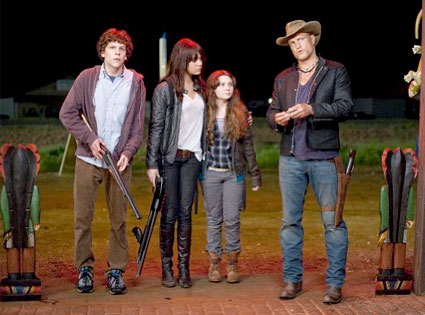
From right to left we have Columbus, Wichita, Little Rock and Tallahassee

From a technical perspective, the movie doesn't break any ground, which is perfectly fine because it doesn't aspire to. The music is mostly familiar, forgettable rock, and the effects are sufficiently bloody. The performances were very enjoyable, though given that every character in the film is a stock character of one kind or another, it was mostly a matter of good casting. That being said, I'm glad that Jesse Eisenberg was chosen to play 'the nerdy sensitive guy' instead of Michael Cerra, and Woody Harrelson makes a hell of a psychotic cowboy. Abigail Breslin of Little Miss Sunshine fame didn't get much in the way of screen time as 'the cute kid' and Emma Stone meets the right balance between wicked hot and playfully bitchy. It's the 'surprise guest' who really steals the show though, but giving him away would be a spoiler punishable by death. As time goes on, the secret will get harder to keep though, so I recommend you get to a theater post-haste. And bring friends. It's that kind of movie.

Friday, October 2, 2009

They Come in Squalor!

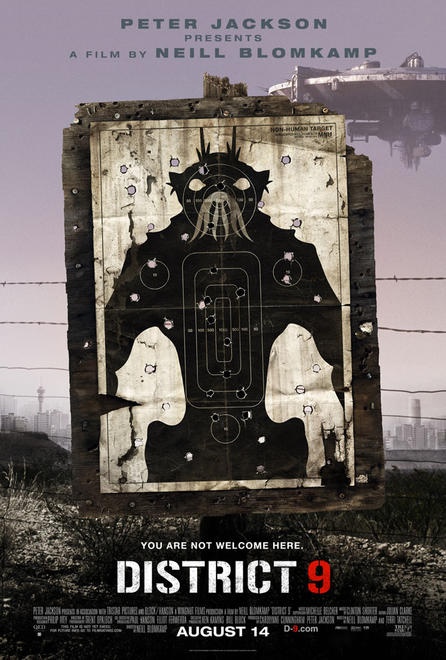
I think enough time has finally passed for me to give District 9 a good talking about without having to worry about catastrophic spoilers. Of course, if you have not seen it yet but you still intend to, do that before reading what I have to say, as the plot will be divulged, and dissected in detail henceforth.

District 9's premise, "what if Aliens came to Earth, not in war or peace, but poverty and desperation?" can be thought of as a return to classic sci-fi form, insofar that it is less concerned with the fantastic trappings of its own genre (laser gunfire, warp drives, paradoxes) , and more concerned with the scenario's social implications. The psuedo-documentary format is a brilliant frame for such examinations, because examining humanity is what documentaries do. We do eventually arrive at flashy firefights, foreign biology and space travel tropes as well, resulting in an intringuing, unique experience. Some critics, whose names I have made a point of not remembering, have complained that the film is simply a mishmash of old and familiar sci-fi tropes, and is therefore not original. Though honestly, if amalgamations cannot be considered original, Homer's a hack, Shakespeare's a schmuck and... you can see where I'm going with this.

The film opens with a collage of interviews and handy cam footage which informs us that an alien ship arrived in the skies of Johannesburg, South Africa in 1982, and ever since, the area has been inhabitted by a populous of alien aliens (Guffaw!) referred to as the Prawns, presumably because Cthulhu-Grasshoppers takes too long to say. An insidious PMC known as Multi-National United (MNU) has seized control of the situation, and it quickly becomes apparent that one of their lackeys, a Wikus van der Merwe, is going to be our main character and he's about as likeable as a wet pair of good shoes; he is boringly average, socially awkward and naive in an way that is simutaneously obnoxious and pitiable, but you aren't going to throw him out because there's good there.
If you think this is heavy-handed, you should check out the promotional website.

Things start to shift gears when Wikus gets sprayed with an alien chemical that (spoiler alert, last chance to turn back) gradually transforms him into a Prawn. Although it may not be all that original as hooks go, the twist works excellently as a plot device because it serves as the narrative's fulcrum, providing a convincing bridge for the disparate switch from docudrama to action thriller. Wikus' metamorphosis begins with his right arm, conveniently allowing him to use the alien weaponry coveted by tribalistic african gangsters and the scheming executives of MNU. All Wikus wants to do is go home to his loving new wife who is inconveniently the daughter of MNU's evil CEO. Since MNU is on high alert and anxious to sell Wikus to the military, he has to turn to the aliens to cure his condition. Carnage and gunfights ensue; the bloodiest seen since Watchman.

Yet District 9's sensationalized gore serves a purpose beyond the superficial: It establishes an atmosphere of intense brutality, which is quite appropriate for a movie set in a politically tense, refugee environment. Documentary fans may argue that the horrors of starvation, subjugation and degradation are brutal enough, and that watching people erupt into showers meat when blasted by lightning cannons only trivializes those subtler, truer horrors, and they may have a point. It's obvious that Blomkamp opted for "totally awesome" instead of social commentary in the final sequence where we see Wikus commandeer an alien battle mech and lays waste to scores of MNU soldiers. Then again, when Wikus is forced to fire a lightning cannon at a hooded, handcuffed prawn, it provokes sorrow and revulsion as opposed to stylized admiration.

That compromise between meaningful social examination and manic spectacle best describes my feelings toward District 9. It is engaging, both emotionally and intellectually, but part of me has to wonder what would have happened if things continued on at their slower initial pace. To a certain extent, it seems like we got to watch the fused halves of two seperate movies. I suspect that a big part of this has to do with the fact that Blomkamp was working on a budget of almost nothing; a condition that, when paired with passion and vision, produces truly remarkable things.
Truth be told, I'm worried about how the inevitable sequel (please come up with something more creative than District 10), will fare with a bigger budget and more press.

Wednesday, September 23, 2009

Rehabilitating House

House has been my favorite TV show since I started watching it in it's second season. I've since gone back and watched the first season on DVD, and it is one of the few shows on television of which I have seen every episode. Although smartest in the first three seasons, when its modern day Sherloc Doc's shock-value was still fresh, the show remains one of the sharpest things on TV, weathering both an unexpected depature and the 2007-8 writer's strike; a black maelstrom that profoundly fucked up other shows.


I cannot deny that the weekly medical mysteries have grown considerably less memorable and intriguing with each passing season, but the show soldiers on by virtue of its excellent plotting: Every season, the writers throw in a story developments or characters who complicate existing character relationships, tweaking the formula just enough to keep things interesting. Despite its callous exterior, House M.D. is at heart, a soap opera, and most of these story-arcs entail perilous romances between characters. Every once in a while, the show uses something other than sexual tension to reinvent itself however, producing some voraciously watchable story arcs. I favored the arcs featuring antagonists Michael Tritter and Vogler over the maybe romances with Cameron and Stacy. My personal favorite arc might have been the season 3 finale which saw House firing his entire team and segued into medical internship survivor.


In my humble yet paradoxically loud and insistent opinion, Season Five was the show's darkest hour. Wilson's drawn-out estrangement from House was unrealistically reconciled in a single episode, Kal Penn's sudden departure left a gaping wound in the team's dynamics, and sin of all sins, the writers pushed House' flirtatious non-relationship with Cuddy towards something approaching a legitimate romance. It's obvious that they'll wind up together in the end, but once we get there -surprise- it's the end! Or at least it'd better be. The last thing I want to see is House and Cuddy work through a season of romantic minutiae. Consequently I've come to regard the pairing as the speed-boat pulling House towards a shark jump. While it pains me to admit it, the show may already be air born.

Shore and Co. seem to be aware of this impending danger as they are taking a huge risk with this new season by having House's character explore the one area he never dared venture before: mental stability. The season premiere restored my faith in the show by managing to believably portray House's rehabilitation as a drug addict and a human being. Making a character do a one eighty like that after five years of story telling is a hell of a feat. Doing it in the space of two hours is nothing short of incredible. The premiere also introduced the clever, tremendously likable shrink Nolan and Lydia; an intriguing, alternative love interest for House, though we have been led to believe that she has already left his life forever. Given the show's maxim (Everybody Lies), I'm remaining skeptical, but I have some hope for House yet.

Friday, September 18, 2009

A Game Worth Ten Thousand Words

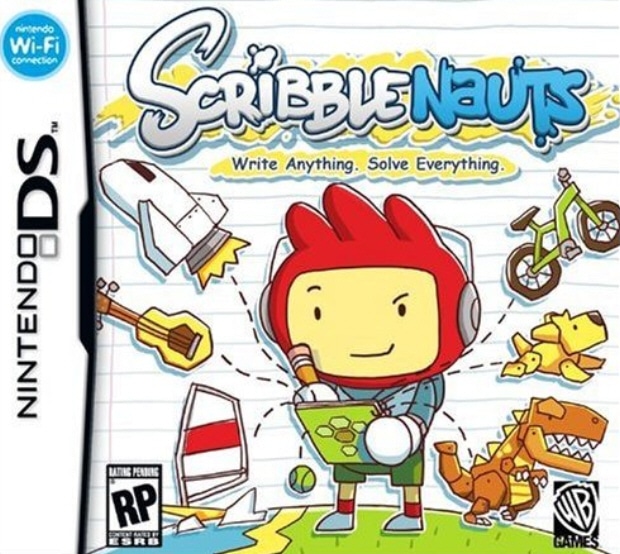
I've been waiting for Scribblenauts for a long time; basically since I first heard about it. For those who haven't heard, it's a DS Game where you can create whatever you want by just writing it. Need to cross a gap? Write "wings" and attach them to your character, or write "Helicopter" hop in and take off. Enemies to deal with? Sure you can summon any firearm, explosive or melee weapon that fits your fancy but that's such small, primitive thinking. Summon a Ninja, or a hoard of robot zombies, or a Cthulhu to do your bidding for you. Conjure a cloud of lightning and fry them up Storm style. Or just drop a kitchen sink on them repeatedly.

I can't remember the last time I read an advertising tag-line that seemed so appropriate.

What I have said may not have piqued your interest. You may be laughing at me now, scoffing that only nerds get excited about playing games were words are your primary weapon. I will concede that using words to exert physical change on the surrounding world is a fantasy almost every nerd has had at some point in their life, (and the basis for 9 out of 10 magick systems) but I assure you, this is a game for everybody who likes creativity. You don't need a terribly broad vocabulary to go wild. You can try to see how many puzzles you can solve using only ninjas (my count is only 5 so far, but I'm optimistic I'll hit at least 10), or explosives. Or you can see how many puzzles can be solved sans-violence. Believe me when I say this is the most creative game in a long time, and easily the most important video game, design-wise, since Braid.

The core game follows your basic "Find the star to clear the level" formula and there are a number of different themed worlds, each with eleven Action levels and eleven Puzzle levels. In the puzzle stages, the star item, here called a Starite, is invisible until you fulfill a condition, like creating an appropriate object (instruments for a band), reuniting something or somebody (gathering flowers into a basket), or performing some kind of action (knocking over a stack of bottles balanced on a table). As far as I've played, the puzzle levels tend to be much easier than the action levels, where the starite is present and awaiting retrieval from the start, but surrounded by all kinds of hazards and traps, including those which can actually destroy the Starite itself, in which case, you fail. What results is a delightfully refreshing take on action and puzzle solving in video games. If you use a crate to solve a puzzle in Scribblenauts, you have nobody to blame but your self.


The lexicon isn't perfect. Naughty stuff, like racial slurs, drugs, alcohol, and sexual material are all taboo, because this is a title intended for everybody. This is no great disappointment, but true wordsmiths will manage to find a few other holes in their playthrough. So far, the game has failed to provide me with greaves and a taser. I can understand a lack of archaic leg armor, but a taser? Really? Then again, the game shows an intimate familiarity with gaming and internet memes, so the omission might be a show of solidarity for... That Guy. Sadly, the game adheres to copyright law out of necessity, which means you won't be able to summon anybody from the eclectic bunch below.
Found on Kotaku, who found it on Tiny Cartridge. My Personal Favorites are Conan O'Brian, Tobias Funke, and Travis Touchdown.

Really, Scribblenauts has only one real flaw, but it is a doozy: All of the action in Scribblenauts is performed on the touch screen with the DS' stylus. Even this isn't so much a flaw as a stylistic choice, since most non-videogamers find touch controls to be far more intuitive and accessible than button inputs. Unfortunately, this set up also suffers from a severe lack of precision. Sometimes, like when you are trying to attach a defibrillator to a comatose creature, or glue a dingo to a baby, (these are entirely hypothetical examples mind you) the item you are fiddling with will 'go red' because it is illegally overlapping with something else. When this happens, your character, Maxwell, will occasionally attempt to trot over to wherever you are pointing, heedless of whatever harm may be in the way, because the stylus also controls his movement. Other times you may try to get him to move, like when avoiding a murderous spring-heeled Jack, and he will just stand there and pull a stupid face. The touch screen is certainly ideal for spelling words and placing or combining items in the play field, but I would have preferred a more traditional set up for movement (D-Pad to run, 'A' to Jump, B to use an item). Apparently my complaints conform to the wikipedia standard (bottom sentence of the third paragraph). How appallingly normal of me.

So in closing, if you have a DS, you should own Scribblenauts as well, awkward controls be damned. It's $30 you won't regret. If you buy it and fail to have fun with it, later this week I will post a list of winning word/item combinations on Biased Video Gamer Blog to help show you how it's done.

Wednesday, September 9, 2009

Still Lost Among the Dunes

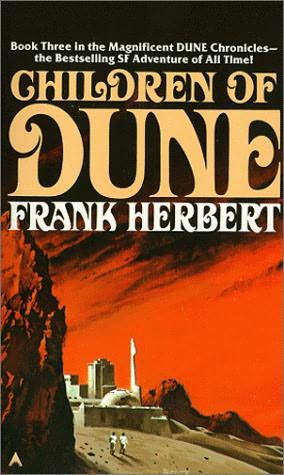
Let's head back to Arrakis shall we? There was very little in the way of literary analysis on the first book of Dune, mostly because I have very little to say about it beyond "this book is so cool and you should read it." To address that deficiancy, this post will analyze both the second and third books in the original dune sextology, and it will also be absolutely saturated with spoilers, so consider yourself forewarned. Last I left off, I was broaching a discussion of Children of Dune, having completely skipped over the second book in the series, Dune Messiah. This was not intentional, though frankly there isn't much to say about the second novel.

Unlike Star Wars, Indiana Jones and Batman, Dune lost some of it's rich complexity when translated to Lego.

I read Dune Messiah in the fall of last year, just a couple months after reading Dune, and it struck me as little more than an extended epilogue to the story which hand already unfolded. It didn't introduce any terribly compelling new characters or convincing threats (Sorry Scytale, you just aren't as cool as your name suggests). Herbert did introduce Ghola cloning technology to the series, but left the concept rather under-explored. That being said, the story does bring added closure to the original, and it brings it very well, beggining with the backlash to Paul's assendency and continuing on to his tragic fate.


I say Children of Dune is a proper sequel, because it runs counter to the first two books in almost every way. The energy dedicated to exploring Paul's ability to predict the future has been redistributed to his children's genetic total recall. Paul's heroic decision to die a mortal death and avert intergalactic Jihad is reconstrued as an act of selfish cowardice. It is revealed that Paul didn't even die at all when he walked off into the desert. Even though the plot twist initially excited me, (for it's hard not to get excited about characters coming back from the dead), I was it left me sad later on, because it's the sort of inorganic story telling Herbert never resorted to in his earlier novels. Admittedly, he does soften the effect of this revelation by repeatedly foreshadowing it and repeatedly stressing that Paul has become a different character, but it still feels like some sort of cheap trick.


Sadly, this is not the most preposterous plot point in Children of Dune. Characters who have been well established as intelligent and wise suddenly suffer from attacks of idiocy, only to display mind boggling insight moments later. Lady Jessica is a prime example. Even though Leto II (Paul's son and the new protagonist) makes her look like an idiot fool in conversation, she somehow mannaged to see past his elaborate feign death and trap him in the desert, even though he is presient and she is not. More messily developed characters like Alia and Duncan (or the Ghola formerly known as Hayt) spiral out of control destroying the few consistent threads of personality which had been previously established. These gaping holes in logic and continuity detract from the wonderfully density Herbert's world displayed in the first book. Even though we have lots of plots twisting around eachother and tangling together like sound trout, they never quite form a worm, or a god-emperor for that matter.

Fortunately, Herbert's philosophical musings remain poetic and potent, and conceptually he continues to engage. I resonate with the book's central message, assuming I correctly understand it to be the sentiment that people are far too eager to submit themselves to the will of heredity. At the same time the Golden Path, Leto II's infallible plan to ensure the survival of the human race, strikes me as an inherently evil concept because it is contingent upon the idea that man must submit to the rule of a single godly tyrant. Indeed, Paul deliberately avoided such a path in the first book for the same reason. Leto denounces this is cowardice, since Paul created a universe that looked for divine justice by becoming a messiah, only to deprive it of such guidence. While I'm willing to concede that Paul's suicide may not have been the best decision for his empire, Leto never provides a convincing explanation as to why tyranny is a better alternative.

In fact, the end of Children of Dune serves as a dark reflection of the original novel's conclusion; the main character storms into his enemies lair, laying waste to all resistance, and coerces the survivors into submission, though for some reason when Leto did it, I felt like evil had won. I think my primariy problem is a lack of motivation. Paul was finally attaining retribution against the Harkonens who had killed his father and brutalized the people of Arrakis, while Leto (who didn't feel human even before merging with worms) is simply killing his demented aunt. The fact that he claimed his sister for a wife and whored her out to his cousin doesn't sit well with me either.

On the pluse side, Leto is primed to be a brilliant villian in God Emperor of Dune, though I think it will be a good long while before I head back to Arrakis.