Thursday, July 25, 2013

Comics Binge 2: The Bingening

I haven't been reading as many traditional books lately because taking in other people's prose when I am writing really throws off my game. To compensate, I have been reading tons of comics, and it is a good time to be a comic book nerd.

Hawkeye by Matt Fraction and David Aja


I haven't devoured a book like this since Whedon's run on Astonishing X-Men. If you are  like me, you probably don't know a lot about Clint Barton, AKA Hawkeye. To put it mildly, his character has been underutilized thus far in the Marvel Cinematic Universe. Even though he was technically one of the stars of The Avengers, his appearances felt like extended cameos. I kind of assumed it was because there isn't a lot to work with there. I mean, what can a really good sharpshooter (who uses a bow no less) bring to a team with whose roster includes a ballerina superspy, a paragon war hero, a one-man armored battalion, an invincible rage monster and a fucking Norse god?

Fraction recognizes this disparity and runs with it, though his run on Hawkeye is about what Clint does when he is not working with the Avengers. It talks about the everyday life of being a superhero. There are still bad guys to fight, but there is also hanging out in his apartment, errands, and actual human relationships. The closest thing I can approximate it to is Astro City, though I actually drastically prefer Hawkeye to that oft-revered series because the writing in the latter is so much wittier and the characters are so damn personable. I never felt like I would want to meet Samaritan, or anybody else from Astro City because they all struck me as one-note superhero caricatures; case studies to make witty observations about superhero comics. I would love to hang with both Clint Barton and Kate Bishop (who both operate under the name Hawkeye) because they are like real people.

Clint is actually kind of a perennial fuck-up. He does something dumb at least once per issue, but he also always manages to save the day anyway. He has a weird sense of humor, occasionally addressing inanimate objects when they frustrate him, and a refreshing self-awareness that never descends into whiny self-deprecation (see Spider-Man) or blatant metahumor (See Deadpool). Kate Bishop is his sassy, but devoted proteje, which sounds derivative and cliched but I dare you not to be charmed by her. The Tracksuits, Russian gangsters who wear (you guessed it) tracksuits, and punctuate every sentence with the word "Bro" are my new favorite flunkies. The entire comic has this excellent sense of humor.

And David Aja's art, my god! Panels aren't only expertly illustrated, but every page is beautifully designed. The ways this comic plays with color theory and panel layouts are absolutely genius. You could pretty much pick a page at random, frame it, put it on your wall, and you would catch eyes and garner compliments. Something as obvious and simple and mundane as phone conversation is presented in spectacular fashion.

I really cannot praise this book enough. If you are into comics or art or superheroes at all, snatch this series up immediately. Today. It will improve your week.


Locke & Key by Joe Hill and Gabriel Rodriguez

File:Joehilllockekey.jpg

Locke & Key has one of those brilliant premises that would make any fantasy writer jealous. After a truly horrific tragedy, three siblings and their mom move to a house that is filled with strange keys. Keys that can turn back time, or allow you to open up your head and pull stuff out or put things in. Keys that can change your sex or race. Keys that can turn you into a ghost, or a giant or an animal. In addition, the kids are stalked by a cunning evil being known as Dodge, who is hunting for the Omega Key.

The series is ultimately horror-flavored, and rife with raw portrayals of violence and psychologically abrasive issues like grief, guilt, alcoholism, adolescent angst. While the dialog lacks the quippery and contemporary colloquialisms of say, Whedon or Fraction, it reads smart and makes the characters real. The pacing is perfect, with a satisfying blend of supernatural action, suspenseful plotting and frank emotional interactions. In many respects, I think Joe Hill has outdone his father (the famed Stephen King) in terms of moving the characters forward through the world and punctuating their journey with meaningful epiphanies. He is perfectly suited to the comic book form, though I am now interested in checking out his other work.

Horror is actually a brilliant genre for books starring adolescents because at that age, everything seems so damn serious and nothing makes any fucking sense--especially other people. It is also the age when you realize, quite abruptly and keenly, that your parents are totally fallible and probably just as flawed as you, though in different ways. All these issues are explored by the book in more than a superficial capacity.

Gabriel Rodriguez's art is actually kind of ugly, but in an intentional and refreshing way. Instead of the physical ideals of superhero comics, we have body types of every stripe, people with poor complexion, weirdly shaped faces, and punkish hair styles that are both endearing and off-putting. Again, these aesthetics are perfect for teenagers (and horror). Also, there's just something about the way Rodriguez does blood... it looks so damn thick and gross. The way he does violence in general is super visceral and compelling.

Again, this is definitely a series to pick up.


The Unwritten by Mike Carey and Peter Gross


This is actually a book I started reading a long time ago, and I could have sworn I've written about it before but I apparently I have not. The Unwritten is about stories and the power they hold over the universe. It is the most literary comic book I have read, eclipsing even Sandman with it's sheer number of references, though where the references were effortless and ephemeral for Gaiman, they are the main course here. If you aren't a fan of metafiction and intertextuality this is a tough sell. There are often moments where this series feels like it would much rather be a series of novels than comic books, though I think it does work best as a comic.

The book is about a man named Tom Taylor, who may have been created from literature by his famous author father, who wrote a series of books that are obvious analogs to Harry Potter. Fiction and magic bleed into reality, history is manipulated by a cabal of evil motherfuckers who use stories to rule the world, and adventure ensues.

It took me a long time to really get into the series. I wasn't completely sold on it until volume 3, but now, having completed volume 7 I am very glad I've stuck along for the ride. I really resonate with the reverence of fiction, and the belief that stories shape our entire understanding of the world. English majors, particularly those with a creative writing bent, are very much the target audience.The alternate history stuff Carey throws in is fascinating, though the pacing feels a bit off-kilter. Most of the characters are also kind flat in terms of personality though, and while the plotting is super elaborate, the relationships are very straightforward.

I have become accustomed to Peter Gross' art style, though compared to the other two books in this binge, it doesn't do much for me. The characters always look extremely normal, with a few notable exceptions, such as Pullman and Savoy. When the comic wanders into fictional worlds, the art perks up a bit, though the colors are always a bit more muted than I would like. The stuff done with magic and things melting into text are really cool, and there are scenes of deeply intricate detail.

In conclusion, The Unwritten is well-worth reading if you are big into literature. Less so for general audiences.

In the coming months, I will be diving into both Preacher and the original Hellblazer because I have heard amazing things about both. I will also be delving deeper into Runaways which is off to a fairly promising start.

Tuesday, July 23, 2013

Summer Movie Recap

I've had quite a lapse since raving about Bioshock Infinite in April. In the following few days, I will be doing a series of recaps on how I have spent the summer, aside from writing my novel (the rough draft is complete by the way, and very nearly ready to be ripped apart). Today I will talk about films I've seen, and soon move on to reading material (including Locke & Key) and video games (including Last of Us).


File:TheGreatGatsby2012Poster.jpg


The Great Gatsby was one of the few books that high School English couldn't poison by assigning it. Fitzgerald had a masterful plot and very pleasing prose. Baz Luhrmann's big budget adaptation had an enticingly interesting hook behind it, highlighting the parallel excesses of contemporary hip-hop culture and roaring twenties bacchanalia. It's weird and it's smart, but sadly, the film doesn't completely commit to the idea. At the beginning when everything is drunken partying, we get some interesting mash-ups, but when shit gets grim and serious, he drops the modern music and converts the great american novel into a surprisingly straight forward popcorn movie.

That said, the way the film handles cars deserves special mention because it is spectacular. In the book, they are presented as almost mythological engines of destruction. Like dragons, they tear through an unsuspecting world unleashing mayhem and inspiring awe. The cinematography brings their jarring speed, growling machinery and bright colors are spot on.

Star Trek: Into Darkness


File:StarTrekIntoDarkness FinalUSPoster.jpg

My nerd cred is about to take a nosedive: I've never seen Wrath of Khan. That said, I think it was a boon for watching Into Darkness, because I was not slavishly comparing the two. From the sound of things, Wrath of Khan is the superior (if not superlative) Star Trek film. Into Darkness lacks the poignant moments of the first rebooted film (the opening sequence was genuinely tragic, and Pike's speech convincing Kirk to join Star Fleet is incredible), but it is a rollicking, visually pleasing adventure. The harder you think about it, the more things feel contrived, but all in all it's not a bad way to finish a bucket of popcorn.


File:Iron Man 3 theatrical poster.jpg

I defended Iron Man 2, even though it wasn't a very good movie (especially when compared to the first movie's surprisingly pertinent 9/11 morality tale). Iron Man 3 is a much better movie than 2, mainly because it's funny. Not just in terms of the jokes, but in terms of narrative structure. Spoilers follow. We have several different movies worked into one: A standard superhero thriller, a brilliant buddy-comedy between Downey's Tony Stark and an unnamed boy actor who is charmingly manipulative and clever, and finally, an absurdist plot twist that re-vitalizes a xenophobic caricature of a villain into a weird but genuinely funny punchline. The movie takes some risks, but I think they pay off on the whole.


File:ManofSteelFinalPoster.jpg

Oh man. This movie was so close to being what Warner Bros. desperately wanted: Superman Begins. But Snyder ultimately misrepresents what Supes stands for. Instead of Superman saving people and being an aspirational paragon for humanity, we have what felt like hours of punching down sky scrapers capitalized by a brutal, thuggish execution. I've since read that Snyder pushed for this ending specifically, and it really does sour the film. Parts of the movie are brilliant. Seeing Clark contend with his budding super powers was moving and brought vulnerability to an impervious character. Reversing Lois Lane's relationship with Superman's secret identity was also a brilliant call (though she had some cringe-worthy dialog). I can't help but wish Nolan were running the show instead of Snyder.


File:Pacific Rim FilmPoster.jpeg

Guillermo del Toro's love letter to mecha anime and kaiju fans. It delivers exactly what it promises on the box: big robots beating the shit out of big monsters. If that sounds fun to you, go see this movie--I want more like it and it is hurting domestically. If that doesn't sound fun to you, I suggest you re-evaluate your world view and priorities. The script is serviceable but suffers from some cringe-worthy dialog and more plotholes than it ought to, even taking the absurd premise into account. The film is still a hell of a lot of fun, and it is thoroughly refreshing to see a new IP as opposed to another sequel or adaptation.


File:Conjuring poster.jpg

A 2010-era horror movie getting above an 80% on Rotten Tomatoes is rarer than a vampiric unicorn, so I had to give this a watch. You have seen this movie dozens of times before. It is a demonic possession/catholic propaganda story in the same vein as The Exorcist, with the "based on a true story / family moving into a new house" frame of Amityville. That said, the scares are very well-done. You see them coming a mile off, (because you've seen this before!) but you still jump with dread when the monsters appear.

My favorite part of the movie is actually the opening, which stands on its own as brilliantly creepy short story. It hints at a more novel movie that has yet to be made; a series of short, horrifying paranormal investigation cases set to the tune of Twin Peaks or Pulp Fiction. That's actually a movie I would love to write myself some day.

Wednesday, April 10, 2013

Above and Beyond


Hello dear readers. I apologize for the lack of posts last month. For the past fifteen years, I have been that guy who is "writing a novel," but since December I have actually been doing it. For real this time, and I am over 120 pages deep in it. Balancing that with work and a social life has left me with very little time for blogging. I will do my best to have at least one of these a month, but my first loyalty is to fiction. 

I also needed some time to digest one of the best videogames I have ever played. Bioshock Infinite is the best game I played since Braid. For my personal tastes, it may even be better. You can read most of this article without suffering any grave spoilers, and I will give you plenty of warning before I get to the big reveals, but you would be well-served to play it now if you haven't.


I agree that Elizabeth would have been a better choice for the cover, but I don't doubt that they will sell more games by featuring Booker. Just the world we live in.

I would like to begin by talking about the characters because they are so damn beautiful. Almost every video game has you play as a guy who can (and must) slaughter a hundred people before breakfast. Master Chief. Nathan Drake. Hell even Link and Mario. The weird, constant incongruity though, is that these are all supposedly "good guys." Bioshock Infinite takes this trope to task and imagines what that guy would be like in real life. Meet Booker DeWitt. Veteran of both Wounded Knee and the Boxer Rebellion, and Pinkerton strikebreaker. The guy is quite literally, a career murderer, but historically perfect for the 1912 setting. He has a gruff, down-to-business personality to match his bloody past and you would be inclined to think that would make the game relentlessly grim.


You'd be right, if the player you controlled was actually the main character. But the soul of this game is the woman you must rescue: Elizabeth. Many people, including the boys of Penny-Arcade, have likened her to a Disney Princess. Belle specifically. And it is an apt comparison, because she is plucky, beautiful, bookish and occasionally headstrong. But those qualities aren't forced on you. She does not come across as saccharine or hapless like so many Damsels from the House of Mouse. This is primarily achieved through her support role: in combat, she can rip tears into alternate realities that benefit her and Booker. She can pick locks and solve coded ciphers for you. And you never actually have to worry about escorting her or guarding her in combat because she's invulnerable, like Alex from Half-Life.

There are other characters. The Lutece siblings, who randomly appear throughout the story have the eccentricity of Portal's GLaDOS, but the unsettling otherworldly quality of Half-Life's G-man. There is the bloodthirsty leader of the vox populi rebellion Daisy Fitzroy. And there is the villainous, charismatic leader of the floating city Columbia,  Father Zachary Comstock. As with the audio files found throughout Rapture in the original Bioshock, these characters are developed steadily through found footage. And they are the most complex characters you will find in any video game to date.

The floating city of Columbia is a character itself as well. The magical powers you gain (called Vigors instead of Plasmids, and powered by Salts instead of Eve) do not dovetail with the game world's central thesis quite as well as they did in Bioshock, but I found the game's tale of racism and zealotry more compelling than the original games examination of Objectivism. People said the game would deal with racism, and I was skeptical, suspecting it would do a mild, toned-down presentation of racism, but it is presented in a refreshingly raw and ugly way that evokes genuine disgust on behalf of the gamer. Sadly the game does not allow you to deal with the issue in a meaningful way, save for one choice near the beginning. Ultimately, you do feel like you are in a racist theme park as opposed to an actual utopia, but Columbia still felt more alive to me than Rapture did.

But what of the actual gameplay? I am a big fan of combat in the Bioshock franchise. The addition of a recharging shield has been derided by a few, but I like the give-and-take rhythm it affords fights. I've talked about videogame violence as a canvas for creativity before, and this is a game that really lets you paint. The mix of magic, firearms, melee attacks and environmental features first introduced by Bioshock is still satisfying, but Infinite spices things up by letting you zip around on skylines and using Elizabeth's dimensional tear powers to alter the world you fight in on the fly. This is a beautiful mechanic that simultaneously develops the game's core concept and spices up fights. The depth available in any given encounter makes Halo's "Holy Trinity of Guns, Melee and Grenades look positively quaint, and Halo has much more variety than most of the shooters out there. That said, it is very easy to understand why 2K canned Infinite's multiplayer. Trying to realistically balance a system like this, especially using the bog-standard COD unlockables and load-out system would be a nightmare. Interestingly, the only FPS that gives Infinite any serious competition is also single-player only: Dishonored. Admittedly, The tone of the two games couldn't be more different, with Dishonored focusing on melee, stealth and careful resource management, while Infinite is pure, bombastic, cartoonish mayhem.


There are so many other little details to talk about. The way buildings bob in the air. The numerous corners, stuffed with well-hidden secrets that reward thorough investigation. Infinite also does ingenious and devious things with anachronistic music. You will hear 1912 versions of songs from the future. Little haunting whispers reminding you that the game's multiverse is coming apart at the seams.

Know this: Infinite's ending is the most satisfying, emotionally gripping and maturely written of any videogame I have played to date. Yes, including Braid. Including any Final Fantasy you can think of and all the Zeldas put together. The final twist not only subverts your expectations and understanding of the overall quest, but transforms your appreciation of specific moments throughout the game. It the videogame equivalent of a movie like Memento, or Inception, where you want to watch it again just to pick up on all the subtle details you missed. So before you read any further, go buy the game and beat it. I'll wait here. Trust me, you don't want this spoiled.


SPOILERS FOLLOW. GO BEAT THE GAME FIRST. SERIOUSLY.


Are we good? Did you finish it? Amazing right! It blew my mind, even though I guessed pretty early on that Elizabeth might be Booker's daughter. Let's talk about that first before I move on to the bigger reveal. As I mentioned, Elizabeth is incredibly charming. Like a Disney Princess, she was made to make you fall in love with her, and throughout the game, the player's almost inevitable attraction to her is at odds with Booker's gruffness and distance. He grows fonder of her as the game continues, and you are left wondering if he is falling for her too. But instead of giving you the obvious, magical castle ending, you find out she is his daughter. And you also find out that you are your own greatest enemy. The dashing rogue, Booker DeWitt is also the heinously racist religious zealot, Father Comstock.

Simply spelled out like that, the ending sounds lame. So does the entire plot of Memento, but the game, like that movie, is masterfully executed. It gives you ample evidence to guess the truth ahead of time--in fact, in many ways it is obvious, and the only logical explanation for the way things are. But it still manages to sneak up on you. And the whole yarn is undone by the smallest plot thread: a severed pinky finger. Think back to the moment at the hall of heroes, where you are confronting Slate. Isn't it odd that Slate and Booker are war buddies, even though Slate looks as old as Comstock? Isn't it odd that Comstock proclaims himself the hero of all these encounters?  The game gives you a hint that misleads you.You think, maybe Comstock was Booker's commanding officer, never suspecting that they are the same man.

Bioshock Infinite is not perfect, but it is the most brilliant title I've played in a long time.

Wednesday, February 27, 2013

Comics Binge

I have been on a comics binge lately. I would blame it all on a co-worker of mine, but she was just a catalyst. My preferred natural state is to be ingesting comics constantly; a homeostatic norm that was interrupted first by graduate school, and later by house-hunting, and finally by wedding planning. Now that all those things have been taken care of, I am going through several books a week. Here are a few of the series I've been reading.

Mind the Gap: A supernatural psychological thriller about a young woman caught in a coma. The writing is pretty sharp, but the plotting and pacing are a little too soapy for my tastes. Also has a ton of musical references I don't get. Still, it gets mad props for having a cast of strong female characters who push the story forward.


These covers are all kinds of awesome.

Manhattan Projects: This one is a  pulpy alternative history where the Manhattan Project is just a cover for numerous top secret pulpy experiments. The cast consists of scientific giants like Oppenheimer, Feynman and Einstein, but each has been re-imagined as a fucked-up evil genius/mad scientist. The books are very entertaining, featuring frequent fights with robots, nazis, aliens, death buddhists, etc. but they aren't very endearing. I find it hard to sympathize with a cast of full-on villains. Also, while the minimalist covers are awesome, I'm not not a big fan of the actual art, with lines that feel messy and characters the seem intentionally ugly. I do like how they play with color and highlighting though.

Captain Marvel (By Kelly Sue DeConnick): This is Marvel's Captain Marvel. More specifically, it is Carol Danvers, formally known as Ms. Marvel and about a half a dozen other monikers. I read the first trade's worth of this comic and found it to be smartly written and beautifully drawn. I'm really not a big fan of time-travel narratives, but despite that, I had a pretty good time. Again, it gets major points for intelligent, powerful and believably flawed female characters.

Astro City: I really like the concept behind these comics; let's show a superhero universe from the perspectives of petty crooks, reporters and other average Joes. Let's explore who inhabits the world of a superhero, other than the superheroes themselves. It's right up my alley. Unfortunately, the characters introduced felt oddly flat, and the stories felt very average. We don't get to spend time to many of the characters introduced, which may account for part of the problem, but in general the plots were just unsurprising. Easier to put down than it should be.


Kind of a boring cover for a very vibrant and lively book.

Jim Henson's Tale of Sand: As you may expect, this tale from the master of muppets is kind of whacky. There is an interesting story behind the story here as well. It started out as a screenplay Jim wrote that never got made because it was too bizarre for the studio's tastes. After languishing for years, it finally got picked up and made into a graphic novel. Crisp art makes all the absurdity feel very real and enjoyable. There isn't much in the way of dialog of characterization, but delightfully zany stuff keeps happening.

Dames in the Atomic Age: A locally-produced book that is quite charming, about a detective and his best friend (a boxer) caught up in a crazy pulp sci-fi universe. Great use of 40's and 50's slang. This book is an odd counter point to Manhattan Projects, as almost all the protagonists are likable, but the stories don't feel as novel. You burn through a lot of tropes, but at the end of the day, the solutions are pretty predictable.

Gaiman's not at the very top of his game here, 
but it's still well-worth a read.

Neil Gaiman's Book's of Magic: Neil Gaiman's story about Tim Hunter; a young boy with the potential become the greatest wizard the world has ever known. He is tutored by a bunch of trench coat wearing magi and occultists, including John "Hellblazer" Constantine. There are some similarities to Harry Potter, but unlike Harry Potter, Tim Hunter doesn''t do much of anything until the very end. He's there along for the ride, occasionally making kid-like noises and simple observations. The message about the dangers of magic, and the supernatural cattle-call of DC characters is diverting, but ultimately the book is a bit of a letdown.

My favorite series of all the ones I've started reading recently is Locke & Key, but that really deserves a post of its own, and it is coming, I promise! Have to finish another couple volumes first, though. I also recently splurged on Runaways volumes 1-9, so expect some verbiage on that relatively soon.

Monday, January 28, 2013

A Hundred Words on Hundreds


2013 GotY? Yeah right. Buy game anyway. Play game. Touchscreen gaming touchstone. Smart mechanics for smartphones. Touch circles, grow to 100. Red circle touching others = death. New mechanics as you go. May actually be GotY.

Simple aesthetic. Bold colors. 
A designer’s wet dream.

Kind of easy. Play more. Some tricky ones. Play more. Getting devious. Play more. How is this one possible? Play more. Every victory is a sweet triumph. Play more…

Soothing music does wonders for frustration. 
Sedate sounds for tense play.

There are also riddles. What the hell do they mean? Doesn't matter. Go play it.

Wednesday, January 16, 2013

A Hot Mess

If we're friends on Steam, (and if we're not, add me; I'm Sarcasmancer there too,) you may have noticed that I've been playing a lot of Hotline Miami lately. Even more than Dishonored, which I raved about not two weeks ago. There's a couple reasons for that. Primarily, I have the attention span of an over-caffeinated hummingbird. Secondarily, I've gotten very serious about a secret writing project that doesn't leave me much time for marathon gaming sessions, and this game is well-suited for shorter play. And finally, it is bloody good.

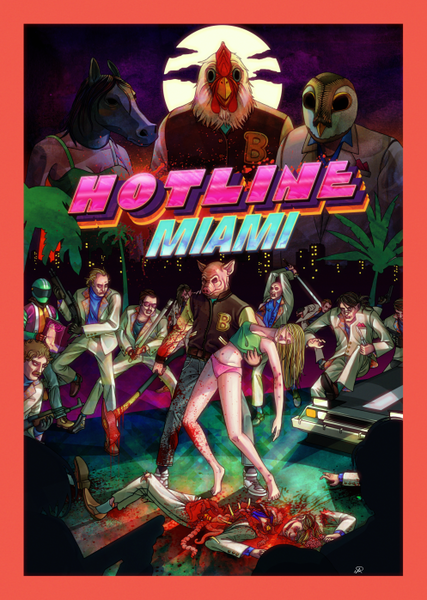
A vibrant cover that gives you a pretty good idea of what you're in for.

Hotline Miami is what might happen if Tarantino decided to design, write and direct a videogame after dropping acid. Various voices on the internet have whispered that Drive is a more prominent influence, but I haven't seen the film, so I can't really speak on that connection. The game is set in the late 80s of Miami, where you play as a letterman jacket-wearing lowlife, who must don animal masks and murder buildings full of other murderers at the behest of cryptic messages on your answering machine.

Now, in the context of videogames, mass murder isn't really that shocking.  It's pedestrian in fact. From GTA to Ratchet and Clank you mow down enemies by the dozen. Even Nintendo, the Disney of entertainment software, has you kill hundreds of enemies in a given playthrough of Zelda, Mario or even Kirby. What's shocking about Hotline Miami is the messy way those deaths are handled. In fact, the entire game is messy on several levels, but remarkably clean where it counts.

The game has an intentionally pixelated aesthetic that invokes an era of lesser graphical fidelity. This was a brilliant artistic decision. It echoes the style of videogames of the late 80s setting, it is an aesthetic that is technically and economically feasible for an independent developer and most importantly, it insulates the player from the game's extreme violence with a much-needed level of abstraction.

And that is the second way it is messy. You will see pixelated blood, guts and bits of brain. Occasionally an enemy will drag himself across the ground before dying. You will bludgeon, slash and shoot gangsters with a huge array of melee weapons, sporting goods, firearms and power tools. In this respect, it is undeniably similar to Rockstar's infamous Manhunt series; games that are literally styled after snuff films.

Manhunt
 however, is vividly rendered in 3D without any stylistic buffer and I don't play it for the same reason I don't watch torture porn: it disgusts me. I don't believe the violence will make rational people into monsters, but there isn't enough art and imagination there to make the experience feel rewarding instead of gross. Admittedly, Hotline Miami sits on the ledge of my limits.

So why play it? Like Super Meat Boy, it pairs brutally unforgiving difficulty with instant 1-button resurrection that gets you back into the action in seconds. You will die a lot. If you are like me, you will die an embarrassing amount. Most people can complete all 15 missions about 6 hours or so, but I think I've already clocked in twice that much time, and I still have a couple levels left.  Dying so much and resurrecting so easily allows you to see past the game's messy wrapper and appreciate its incredibly refined core-system: It is a puzzle game masquerading as an action game.

Each mission is broken up into a series of encounters which boil down to ridiculous runs of skillful twitch reflexes and the dumbest of dumb luck, or meticulously choreographed strategy and cheap tricks that exploit the predictable enemies. In most missions, you will do a mix of both. And the sense of relief and triumph you feel when you've completely cleared a level is enormous. I like this game better than Meat Boy, because while it demands excellence, it also indulges player improvisation to a greater degree. You have a variety of animal masks you can wear, which will subtly alter your character's abilities, and you also have a ridiculously large arsenal to draw from for your dark tasks. No two plays are alike, even when you play the same mission over for a higher score.

The last way in which the game is messy is the story. Your involvement with the voices on the answering machine are left open to interpretation, and these already-murky waters are further muddled by both surreal dream sequences and waking hallucinations. Toward the end of the game, you encounter talking corpses (who are apparently only there to tell you to fuck off), and there is also a last-minute change in protagonists. There is also a surprising moment of vulnerability early on though, when you rescue a girl from one of your crime scenes, and allow her to live in your apartment. Spoiler Alert: that doesn't end well. Those moments suggest the game is trying to call itself out, and point out just how screwed up this all is, but it never really coalesces into anything meaningful, because you are back on the mandatory murder train in seconds. It gets points for self-awareness, but loses some for failing to make a salient point. Also, the secret ending you can unlock provides a psuedo-political explanation that comes from far left field and fails to add any real depth to the experience. That said, it does raise questions and incite emotional reactions in the player, which is more than you can say for a lot of AAA titles out there.

Another area where the game excels is in the soundtrack. Each song alternates between pleasantly catchy and grating, so it pretty much captures the 80s perfectly. The mission music is high energy and frenetic, like the gameplay. The track that plays after each mission sounds like the formic ideal of a supermarket's ambiance filtered through a game console. And the song that blares in your apartment after every mission manages to be soothing and laid back, despite, you know, the blaring.

So would I recommend Hotline Miami? Kids obviously shouldn't be allowed anywhere near it. And neither should immature adults (particularly political alarmists who will refuse to look past the blood). Even with those caveats, I can't recommend it to general audiences, not because the game is dangerous, or because I believe it will make people more dangerous than they already are, but because most people don't have the masochistic mentality of an old school gamer. It takes a special kind of person to enjoy dying 20 times in a single firefight. If that sounds like you though, and you're looking for an experience that is both focused and messy, I can't recommend it highly enough.

Friday, January 11, 2013

Gunning Down Gangster Squad

When I told a friend I was heading to a screening of Gangster Squad last night, he apologized and wished me the best of luck. His concern was understandable given the critical consensus, and while I had planned on avoiding any kind of reviews prior to viewing, I had a good time with my expectations moderated. Faint praise, I know, but the bottom line is you can afford to give this one a pass, especially amidst Oscar season. The movie does have a few fun moments though, and it is worth a casual viewing on TV or Netflix (if it ever gets there).

The poster, like the rest of the movie, is passable.

I was an almost embarrassingly huge fan of Zombieland, director Ruben Fleischer's main claim to fame, but he was a poor choice here. While he has a gift for portraying both violence and comedy, he also has a very modern and lighthearted style that is ill-suited for a more serious period piece. The film feels like several different movies at different times, and never really forms a consistent identity. The best thing I can say about Gangster Squad is that it does not try to be L.A. Confidential, or anything else by James Elroy. That off-the-mark comparison is inevitable though, given the film's setting and subject matter.

Another reason I wanted to see the movie was the cast. Sean Penn gives a passionate performance, but that is also a mixed blessing. He portrays Mickey Cohen with such menacing intensity that it has a larger-than-life quality to it. Like Fleischer's direction, it flirts with full-on parody, but doesn't quite get there. A script with Disney-villain characterization doesn't help matters. Cohen unceremoniously kills off his subordinates, periodically explodes with rage, and makes a bunch of speeches that only serve to emphasize how despicable he is.

Josh Brolin gives a solid performance for a boring lead character: Sergeant John O'Mara. You've seen this soldier-turned-cop a hundred times before, and his iteration isn't written to be that likable. People repeatedly call him an honest cop and say he's got a good heart, but I think his dismal self-assessment as a retired soldier who doesn't know how to do anything but fight is far more accurate. He's almost as brutal as Cohen, and even more bullheaded.

Ryan Gosling's character, Jerry Wooters, is more likable and the other characters assess him far more accurately. One of the best lines in the movie is, "He's got a smart mouth but he's dumb where it counts." Emma Stone is wasted on a script that delegates her as mere eye-candy, though she does look stunning and her wardrobe will make you weep for what has become of women's fashion. Stone and Gosling comprise the star-crossed lovers of the film, though they don't really seem to sizzle in this movie, which is crazy because they were supposed to be stupid-good together in Crazy Stupid Love.

While the rest of the titular Gangster Squad is likable, nobody else in the supporting cast really gives a stand out performance. Again, I think a bad script is to blame. For every good line, there are at least five lazy cliches and trite observations. For every fresh scene, there are three you have seen before.

It seems like the stars just aren't right for Gangster Squad. It had a rough road to the silver screen too. After the Aurora massacre happened, Warner Bros. pulled the trailers and pushed back the premiere to re-shoot a gunfight that was originally supposed to occur in a movie theater. It was a compassionate gesture that will go completely unrecognized in the wake of Sandy Hook, with Washington and every media outlet imaginable blaming these atrocities on video games and Hollywood instead of a culture that systematically ignores mental illness and viciously preserves easy access to assault rifles. But that's an issue for another post.