Originally Posted: 8-11-14
So, I was surprised by Robin Williams like everybody else, but for some reason one of my first thoughts was "that makes sense." At least, to the extent that suicide ever makes sense.
I read one his interviews where he was supposed to be promoting his new show, and even in the blurb that popped up on google, the interviewer noted that he was talking more about bad decisions and regrettable behavior than sticking to the supposed subject. It's clear that he had been struggling with some serious demons for a long time.
It would be crass for me to pretend I was a huge fan. I preferred to take his stuff in single doses. But everybody I know, even others who didn't really care for him, can name at least one of his performances that they either tremendously enjoyed or respected.
In order, my favorite things by him were Aladdin, Dead Poet Society, Good Will Hunting, Insomnia, Mrs. Doubtfire, his HBO stand up special, and his appearance on Who's Line.
Each one of those performances were excellent and together they demonstrate a marvelous, magical range.
Even though I thought "that makes sense," the news also hurt. More than I would have guessed. Genie, John Keating, Sean Maguire, Walter Finch, Mrs. Doubtfire, I hope you all found peace. You are missed.

Wednesday, January 14, 2015


2014 FB Highlights: Oculus Rift
Originally Written 3/26/14
If you are not disappointed by Facebook's purchase of Oculus, you haven't been paying attention. Which of their acquisitions have been improved, or even leveraged to their full potential? When was the last time the core site added functionality you actually enjoyed or valued?
Feeds (or walls, or timelines, or whatever the hell we're supposed to call them this week) have become polluted by targeted sponsorship and throttled by algorithmic efforts to 'tailor' the content you receive, neutering them of their spontaneity and variety. People forced to develop for Facebook's "platform" have compared it unfavorably to Alighieri's Hell.
Zuckerberg's aspirations for VR resemble Second Life circa half a decade ago more than anything from Snow Crash or Neuromancer. Given Facebook's stake in developing VR as a social communications medium (read: a tarted up telepresence and home-shopping engine), it is naive to assume that the Oculus team will have nearly as much time and creative freedom to devote toward developing artistic and entertainment applications. The agenda behind an acquisition ALWAYS transforms the acquired.
All of that having been said...
If The Devil himself offered you $2B in resources to develop your dream project, and the exposure to make it a household name overnight, most people would find it very hard to walk away. That kind of money gives you the ability to test and refine your product in ways that VC funding cannot hope to match. Facebook's (admittedly dubious) ambitions also give Oculus an incentive to escape the techno-limbo of gaming peripherals. All of the potential applications Zuckerberg described are uninspired (or insipid), but if you really want to see Virtual Reality blossom into something beyond a fetish object, this is a smart horse to put money on.
Could Oculus have pulled it off on their own? Maybe. I like to think so, but I was always the target market. Even when it was primarily a gaming peripheral, their product hinted at a world I always wanted to live in. So yeah, of course I'm disappointed that Luckey and Carmac signed up with Z-bag. If I were more invested in this, I might even be outraged. But it is also laughable that Kickstarter backers and gaming enthusiasts feel like they have the right to tell a stranger to turn down a literal fortune to develop his dream.
If you are not disappointed by Facebook's purchase of Oculus, you haven't been paying attention. Which of their acquisitions have been improved, or even leveraged to their full potential? When was the last time the core site added functionality you actually enjoyed or valued?
Feeds (or walls, or timelines, or whatever the hell we're supposed to call them this week) have become polluted by targeted sponsorship and throttled by algorithmic efforts to 'tailor' the content you receive, neutering them of their spontaneity and variety. People forced to develop for Facebook's "platform" have compared it unfavorably to Alighieri's Hell.
Zuckerberg's aspirations for VR resemble Second Life circa half a decade ago more than anything from Snow Crash or Neuromancer. Given Facebook's stake in developing VR as a social communications medium (read: a tarted up telepresence and home-shopping engine), it is naive to assume that the Oculus team will have nearly as much time and creative freedom to devote toward developing artistic and entertainment applications. The agenda behind an acquisition ALWAYS transforms the acquired.
All of that having been said...
If The Devil himself offered you $2B in resources to develop your dream project, and the exposure to make it a household name overnight, most people would find it very hard to walk away. That kind of money gives you the ability to test and refine your product in ways that VC funding cannot hope to match. Facebook's (admittedly dubious) ambitions also give Oculus an incentive to escape the techno-limbo of gaming peripherals. All of the potential applications Zuckerberg described are uninspired (or insipid), but if you really want to see Virtual Reality blossom into something beyond a fetish object, this is a smart horse to put money on.
Could Oculus have pulled it off on their own? Maybe. I like to think so, but I was always the target market. Even when it was primarily a gaming peripheral, their product hinted at a world I always wanted to live in. So yeah, of course I'm disappointed that Luckey and Carmac signed up with Z-bag. If I were more invested in this, I might even be outraged. But it is also laughable that Kickstarter backers and gaming enthusiasts feel like they have the right to tell a stranger to turn down a literal fortune to develop his dream.
On Max Barry's 15 Ways to Write a Novel
Max Barry's "15 Ways to Write a Novel," is a fantastic read for authors (aspiring and otherwise) that I found in r/writing of all places. It's so refreshing to see somebody link an article whose author acknowledges multiple ways to skin a cat instead of couching a personal epiphany as the answer to writing.
A couple of these are opposing philosophies, but I don't think any are actually mutually exclusive; especially if you take different approaches toward different projects. I have tried most (but not all) of these methods/strategies. Here is how they worked out for me:
#1. Word/Page Count: Primary method I used to finish my first book, but I did it over a year instead of nanowrimo. (I share his assessment of nanowrimo too, though).
#2. Word Ceiling: Wow, what the hell. Haven't tried or heard of this one before. Seems weird and very hard. I may try it later when I can afford to experiment. I think I could only pull it off if my ceiling was also my count. Interesting idea though. May ensure quality.
#3. Coffee Shop: If I ever become a full timer, I think I'll need to do this. Coming home from work is the reverse process but it draws the same space/time distinction to form habits.
#4. Quiet Place: Tried it, doesn't work for me. Need music or some kind of white noise. If noise is distracting me, there is something else that is wrong with the story. Usually get through it by talking to Grace.
#5. Bursts: Impossible on ADD meds (personally speaking, anyway). Feasible with untreated ADD, but more risky because you might not bounce back to the keyboard. I do my best writing in one to three hour streaks every day.
#6. Immersion: I try to be as immersed in my world as possible but rarely disconnected. Often need to look things up... though come to think of it, I get a lot of good writing done on planes, or writing in notebooks when internet is not feasible. A reassessment may be in order.
#7. Intoxicants: ...part of my process more commonly than I ought to admit on the internet. I'm no Hunter S Thompson, but from what I’ve heard, my booze and caffeine intake strikes a chord with Hemmingway.
#8. Headphones: these days I almost always have a play list going, but never through headphones. It makes it too intense; I focus on the music more than the words.
#9. Break of Dawn: Did this the last few chapters of my first book. Worked very well, but prescriptions were in a weird place at the time; I am not a morning person by default. Also occasionally made me run late.
#10. Dead of Night: More my style, though usually I try to write about thirty minutes after getting home. I use this as more of an ultimatum: you can’t sleep until you've busted this clot. Great for breakthroughs, bad for the following morning.
#11. Jigsaw: I can never start a book like this, but I do it throughout the process; write a thing I like, find it doesn't work there, pull it out and plug it in later. Or save it for a different project!
#12. The End to End: This is another thing that got me through the first book. When I start jumping around, things become inconsistent. You need to have at least a general ending in mind for this to work though, making it very hard to square with The Journey approach. Why editing the first third of this new book is taking so long.
#13. The Outline: My standard approach; never would have completed a story if I couldn't do this at least once. But this approach swallowed everything I attempted before The Harrowing. It's very dangerous to do this with stories that require a lot of world building. You can get lost in the beautiful details without ever creating a character anybody but you will care about, or write something that feels more like a textbook than a story.
#14. The Journey: Started my current book this way. It was terrifying, and it resulted in tons of bloat and inconsistencies. But it forced me to write characters who feel more like people; who challenge me and say "I'm not doing that for the sake of your plot. Screw yourself." I think I also ended up with a very richly developed and more coherent world. But once I finished the first third, I got an idea where this was heading, and had to go back to the beginning to address the inconsistencies before moving forward. Time will tell if that was a mistake... Not one to start with I think.
#15. The Restart: This is how all of my Outline approaches ended up prior to my first novel. I usually find the idea itself is the problem. Instead of scrapping 'mostly' everything, and trying again immediately, put the thing in a box. Let it age. Maybe for a couple years. As long as necessary. An idea I had in high school will finally pay dividends in this novel.
Fellow writers! Please share which methods have worked for you!
A couple of these are opposing philosophies, but I don't think any are actually mutually exclusive; especially if you take different approaches toward different projects. I have tried most (but not all) of these methods/strategies. Here is how they worked out for me:
#1. Word/Page Count: Primary method I used to finish my first book, but I did it over a year instead of nanowrimo. (I share his assessment of nanowrimo too, though).
#2. Word Ceiling: Wow, what the hell. Haven't tried or heard of this one before. Seems weird and very hard. I may try it later when I can afford to experiment. I think I could only pull it off if my ceiling was also my count. Interesting idea though. May ensure quality.
#3. Coffee Shop: If I ever become a full timer, I think I'll need to do this. Coming home from work is the reverse process but it draws the same space/time distinction to form habits.
#4. Quiet Place: Tried it, doesn't work for me. Need music or some kind of white noise. If noise is distracting me, there is something else that is wrong with the story. Usually get through it by talking to Grace.
#5. Bursts: Impossible on ADD meds (personally speaking, anyway). Feasible with untreated ADD, but more risky because you might not bounce back to the keyboard. I do my best writing in one to three hour streaks every day.
#6. Immersion: I try to be as immersed in my world as possible but rarely disconnected. Often need to look things up... though come to think of it, I get a lot of good writing done on planes, or writing in notebooks when internet is not feasible. A reassessment may be in order.
#7. Intoxicants: ...part of my process more commonly than I ought to admit on the internet. I'm no Hunter S Thompson, but from what I’ve heard, my booze and caffeine intake strikes a chord with Hemmingway.
#8. Headphones: these days I almost always have a play list going, but never through headphones. It makes it too intense; I focus on the music more than the words.
#9. Break of Dawn: Did this the last few chapters of my first book. Worked very well, but prescriptions were in a weird place at the time; I am not a morning person by default. Also occasionally made me run late.
#10. Dead of Night: More my style, though usually I try to write about thirty minutes after getting home. I use this as more of an ultimatum: you can’t sleep until you've busted this clot. Great for breakthroughs, bad for the following morning.
#11. Jigsaw: I can never start a book like this, but I do it throughout the process; write a thing I like, find it doesn't work there, pull it out and plug it in later. Or save it for a different project!
#12. The End to End: This is another thing that got me through the first book. When I start jumping around, things become inconsistent. You need to have at least a general ending in mind for this to work though, making it very hard to square with The Journey approach. Why editing the first third of this new book is taking so long.
#13. The Outline: My standard approach; never would have completed a story if I couldn't do this at least once. But this approach swallowed everything I attempted before The Harrowing. It's very dangerous to do this with stories that require a lot of world building. You can get lost in the beautiful details without ever creating a character anybody but you will care about, or write something that feels more like a textbook than a story.
#14. The Journey: Started my current book this way. It was terrifying, and it resulted in tons of bloat and inconsistencies. But it forced me to write characters who feel more like people; who challenge me and say "I'm not doing that for the sake of your plot. Screw yourself." I think I also ended up with a very richly developed and more coherent world. But once I finished the first third, I got an idea where this was heading, and had to go back to the beginning to address the inconsistencies before moving forward. Time will tell if that was a mistake... Not one to start with I think.
#15. The Restart: This is how all of my Outline approaches ended up prior to my first novel. I usually find the idea itself is the problem. Instead of scrapping 'mostly' everything, and trying again immediately, put the thing in a box. Let it age. Maybe for a couple years. As long as necessary. An idea I had in high school will finally pay dividends in this novel.
Fellow writers! Please share which methods have worked for you!
Sarcasmancy: Now Featuring Greatest Hits from Hank's Facebook
I know it has been a long time since I updated. It's something of a seasonal pattern. But I recently had one of those 'obvious to everyone else all along' epiphanies. I treat my Facebook feed (or whatever the hell we're calling it this week) more like a blog than this site, and post on it more regularly. Sarcasmancy has always essentially been a nerdy editorial column that is mostly read by facebook friends and relatives.
Originally the idea was that I would 'maybe' use this blog to build a following and maybe become a legit entertainment critic, but you can't 'maybe' do either of those things. There are too many bloggers and aspiring critics writing good content to succeed with half-assery. I made peace with that a long time ago, and decided to just used this place to practice my writing, establish a voice, and analyze the entertainment I consume so I can learn from it. Occasionally ranting about politics, or current events, or responding to articles. My Facebook feed is the same thing, but in brief.
So Sarcasmancy is just going to be a public, remastered, highlights-reel of that feed. Why do this? Often times I end up putting off posts indefinitely, because I feel they have to reach an arbitrarily-determined depth of discussion. And between work, book writing, and everything else, the time for that depth rarely appears. Whereas with friends, I fire off things as quick as I find them, with a witty quip, comment, or opinion.
In terms of content changes, you can expect more political and political posts, more stuff on design, and more linked content. I will not be including links to the weirder inane fluff that catches my fancy--at least not here. I may start a Tumblr or something to scratch that itch, if people are interested.
To my potentially imaginary Not-Facebook-Friend readers, I cherish you, and sincerely hope you enjoy the new format and keep reading.
Originally the idea was that I would 'maybe' use this blog to build a following and maybe become a legit entertainment critic, but you can't 'maybe' do either of those things. There are too many bloggers and aspiring critics writing good content to succeed with half-assery. I made peace with that a long time ago, and decided to just used this place to practice my writing, establish a voice, and analyze the entertainment I consume so I can learn from it. Occasionally ranting about politics, or current events, or responding to articles. My Facebook feed is the same thing, but in brief.
So Sarcasmancy is just going to be a public, remastered, highlights-reel of that feed. Why do this? Often times I end up putting off posts indefinitely, because I feel they have to reach an arbitrarily-determined depth of discussion. And between work, book writing, and everything else, the time for that depth rarely appears. Whereas with friends, I fire off things as quick as I find them, with a witty quip, comment, or opinion.
In terms of content changes, you can expect more political and political posts, more stuff on design, and more linked content. I will not be including links to the weirder inane fluff that catches my fancy--at least not here. I may start a Tumblr or something to scratch that itch, if people are interested.
To my potentially imaginary Not-Facebook-Friend readers, I cherish you, and sincerely hope you enjoy the new format and keep reading.
Friday, October 17, 2014
On Hatred: Lines Crossed in Videogame Violence
Destructive Creation's honestly titled new game, Hatred, has already achieved infamy in gaming outlets, and I am expecting it to hit mainstream media before the week is out. The trailer portrays a trench coated psychopath, spouting a grandiose speech about a genocide crusade with growling menace. After that he proceeds to gun down innocent after innocent, unarmed people who are powerless against his arsenal, often pleading for their lives. Not going to link it. I don't blame you for refusing to watch it, but if you want to be part of the discussion, it will help.
The trailer disturbed me because it was carefully design to do exactly that, but also because it took me to a place where I never thought I would be: condemning violence in a videogame without qualification. I think it is a matter of days if not hours before this game is sensationalized, and once again used to typify all videogames and the people who play them. My goal here, is to get in front of the alarmist arguments, and lay out a case for other gamers as to why this game is different than the controversial ones that came before it. First, I want to broadly restate why I have defended and even championed violent games.
The trailer disturbed me because it was carefully design to do exactly that, but also because it took me to a place where I never thought I would be: condemning violence in a videogame without qualification. I think it is a matter of days if not hours before this game is sensationalized, and once again used to typify all videogames and the people who play them. My goal here, is to get in front of the alarmist arguments, and lay out a case for other gamers as to why this game is different than the controversial ones that came before it. First, I want to broadly restate why I have defended and even championed violent games.
Why draw the line here, when Grand Theft Auto also lets you shoot innocents and police? When Mortal Kombat has obscene graphic violence? When Hotline Miami forces you to kill room after room of enemies with brutal methods? Ultimately, I think one of the more meaningful distinctions on the value of controversial violence can be distilled down to a quote I really enjoy:

A grim sentiment from the start. And there is also some subtext that needs unpacking. Videogames often have you permanently dispatching foes with their backs turned, weapons holstered; just name any mature-rated game with a stealth mechanic. Halo lets you shoot groups of sleeping grunts. Not terribly honorable. Mal and the rest of the Serenity crew often lay beatdowns on bad guys who can't see it coming (though they do adhere to Mal's code of never killling outside a fair fight). The most important part of that quote though is the sentiment that I let my enemies make a choice. I will only end lives when somebody decides they are going to end mine, or one of my own. Real violence is an ugly thing. I think it is inherent to life and sometimes I think lethal measures are necessary. Following Mal's rules does not even make it right, but there is a justification there that adheres to the terms we have set as a society. As a species. I feel that the further you stray from these principles, the more problematic the violence becomes.

For all its tasteless gore and rage, Mortal Kombat actually satisfies every tenant of this code. Both combatants have made a decision to brawl to the death, down to the fact that they cannot attack until some unseen announcer counts down the fight. This is a game design decision, to allow players to orient themselves, but that seemingly inconsequential mechanic instills an intent of fair play by design. The gore is there to grab your attention; plain and simple. It was sensational. A cheap ploy that worked exactly as intended. But set in a universe populated by monstrous ninjas, cyborgs and mythological gods, the dismemberment, decapitations and over the top violence become comic. There is an appreciable distance from reality there. God of War works in a similar space, and Kratos' butchery is even less cartoonish, but the franchise has a better thematic excuse: the source material it is working from (Greek mythology) is also incredibly violent. Same with the gratuitous sex scenes present in every game.
Context also goes a long way towards establishing the appropriateness of violence. If the enemies being fought are members of an opposing war, they have made a choice to fight for their nations cause (I have yet to see a game that addresses conscripts in any meaningful capacity). If they are terrorists hell bent on starting a nuclear war (a very popular set-up), there is at least a ham-fisted narrative justification for sneaking into their base and using guerrilla tactics to kill enemy guards unaware. In Metal Gear Solid, (a game cast from that mold) the player must also contend with additional problems, like having to keep quiet, and finding places to hide enemy corpses to avoid alerting others. The game mechanically establishes consequences for violence; not just with the threat of injury, but by making life harder for the player even when he wins. Though now that I reflect, I can't remember what thin excuse Kojima presented to explain why the government's of the world didn't just turn Shadow Moses into a parking lot with a barrage of cruise missiles.

Dishonored, another stealth game where you can kill swathes of enemies unseen, has a better narrative explanation, as it occurs in a burgeoning industrial setting with dark magic leaking out of its dingy cracks: there are no weapons of mass destruction. More importantly, it gives you a choice. You can beat the entire game without killing anybody. And the lower your body count, the better shape the dismal world we be in when you are done. It makes the game harder. Players who want to take a bull in a china shop approach have a ton of very creative options. That range of experiential possibilities is art, and it is also gives the lie to Destructive Creations shameful, compulsive yet cursory excuse for creating Hatred: "We wanted to create a pure gaming pleasure," and "It's just a game." The implication being that the purest pleasure in gaming is killing people, and that games don't matter. Screw those fags trying to turn our fun into art! This is the argument of an idiot, full of sound and fury, signifying a sub-juvenile understanding of the world.
But onto bigger fish. Grand Theft Auto. Shooting cops. Killing hookers. Running over pedestrians. First of all, two of those activities are optional things you can do in the game, and all three have mechanical repercussions. Conflict with cops is no different than in heist movies; news outlets sensationalize that by presenting viewers with the fallacy that the game is for kids because all videogames are for kids. But they are not. When I am a parent, I will not allow my kid to play Grand Theft Auto until she or he demonstrates elsewhere, that they can appreciate and explain the satire present in it. Because every game is laced with humor that viciously criticizes society. It rarely offers any deep insights, but it undercuts the seriousness of the violence. Anybody who pays any attention to it will understand you are playing in a caricature of our universe.
The general themes of the story also demonstrate that the main characters are miserable, and the violence that typifies their lifestyle is often a primary contributor to their misery. The franchise started to take itself a lot more seriously with GTAIV, and Rockstar actually backed off the solemnity for the franchises most recent installment. In many ways, GTAV's third POV character, Trevor, is a satire of what a GTA protagonist would actually be like in real life and the answer is an ugly, volatile, borderline nonsensical, psychotic drug dealer (even after his actions are eventually given some narrative context). Should the player decides to go on a rampage, people do not plead for mercy. They do not cower on the ground, validating their murderer's power trip as they do in the Hatred trailer. That said, GTAV's mission featuring "enhanced interrogation techniques" made me walk away from the game indefinitely. I'm curious to see how the story turns out, but that mission killed my momentum.
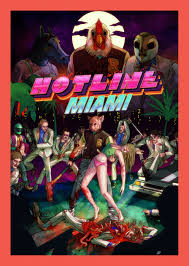
Another important question to ask of violence in any fiction is "what does this accomplish?" What is the point? The game I have felt guiltiest about enjoying is Hotline Miami. Even though the art style is abstract and very pixelated, its violence is utterly savage, and there is almost nothing else to the gameplay. There are surreal interludes between the game's frenetic, improvised fights, which employ everything from traditional weapons to appliances and the environment. There are hints of a very dark story. The thing that kept me playing is the brutal difficulty; and the gameplay that makes combat feel almost like a puzzle, but with far more nuance and variability than a Nintendo boss fight (which are puzzles). The only positive lesson you can scrape from it, is that it emphasizes how improbable an actual massacre is. You will die. Constantly. Over and over again. This is what would happen if you tried to fight even three people at once. But that good does not outweigh the desensitizing effect, where you no longer see the blood, and just start looking for the patterns. It is not only illicit but genuinely perverse. I think there is still a place for that in gaming.
Hatred's trailer exhibits none of this. The trailer does not show a creative variety in combat, or stylistic filter to temper and inform its violence. There is no broader purpose behind your actions (as there was in the also shamelessly controversial 'No Russian' mission in Modern Warfare 2). It fails to convey even the puerile thrill of crushing enemies. That may be buried in the game, somewhere, but the trailer is framed to emphasize that these people are helpless victims. One cut, one that I can't wash out of my head, is delivered with the same sexually sadistic tone as rape. Your goal, is to kill as many people as you can before the cops gun you down. The core tenant of Mal's grim, but ultimately noble promise: these people did not get to make a choice. Neither does the player.
Polygon claims that this game is powerless. That shock culture is dead, and this seems comical. Funny then, that it is the third article they've written on the trailer in as many days. Their editors realize that they cannot ignore it; they feel a pressing need to thoroughly address it. But they don't know how. I firmly believe that trying to laugh this one off is the wrong call. When school shootings are so common that they don't always warrant news coverage, a game that un-ironically worships at the altar of suburban gun massacre is dangerous. It will give credence to an argument that has been false more often than not: I can easily see future shooters using this one to practice.
Why should we care? Why give this any more attention by addressing it? Because it is going to erode the meager amount of perceived maturation gaming has accrued in recent years. It's going to breed a new generation of Jack Thompsons. The whole thing reeks of straw, like a politician has secretly financed the project to illustrate how depraved we are. But I am smelling what I want to. The detail in the animations are the product of a considerable budget and hours of work. This is real. Like school shooters, these people want to cause as much violence as they can, and be deified by the attention it demands.
So what should we do? I think the ESRB should take their Adults Only rating out of the glass and persuade retailers to cast this one out. I hope gaming journalists and critics use this as an opportunity to take stock of our industry and examine our medium's increasingly troubled reliance on violence and hype. I call upon fellow First Amendment champions to concede you can do some truly heinous shit with Freedom of Speech. We can't and shouldn't stop Destructive Creations from trying to make Hatred. But we as a community can point at them and say "See those guys? They're The Westboro Baptist Church of game developers."
For all its tasteless gore and rage, Mortal Kombat actually satisfies every tenant of this code. Both combatants have made a decision to brawl to the death, down to the fact that they cannot attack until some unseen announcer counts down the fight. This is a game design decision, to allow players to orient themselves, but that seemingly inconsequential mechanic instills an intent of fair play by design. The gore is there to grab your attention; plain and simple. It was sensational. A cheap ploy that worked exactly as intended. But set in a universe populated by monstrous ninjas, cyborgs and mythological gods, the dismemberment, decapitations and over the top violence become comic. There is an appreciable distance from reality there. God of War works in a similar space, and Kratos' butchery is even less cartoonish, but the franchise has a better thematic excuse: the source material it is working from (Greek mythology) is also incredibly violent. Same with the gratuitous sex scenes present in every game.
Context also goes a long way towards establishing the appropriateness of violence. If the enemies being fought are members of an opposing war, they have made a choice to fight for their nations cause (I have yet to see a game that addresses conscripts in any meaningful capacity). If they are terrorists hell bent on starting a nuclear war (a very popular set-up), there is at least a ham-fisted narrative justification for sneaking into their base and using guerrilla tactics to kill enemy guards unaware. In Metal Gear Solid, (a game cast from that mold) the player must also contend with additional problems, like having to keep quiet, and finding places to hide enemy corpses to avoid alerting others. The game mechanically establishes consequences for violence; not just with the threat of injury, but by making life harder for the player even when he wins. Though now that I reflect, I can't remember what thin excuse Kojima presented to explain why the government's of the world didn't just turn Shadow Moses into a parking lot with a barrage of cruise missiles.
Dishonored, another stealth game where you can kill swathes of enemies unseen, has a better narrative explanation, as it occurs in a burgeoning industrial setting with dark magic leaking out of its dingy cracks: there are no weapons of mass destruction. More importantly, it gives you a choice. You can beat the entire game without killing anybody. And the lower your body count, the better shape the dismal world we be in when you are done. It makes the game harder. Players who want to take a bull in a china shop approach have a ton of very creative options. That range of experiential possibilities is art, and it is also gives the lie to Destructive Creations shameful, compulsive yet cursory excuse for creating Hatred: "We wanted to create a pure gaming pleasure," and "It's just a game." The implication being that the purest pleasure in gaming is killing people, and that games don't matter. Screw those fags trying to turn our fun into art! This is the argument of an idiot, full of sound and fury, signifying a sub-juvenile understanding of the world.
But onto bigger fish. Grand Theft Auto. Shooting cops. Killing hookers. Running over pedestrians. First of all, two of those activities are optional things you can do in the game, and all three have mechanical repercussions. Conflict with cops is no different than in heist movies; news outlets sensationalize that by presenting viewers with the fallacy that the game is for kids because all videogames are for kids. But they are not. When I am a parent, I will not allow my kid to play Grand Theft Auto until she or he demonstrates elsewhere, that they can appreciate and explain the satire present in it. Because every game is laced with humor that viciously criticizes society. It rarely offers any deep insights, but it undercuts the seriousness of the violence. Anybody who pays any attention to it will understand you are playing in a caricature of our universe.
The general themes of the story also demonstrate that the main characters are miserable, and the violence that typifies their lifestyle is often a primary contributor to their misery. The franchise started to take itself a lot more seriously with GTAIV, and Rockstar actually backed off the solemnity for the franchises most recent installment. In many ways, GTAV's third POV character, Trevor, is a satire of what a GTA protagonist would actually be like in real life and the answer is an ugly, volatile, borderline nonsensical, psychotic drug dealer (even after his actions are eventually given some narrative context). Should the player decides to go on a rampage, people do not plead for mercy. They do not cower on the ground, validating their murderer's power trip as they do in the Hatred trailer. That said, GTAV's mission featuring "enhanced interrogation techniques" made me walk away from the game indefinitely. I'm curious to see how the story turns out, but that mission killed my momentum.
Another important question to ask of violence in any fiction is "what does this accomplish?" What is the point? The game I have felt guiltiest about enjoying is Hotline Miami. Even though the art style is abstract and very pixelated, its violence is utterly savage, and there is almost nothing else to the gameplay. There are surreal interludes between the game's frenetic, improvised fights, which employ everything from traditional weapons to appliances and the environment. There are hints of a very dark story. The thing that kept me playing is the brutal difficulty; and the gameplay that makes combat feel almost like a puzzle, but with far more nuance and variability than a Nintendo boss fight (which are puzzles). The only positive lesson you can scrape from it, is that it emphasizes how improbable an actual massacre is. You will die. Constantly. Over and over again. This is what would happen if you tried to fight even three people at once. But that good does not outweigh the desensitizing effect, where you no longer see the blood, and just start looking for the patterns. It is not only illicit but genuinely perverse. I think there is still a place for that in gaming.
Hatred's trailer exhibits none of this. The trailer does not show a creative variety in combat, or stylistic filter to temper and inform its violence. There is no broader purpose behind your actions (as there was in the also shamelessly controversial 'No Russian' mission in Modern Warfare 2). It fails to convey even the puerile thrill of crushing enemies. That may be buried in the game, somewhere, but the trailer is framed to emphasize that these people are helpless victims. One cut, one that I can't wash out of my head, is delivered with the same sexually sadistic tone as rape. Your goal, is to kill as many people as you can before the cops gun you down. The core tenant of Mal's grim, but ultimately noble promise: these people did not get to make a choice. Neither does the player.
Polygon claims that this game is powerless. That shock culture is dead, and this seems comical. Funny then, that it is the third article they've written on the trailer in as many days. Their editors realize that they cannot ignore it; they feel a pressing need to thoroughly address it. But they don't know how. I firmly believe that trying to laugh this one off is the wrong call. When school shootings are so common that they don't always warrant news coverage, a game that un-ironically worships at the altar of suburban gun massacre is dangerous. It will give credence to an argument that has been false more often than not: I can easily see future shooters using this one to practice.
Why should we care? Why give this any more attention by addressing it? Because it is going to erode the meager amount of perceived maturation gaming has accrued in recent years. It's going to breed a new generation of Jack Thompsons. The whole thing reeks of straw, like a politician has secretly financed the project to illustrate how depraved we are. But I am smelling what I want to. The detail in the animations are the product of a considerable budget and hours of work. This is real. Like school shooters, these people want to cause as much violence as they can, and be deified by the attention it demands.
So what should we do? I think the ESRB should take their Adults Only rating out of the glass and persuade retailers to cast this one out. I hope gaming journalists and critics use this as an opportunity to take stock of our industry and examine our medium's increasingly troubled reliance on violence and hype. I call upon fellow First Amendment champions to concede you can do some truly heinous shit with Freedom of Speech. We can't and shouldn't stop Destructive Creations from trying to make Hatred. But we as a community can point at them and say "See those guys? They're The Westboro Baptist Church of game developers."
The M.G.T.T.R. and other Guardians of the Galaxy
A lot of people are praising Guardians of the Galaxy for proving that the MCU (Marvel Cinematic Universe) can accommodate a space opera, but I think its more important contribution to their film cannon, and the superhero genre in general, is proving that an outright screwball comedy can work in this space. There is more than a touch of that in Iron Man 3, but at the end of the day, only one of those movies pushes this into new territory. Here's a hint: it's the one with the Machine-Gun-Totting-Talking-Raccoon, or MGTTR.

Really, Rocket is the core of the movie. Don't get me wrong, Groot is probably my favorite; the expressive range of his three word 'vocabulistics' (as the MGTTR puts it) outcasts Hodor (and many of his more articulate companions) too shame. Gamora is more conventional but still fun; Xena cosplaying as Captain Kirk's Girlfriend, and Zoe Saldana has proven track record with portraying painted space ladies. Peter Quill is the most familiar character; the viewer's point of entry, but Chris Pratt does an amazing job with his role; Han Solo re-imagined as an affably eccentric fuck up, filtered through 80s pop culture.
Rocket tho. He is the primary reason I was skeptical, and seeing him in motion, credibly, in the first teaser (and the amazing trailers that followed) was what sold me on the film. He is the element that grew the audience beyond established fan because anybody who is not yet a marvel fanatic has seen superhero movies before, they know what they look like, and they are tired of them. But an MGTTR? Never seen that before. Except we have. Putting aside his gruff, shoot'em all attitude, it is clear that Rocket is not a Wookie, or an Ewok, or any other alien. He is a bipedal, sentient raccoon from outer space.

From the start, you wonder what's happening there. And even though the movie never really spells out his origin (I have a hunch), you don't care because the flick is so aggressively entertaining. The movie begins with a joyful one man dance routine through an alien cave--scratch that. The beginning of the movie is actually a surprisingly poignant emotional sucker punch. It doesn't hit as hard as the opening of JJ's Star Trek (which made me tear up; a cinematic feat that hasn't happened since I was in the target demo for the Golden Age of Disney animation) but it is in the same weight class. Yeah, okay, it is incredibly tropey and brazenly yanks on your heart strings with a grip that only "mom dying of cancer in front of her son" can, but it works. And the whole damn movie is like that. It's shamelessly entertaining.
Guardians doesn't shed new light on the human condition, or even offer the subtle Post 9/11 criticism that the original Iron Man did, or offer the undercurrent of Snowden-era commentary of Winter Soldier. But what did you expect when you saw the MTTGR?! Marcel Proust? Are you here to have a good time or not? Throughout my writing education and career, I have heard the question "is this a cliche or not?" countless times, and answered in a dozen different ways, but the best answer is another question: Does it work? Your possible cliched thing, that familiar scene, or character, or turn of phrase; does it work for your story? If you are entertained, or if it makes you feel something real that is consistent with your intent and what has been written so far, then it is good storytelling. If you are exasperated, skeptical, or it's jarring, you've perpetrated a cliche.
There are not many original ideas in here, which usually kills something for me. Off the top of my head, I can only think of the MTTGR, the juxtaposition of 80s pop hits against a space opera backdrop, and Yondu's whistle-controlled arrow of mass destruction. You have seen everything else before. Even Groot's one word dialog is a refinement on Chewbacca's howls. But space cops? Space criminals and or bounty hunters? Collectors of alien menageries? Space bars? You see where I'm going with this.

I still wonder (or perhaps marvel is more fitting) at how James Gunn (or anybody) could pull this off, much less situate it in the same universe as Captain America: The Winter Soldier. Because that movie demonstrates the MCU has some observations to offer about the state of the world--without taking themselves as seriously as Nolan takes Batman. Between those two films, you have the entire range of Marvel's movies to date. If they can fit Dr. Strange in there, without explaining his magic via midiclorians, nanobots, or otherwise screwing him up, they will be able to do almost anything they want.
Almost. I still think Howard the Duck would be a bad idea (and Gunn even said the stinger was a joke). But hey. Guardians is proof that I have been wrong before.

Solid poster, but the first trailer and Blue Suede's Hooked on a Feeling
were what sold this movie. That and the MGTTR.
Really, Rocket is the core of the movie. Don't get me wrong, Groot is probably my favorite; the expressive range of his three word 'vocabulistics' (as the MGTTR puts it) outcasts Hodor (and many of his more articulate companions) too shame. Gamora is more conventional but still fun; Xena cosplaying as Captain Kirk's Girlfriend, and Zoe Saldana has proven track record with portraying painted space ladies. Peter Quill is the most familiar character; the viewer's point of entry, but Chris Pratt does an amazing job with his role; Han Solo re-imagined as an affably eccentric fuck up, filtered through 80s pop culture.
Rocket tho. He is the primary reason I was skeptical, and seeing him in motion, credibly, in the first teaser (and the amazing trailers that followed) was what sold me on the film. He is the element that grew the audience beyond established fan because anybody who is not yet a marvel fanatic has seen superhero movies before, they know what they look like, and they are tired of them. But an MGTTR? Never seen that before. Except we have. Putting aside his gruff, shoot'em all attitude, it is clear that Rocket is not a Wookie, or an Ewok, or any other alien. He is a bipedal, sentient raccoon from outer space.

The hero superhero movies deserved.
From the start, you wonder what's happening there. And even though the movie never really spells out his origin (I have a hunch), you don't care because the flick is so aggressively entertaining. The movie begins with a joyful one man dance routine through an alien cave--scratch that. The beginning of the movie is actually a surprisingly poignant emotional sucker punch. It doesn't hit as hard as the opening of JJ's Star Trek (which made me tear up; a cinematic feat that hasn't happened since I was in the target demo for the Golden Age of Disney animation) but it is in the same weight class. Yeah, okay, it is incredibly tropey and brazenly yanks on your heart strings with a grip that only "mom dying of cancer in front of her son" can, but it works. And the whole damn movie is like that. It's shamelessly entertaining.
Guardians doesn't shed new light on the human condition, or even offer the subtle Post 9/11 criticism that the original Iron Man did, or offer the undercurrent of Snowden-era commentary of Winter Soldier. But what did you expect when you saw the MTTGR?! Marcel Proust? Are you here to have a good time or not? Throughout my writing education and career, I have heard the question "is this a cliche or not?" countless times, and answered in a dozen different ways, but the best answer is another question: Does it work? Your possible cliched thing, that familiar scene, or character, or turn of phrase; does it work for your story? If you are entertained, or if it makes you feel something real that is consistent with your intent and what has been written so far, then it is good storytelling. If you are exasperated, skeptical, or it's jarring, you've perpetrated a cliche.
There are not many original ideas in here, which usually kills something for me. Off the top of my head, I can only think of the MTTGR, the juxtaposition of 80s pop hits against a space opera backdrop, and Yondu's whistle-controlled arrow of mass destruction. You have seen everything else before. Even Groot's one word dialog is a refinement on Chewbacca's howls. But space cops? Space criminals and or bounty hunters? Collectors of alien menageries? Space bars? You see where I'm going with this.

If you need more MGTTR, or just enjoy comic book heroes that are actually in comic form, apparently Skottie Young's run on Rocket Raccoon is a hoot.
I still wonder (or perhaps marvel is more fitting) at how James Gunn (or anybody) could pull this off, much less situate it in the same universe as Captain America: The Winter Soldier. Because that movie demonstrates the MCU has some observations to offer about the state of the world--without taking themselves as seriously as Nolan takes Batman. Between those two films, you have the entire range of Marvel's movies to date. If they can fit Dr. Strange in there, without explaining his magic via midiclorians, nanobots, or otherwise screwing him up, they will be able to do almost anything they want.
Almost. I still think Howard the Duck would be a bad idea (and Gunn even said the stinger was a joke). But hey. Guardians is proof that I have been wrong before.
Monday, September 8, 2014
Celebugation
I am really glad I actually didn't learn about Celebgate until last Wednesday (sign of an awesome vacation) or the further developments of gamergate. I was gonna write about them then, and then I wasn't but the internet is single-handedly digging a new trench for deplorability and dragging the averages of human decency beneath standards set decades ago.
Certain contingents are using celebgate a kind of slut-shaming field day and that’s bullshit. Taking racy, or even sexually explicit photos in private, to be shared exclusively with your lover is not deviant, or promiscuous. It's your own damn business.
Every time you take an intimate photo, there is a chance somebody other than the intended recipient will see it. And obviously, that probability increases in direct proportion to the lengths people are willing to go to make that happen. If you are an internationally recognized celebrity, those lengths are long, and should a photo get out, it will enjoy immortality on the internet. To most people, particularly older generations, the answer seems obvious: if clothes come off, the lens cap stays on. After seeing the heinous backlash these women are dealing with, it is an easy argument to make. But love and lust have a remarkable talent for making simple things complicated. Throw some nascent technology in there and things get messy quick.
In a world where cameras are ubiquitous and so much of our lives are mediated through screens, it’s not hard to understand why sexual photography has become a more prevalent part of intimacy and courtship. As human adults possessing free will, we should be able to weigh those risks, and make whatever decision we feel is fit. A risk is not equivalent to a consequence though, especially when a third party you trust promises to mitigate that risk and protect you from consequence.
A networked database would not be my first choice for storing sex pix—that’s what really took this from the scale from a home invasion to a declaration of war against female celebrity privacy—but Apple did not tell people to use common sense. They told them to trust their Cloud, where all their data would be safe. It wasn’t of course, so now they are obligated to explain how they fucked up (in a very detailed and public way), and make it right as soon as feasible. I predict a storm of God’s Wrath-grade litigation, and I hope the damages are severe enough to help Apple understand why some of us are still skeptics.
The fact that people are passing the leaked photos around like bubblegum cards is sick but absolutely predictable. As a former fourteen-year-old, I can tell you I would not be able to quash both my curiosity and my hormones if somebody offered me a consequence free opportunity to peek at what my celebrity crushes get up to in the bedroom. That’s not to excuse it. By and large, fourteen year old boys are terrible people. But short of Great Firewall censorship measures, or divine intervention, I’m not sure how you curb that behavior.
I think one solution is a broader acceptance of sex in general; being willing to talk about it, joke about it, and show it--provided that the parties being shown consent. That’s another post though, and I think it will be controversial and divisive, even if I handle it with care, and that’s not what I’m after. We have enough people stirring the pot. When I started Sarcasmancy, I hoped that I would develop this broad following, but honestly, this blog has mostly been a place to analyze stuff I’ve seen, practice my voice, and share my opinions with friends. If I was looking for attention, there are other models to follow.
Like Gawker. Sadly, they do not have a monopoly on clickbait. Upworthy and BuzzFeed are more prominent offenders, but they have enough dignity to refrain from peddling what they write as journalism. It’s especially saddening and frustrating since I remember a time when their network (or at least Kotaku and iO9) were better.
Gawker's "coverage" of celebgate has been particularly insulting. They’ve made mad clicks on it. Deadspin posted the Upton pictures, but Jezebel has been the most egregious offender. Here is their latest offering. The title presents an obvious positive, which they use as a Trojan for a vapid screed. The thrust of the piece is that Reddit complied with a court-order (against it's stated charter) but Reddit's owner, Yishan Wong didn't feel sorry enough about what the user-created board did (in accordance with Reddit's stated charter) and maybe did not go far enough to correct or apologize for their complicity in celebgate.
I'm glad /r/fappening is gone, but it was largely a symbolic gesture and Wong’s tone reflects that. The circulation of leaked photos is not going to stop, even on Reddit, and a more impassioned response implies more thorough action which would be disingenuous for practical purposes. Reddit is essentially 4chan, refined and writ-large. It is a microcosm for the entire internet (not just the otaku and assholes) that keeps score. There are countless forums organized by interest, and just like on 4chan, the content comes too quickly for human mods to be entirely in control. By and large, the mods do a very impressive job, but there are no codified standards, and next-to-no accountability for shirking or screwing up.
A couple years back, Reddit did a (long overdue) purge of their ‘jailbait’ focused forums featuring suggestive pictures of underage people (in theory, they guarded against out-and-out child porn from the start). A lot of people cried free-speech and slippery slope, but personally, I think that’s always a good place to draw a hard line. I think banning forums founded on ‘the interest’ of distributing stolen photos is a good idea as well (though for certain webheads who regard ownership and privacy as outdated notions I imagine it rankles). By eliminating the forums that openly facilitate the exchange of that material, Reddit made it harder for people to find the photos, and in an instant gratification culture, that actually does quite a lot. The ugly truth though, is that both things are still traded on Reddit, just like the internet at large. As long as there is an internet, terrible stuff will continue to be circulated on it. This is the ugly side of an open communication forum, but both Reddit and the internet should remain as open as they can. Ultimately, Wong’s appeal to personal morality is more honest than an empty promise, or the earnest intent to compromise what is valuable about the site.
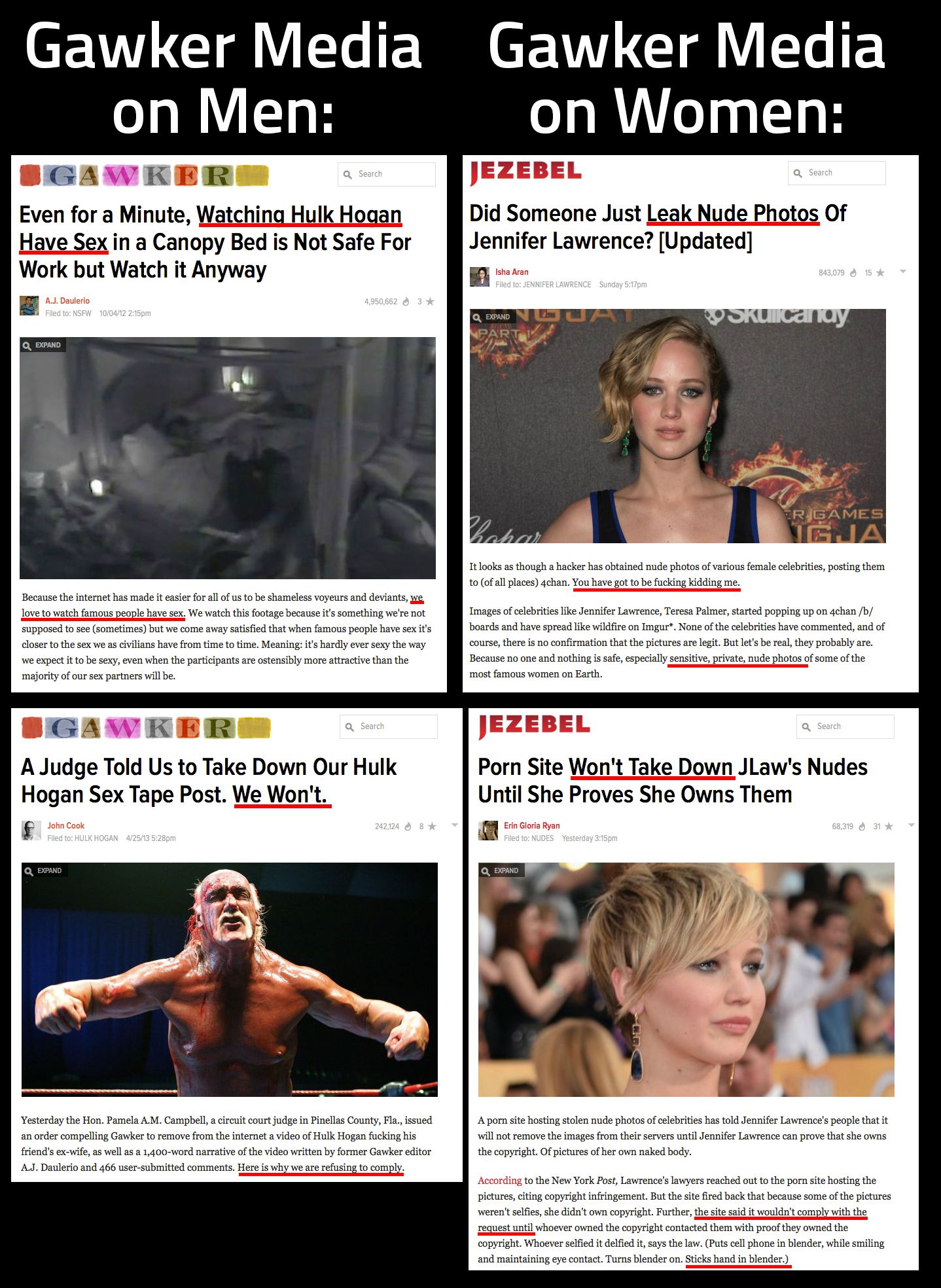
Gawker also seems to think that it's hilarious when a male sextape gets leaked, but when it happens to a woman it's sexism. Admittedly, there is a certain degree of theater-of-the-absurd-comedy to Hulk Hogan banging in a canopy bed--something this Tumblr meme pointedly ignores, but Gawker's proud refusal to obey a court order, contrasted against their use of Jezebel as a mouth piece to condemn Reddit for complying with one, is pretty loathsome. If you vocally identify as feminist (and that seems to be Gawker's sole purpose for Jezebel), you cannot celebrate one invasion of sexual privacy and condemn the other from the same soap box. I don't know how their writers don't choke on their own hypocrisy but I imagine it's one of the benefits that comes with having two faces.
It’s not just bad lazy, opportunistic writing; it’s also fuel for the Fedora Brigade. This is the kind of shit that makes confused boys and frustrated men think /r/redpill really does reveal some grand truth about the universe, and why tons of women are suddenly declaring that they are against feminism. It makes everyone serious about civil rights seem petty and sexist by mere association.
I know I’ve been writing about current events, social politics, and Serious Business more than entertainment lately. I know that’s not what I started this site for, or why most people come here, and frankly it’s less fun. But it’s important, more is coming (like I said, I’ve already started working on the next post in this vein) and I don’t think that’s gonna change anytime soon.
The next post I publish will probably be on Guardians of the Galaxy because I had the pleasure of re-watching it last night, and it’s fun enough (and weird enough!) that it deserves some unpacking. After that, I’m going to talk about The Magician’s Land (and the trilogy it concludes) with some Lev Grossman anecdotes from Dragon*Con to supplement it (Go read it. Go read all three. There will be spoilers). The Magicians is a series that wrestles with privilege and the relationship between fantasy.
In other news, I reached the end of part one of my second novel. That’s a gross sentence to read, but the awkward word choice is deliberate. Nothing is actually finished yet. This book changes like Tam fucking Lin as I write it, so now I need to go back and make it so all the chapters agree with each other. Right now, they’re like a pack of over-imaginative kids who can’t agree on who broke the cookie jar and how. It’s already nearly as long as my first book, and all three parts together are shaping up to be about 3 times longer. But I also think it is going to be at least that much better.
In other news, I reached the end of part one of my second novel. That’s a gross sentence to read, but the awkward word choice is deliberate. Nothing is actually finished yet. This book changes like Tam fucking Lin as I write it, so now I need to go back and make it so all the chapters agree with each other. Right now, they’re like a pack of over-imaginative kids who can’t agree on who broke the cookie jar and how. It’s already nearly as long as my first book, and all three parts together are shaping up to be about 3 times longer. But I also think it is going to be at least that much better.
Subscribe to:
Posts (Atom)