Still dealing with the health issues detailed in my last post. I promise I will get to reviewing Skin Game, and then move on to Gotham Central eventually. But a friend posted something on her wall that really set me off. Read this first: http://www.vice.com/read/women-against-feminism-have-a-strange-fixation-on-jars-723
You good? Okay. Cue rant:
Third Wave feminism was always doomed to have an image problem. Some of the Second Wavers were extremely radical (and they really needed to be to win what battles they did). But now detractors just remember the radicalness and chalk up the progress to... well, nothing actually, because they have not seen things progress first hand. To them, feminists were just a bunch of uppity bitches. The thrust of the piece is that if people just explained the truth to these people everything would get better. It's actually one of my problems with the way Women's Studies are taught: awareness is the tonic to every problem. Education is sufficient activism.
But a five minute conversation won't fix this problem (or MRAs). And honestly, neither will a university breadth-requirement. I suspect that many of these anti-feminist women feel threatened at some level. They assume fighting for equal pay and professional opportunities comes with the implicit expectations that all women everywhere become something more than a stay-at-home mom, or completely sloughing off your femininity, or burning bras, or refusing to shave, or learning how to open jars yourself (god forbid). It really doesn't though. To them, giving somebody an option that you have no interest in and does not affect their own choices or lifestyle in the slightest translates to harm. It's the same kind of logic that spurs conservatives to imply that allowing gay marriage somehow degrades heterosexual marriage.
And that's the second part of the problem. Third Wave feminism expanded it's scope to embrace every non-normative gender and sex that has been disenfranchised by the status quo (patriarchal and otherwise). And lots of people aren't cool with that, including some people who would have happily been quite radical Second Wave feminists. "We're about women! Why should we bother fighting for the queers or trannies?!" The Third Wavers did it because it was the right goddamn thing to do. If you are serious about fighting 'the patriarchy,' you have to call them out on all of their crimes; not just the ones that affect you specifically.
Unfortunately, that stance also makes things easier for conservatives to lure in people who purport to have "traditional values." The definition of feminist shifts from being "pro-women" to being "against every form of normativity and masculinity." Again, that's not what this is about. Admittedly, the agenda is more 'aggressive' than mere tolerance: we not only want people to stop actively persecuting women, lesbians, gays and trans people, we want them to enjoy the same rights you do as well. But we aren't going to force you to open your own jars.
That inclusive approach though also gave us the birth of Men's Rights Activists who, from my experience, typically range from boys who assume that there must be some misandrist conspiracy which accounts for why all those girls they liked never put out for them, to conservative pseudo-intellectual fuckwits who are frustrated that they can't play the victim card. And this opens the door for the whackjobs who believe that being considered 'dragon-kin' or whatever-the-hell ought to be a constitutional right. Social Justice Warriors are real, and they are also a problem, because they make everybody fighting for actual civil rights issues seem absurd by association.
These are world views that inherently impede and damage progress and equality. You can explain things to people who are confused and want to know more, but mere awareness will not course-correct assholes at cross-purposes. Those people, you have to fight. You can't shame them, or make them feel bad because they don't care what happens to you. They are hoping you're going to magically die off.
Not sure what the solution is, honestly. Neither conservative institutions, nor the "people of traditional values" they puppeteer give a shit about academics. Conservative business interests have the government effectively deadlocked with lobbying. So what channel of discourse is left? You never want to become the monsters they make you out to be, but I think it may be time for a Fourth Wave that's not afraid to kick some teeth in.
Figuratively speaking, of course.
(Mostly)

Thursday, July 24, 2014


Thursday, July 10, 2014
Kidney Crush Saga
This is the tale of why I have been suffering a parade of
medical problems for the past quarter year. I’ve been complaining about chronic
kidney stones on Facebook for a while now. But I was operating under false
assumptions. I have had one stone. And it has yet to pass. Most stones take a couple days to pass. Sometimes a week. A
month if you’ve really pissed off God.
I got diagnosed with this stone in April.
I got diagnosed with this stone in April.
Normally this would be a medical emergency, because a stone that gets stuck for that long is usually completely obstructing your ureter, and that is usually because it is enormous. This one started out at 4mm and now it’s grown to 5. Even by kidney stone standards, that’s not huge. It’s not obstructing either, so for a good month or so, I was not even aware it was there. But it’s stuck in there pretty good, and it has been steadily irritating my left kidney since April, causing it to swell, making the stone less likely to pass… vicious cycle, etc.
I experienced ‘descending pain’ several times throughout the
past months, which is pain that starts in you back and languidly makes its way
to your groin; the characteristic symptom of kidney stones. So naturally, we
assumed that I had a lot of the little bastards. But the pain was never as bad
as it was supposed to be, and no matter what, I could not ‘catch’ a stone to
find out what was causing it. Instead, it’s likely that little bits were
breaking off this stone, and disintegrating on the way down.
How did nobody notice? Well. I went to a clinic who sent me to
get a CT scan, and they said that I had about an 80% chance of passing the
stone naturally. I went to my doctor, who pretty much said “Drink lots of
fluids, GLHF.” Pain goes away and comes
back about a week later. Go back to the doctor. She says “You probably passed
it and got a new one. Drink more fluids. You don’t want to have another CT scan
so soon cause radiation is bad. Try an ultrasound.” So I get an ultrasound.
Fun Fact: ultrasounds are apparently shit worthless unless
you are previewing your progeny. The diagnosis was “Yup, probably a couple
stones in there.” Oh swell. Wait, 'a couple'? How many is 'a couple'? Does 'a couple' qualify as a scientific unit of measurement now? Anyway, same deal. Awful
descending pain that eventually disappears. I try to go back to my doctor again, but
she is on vacation so I see another doc in the office. He blames salt. Admittedly, I
do consume too much sodium and I have since cut back, but my wife (a nursing
student), my in-laws (pharmacists), and my father (molecular biologist) all told me that diagnosis is insipid. But he says “See a urologist. Drink lots
of fluids.”
The nearest urologist slot is open in a month. In that
intervening month (late May to late June), the descending pain stops altogether.
But I start to experience gas pain in my chest. Very uncomfortable, but I deal with it because I am tired of spending $30 to have some asshole in
a white coat tell me to drink more fluids. The pain gets worse though, as
ignored pain does.
Finally see the urologist. I ask him if the newfound pain in my chest has anything to do with kidney stone pain that has stopped (and at this point, I am very skeptical that I even had kidney stones at all because I’ve been trying to catch one this whole time). He says I need another CT, and that the gas pain is definitely not related to the stone. I consider telling him to piss up a rope, but agree to get another scan.
I get the other scan, and my parents and wife persuade me to see my doctor again. The day I decide to go, the gas pain disappears. Naturally. The doctor says we should wait for the scan results, confirms the chest pain is unrelated, but prescribes me some anti-acid pills. I don’t fill the script immediately because I have to get to work (having missed a lot of days due to debilitating pain and doctor’s appointments) and I am not in pain.
Finally see the urologist. I ask him if the newfound pain in my chest has anything to do with kidney stone pain that has stopped (and at this point, I am very skeptical that I even had kidney stones at all because I’ve been trying to catch one this whole time). He says I need another CT, and that the gas pain is definitely not related to the stone. I consider telling him to piss up a rope, but agree to get another scan.
I get the other scan, and my parents and wife persuade me to see my doctor again. The day I decide to go, the gas pain disappears. Naturally. The doctor says we should wait for the scan results, confirms the chest pain is unrelated, but prescribes me some anti-acid pills. I don’t fill the script immediately because I have to get to work (having missed a lot of days due to debilitating pain and doctor’s appointments) and I am not in pain.
Never do this. Break any date. Piss off whoever you have to.
If a doctor gives you meds, get them before you do anything else. Because around
noon the next day, my abdomen began to burn, and a couple minutes later it felt
like Lucifer himself was trying to screw his way out of my guts with a white-hot
railroad spike. Fortunately, all these trips to the doctor have given me an
arsenal of absurdly potent pain killers. Twenty minutes later, I am no longer in
agony, but trying to do my job while bombed out of my skull.
I get the anti-acids and take them every morning. Been doing that for a week now and I will keep
doing it until the doctor tells me I have to stop. So anyway, I start to look
stuff up, because if this is an unrelated problem, it’s clearly pretty serious.
I have always had an over-zealous gag reflex, but since June, I wake up every
morning and gag uncontrollably, sometimes to the point of vomiting. I had gas
pain that gave way to incredibly intense abdominal pain. I have been under a
lot of stress. Pain responds to anti-acids. This hasn’t been officially
diagnosed yet, so maybe it is just the devil with a railroad spike, but all
signs point to ulcer.
Today I went back to the urologist for the second CT scan
results.
Urologist: Yup, you’ve
got a stone in there.
Me, laughing: Damn,
another one? That’s weird I haven’t even felt any descending pain in like a
month.
Urologist nods: That’s
because it’s the same one.
Wut.
He continues: The first scan showed it at 4mm. This one is
5mm in the same position. It’s stuck.
Me, not laughing anymore: Oh. Uh, so what do we do now?
[Trigger warning for people with a penis]
Urologist: It’s a very simple procedure. We thread a wire up
your urethra, shoot the stone with a laser, vacuum out all of the shards, and put
in a stent to make sure nothing gets lodged in the indentation while it recovers.
Me: Right. Yeah. Okay. And uh, how does the stent come out? Does it bio-degrade, or…
Urologist: Oh no. We just yank it out three days later.
How does a week from today sound?
Funny thing is, this procedure will still probably be far
less excruciating than passing the stone naturally. And much more expedient. So
that’s why I have not been blogging much lately, and why I am having an operation next Thursday.
Saturday, April 12, 2014
Shields of the Marvel MCU
A week ago I saw Winter Soldier. Meant to write sooner but life has been very dense lately.
It was a great movie. Maybe the MCU's best offering yet, including Iron Man and The Avengers. It has the focused storytelling and character development of the original Iron Man, with all of the interconnected cross-world hijinks of The Avengers. And best of all, it had the MCU's cannon diverge from the comic books in a daring, meaningful way. Frankly, it's the kind of storytelling I expected from Joss. I wanted to see it in The Avengers. I wanted to see it in Agents of S.H.I.E.L.D. The last place I expected to find an enormous in-fiction paradigm shift was with Marvel's most conventional leading man. Like a c-list super villain, I have a bad habit of underestimating the Cap.
Spoilers will be peppered throughout.

My initial assessment of Captain America was that he was another cardboard paragon; Superman sans superpowers--a really fit boy scout. The first Cap movie, The First Avenger, set me straight. It showed me Steve Rogers was a man who earnestly wanted to make a difference, but lacked the ability to do so. When the universe called his bluff, he rose to the occasion and proved that all he needed was the chance. There's some other really good shit in there about a man who becomes co-opted by propaganda and decides to become something more. It was better than I ever dared dream.
But I figured, "Alright. We've seen this guy's arc. It was a fantastic story, but he's a product of his time, and taken out of that context, what is there left to say?" A whole hell of a lot it turns out. While the self-referential anti-propaganda plot threads of The First Avenger did a lot to quell the inherent jingoism of the Captain America identity, it was still there lurking in the shadows. If you see a guy with armor colored like Old Glory, you can't help but imagine a soldier who will do whatever his country deems necessary. Winter Soldier takes that misconception to task and shows general audiences that Cap not only represents what America is, or even what it can be, but what it ought to be.
Screenwriters Christopher Markus and Stephen McFeely waste no time putting Steve Rogers at odds with Marvel's super-spy agency S.H.I.E.L.D. (Strategic Homeland Intervention, Enforcement and Logistics Division). In this case, S.H.I.E.L.D. is a transparent stand-in for the NSA with obviously toxic, Minority Report notions on surveillance and security. So, already, like the original Iron Man flick, which stands as one of the first, mainstream cinematic Trojan Horses for post 9/11 thought, Winter Soldier gives us one of the first mainstream post-Snowden narratives. And it's fairly meaty! At least, as meaty as such a thing can be when your heroes primary vehicle of expression are fisticuffs and gunfire. That and shield-bashing.
Please indulge me a paragraph to nerd out about Cap's shield.
Shields are the punchline of violent literature. They are typically ineffectual, or at least invariably penetrable, and generally portrayed as the armament of choice for cowards or hidebound meat heads. One of the things that makes Captain America refreshing as an icon, is that he is a bad-ass who takes care of shit with a shield. In The First Avenger he also regularly uses guns and rifles to eliminate opposition, but it was a war-movie. In a war, a shield is not sufficient to win the day. But in Winter Soldier, we are in the modern day of the USA which is peacetime. A shield is a far more fitting tool for somebody whose mandate is to protect. In Winter Soldier Cap bashes the crap out of people with his magic shield, only briefly wielding guns and knives to turn them back on his attackers. His shield really is magic too. There is a ridiculous (but admittedly awesome) scene where he takes out a S.H.I.E.L.D heavy aircraft by jumping on top of it and throwing his shield at it a couple of times, really, really hard. In this specific scene, the shield causes explosions and works as a perfect boomerang. In other parts of the movie, it completely negates fall-damage, stops all gunfire and incendiaries, and cuts through anything (admittedly most of this is consistent with the properties of vibranium in comic lore. Freaking Wakanda man).
Okay. Shield rant over. Initiating S.H.I.E.L.D rant:
The thing I liked best about Winter Soldier is its big plot twist (which I am about to spoil). It is not an upheaval for the sake of controversy, but an IP molting; a fictional universe sloughing off vestigial and irrelevant appendage to create a newer, leaner, more relevant form. Midway through the movie, it is revealed that S.H.I.E.L.D. has not only been infiltrated by, but sculpted in the image of H.Y.D.R.A., the sci-fi branch of Nazi fucks Cap defeated back in The First Avenger. It is a fitting (if crude and underdeveloped) allegory for what happened to our national psyche in the 50s through the 80s. To this day, S.H.I.E.L.D. is a mainstay of Marvel comics, though frankly, they've always been more than a little scary and Orwellian. They reek of Cold War politics, policies, and paranoia. They are villains more often than not, and in a universe full of godlike heroes, it was high time somebody took them to task, or at the very least, instigated a serious regime change.
Captain America, Black Widow, Falcon, Maria Hill and Nick Fury do just that in Winter Soldier. By the end of the movie, S.H.I.E.L.D. is not a thing any more. They physically destroy and then legally dissolve S.H.I.E.L.D. from the MCU. Even if you brush aside over 50 years of comic continuity, that is still a really bold and interesting choice if you will recall that Marvel has a prime time network television program in the same shared universe called Agents of S.H.I.E.L.D. It would be even more interesting if Agents wasn't just awful.
A couple months back, I firmly stated that I would give Agents the benefit of the doubt, at least for the first season. Well folks, time makes fools of us all. I quit a quarter of the the way through. The standalone episodes were disposable. The writing has been atrocious, from predictable plot-points to a heinously shallow and unlikable main cast. Even the frank and earnest every man, Phil Coulson could not carry such an unevenly paced, cliched, and downright dumb show. Winter Soldier made me care enough to look up the episode synopses, and frankly, I feel like I've dodged a round of bullets. I did watch the latest episode, with it's scandalous betrayal and direct address of Winter Soldier's fallout, but the whole thing still feels like an anomalous lump on the body of the MCU. It has completely failed to pay off on the titular promise of my initial review.
There is a lot I'm not going to delve into. The huge laundry list of Easter Eggs, setting up innumerable sequels. Robert Redford playing the best MCU villain since Tom Hiddleston's Loki. Scar-Jo's awful one-expression, one-tone, one delivery approach to acting, but her appealing psuedo-sexual bromance with Chris Evans. Anthony Mackie's immensely likable Falcon. The surprisingly poignant and understated man out of time narrative present at the periphery of the movie.
But if you ever wondered why the really cut guy with the magic shield was calling the shots for Hulk, Iron Man and Thor, this movie will answer that question.You see, Steve Rogers is not like Superman without godlike abilities. He is more like the Batman's optimistic, socially adept twin. Both Steve and Bruce are orphans. Both feel powerless and rise to make a difference in imperiled worlds. Batman's quest is personal. His motivations are personal. His resources are personal. Even with his extended 'Bat Family' of crime-fighters, his methodology is deeply personal. Cap is an extrovert's superhero. He was a team player from the start. His resources were governmental. His motivations were global. He was not concerned with America, but rather, what he wanted America to do for the rest of the world.
The best superhero scene in the movie is not the opening sequence when Cap wrecks a ship full of bad guys, or even that part where he takes out a gunship with just a disc of witch-metal, but rather at the climax, where he gives a speech to an entire institution, and convinces at least half of them to do the right thing and fight for the good guys. After a spate of grimdark reality, and grimdark heroes to match, Captain America is the kind of hero we need, and the one audiences deserve.
It was a great movie. Maybe the MCU's best offering yet, including Iron Man and The Avengers. It has the focused storytelling and character development of the original Iron Man, with all of the interconnected cross-world hijinks of The Avengers. And best of all, it had the MCU's cannon diverge from the comic books in a daring, meaningful way. Frankly, it's the kind of storytelling I expected from Joss. I wanted to see it in The Avengers. I wanted to see it in Agents of S.H.I.E.L.D. The last place I expected to find an enormous in-fiction paradigm shift was with Marvel's most conventional leading man. Like a c-list super villain, I have a bad habit of underestimating the Cap.
Spoilers will be peppered throughout.

I really dug Cap's new outfit. Very solid poster too,
excepting the obvious T&A pose from Black Widow.
excepting the obvious T&A pose from Black Widow.
My initial assessment of Captain America was that he was another cardboard paragon; Superman sans superpowers--a really fit boy scout. The first Cap movie, The First Avenger, set me straight. It showed me Steve Rogers was a man who earnestly wanted to make a difference, but lacked the ability to do so. When the universe called his bluff, he rose to the occasion and proved that all he needed was the chance. There's some other really good shit in there about a man who becomes co-opted by propaganda and decides to become something more. It was better than I ever dared dream.
But I figured, "Alright. We've seen this guy's arc. It was a fantastic story, but he's a product of his time, and taken out of that context, what is there left to say?" A whole hell of a lot it turns out. While the self-referential anti-propaganda plot threads of The First Avenger did a lot to quell the inherent jingoism of the Captain America identity, it was still there lurking in the shadows. If you see a guy with armor colored like Old Glory, you can't help but imagine a soldier who will do whatever his country deems necessary. Winter Soldier takes that misconception to task and shows general audiences that Cap not only represents what America is, or even what it can be, but what it ought to be.
Screenwriters Christopher Markus and Stephen McFeely waste no time putting Steve Rogers at odds with Marvel's super-spy agency S.H.I.E.L.D. (Strategic Homeland Intervention, Enforcement and Logistics Division). In this case, S.H.I.E.L.D. is a transparent stand-in for the NSA with obviously toxic, Minority Report notions on surveillance and security. So, already, like the original Iron Man flick, which stands as one of the first, mainstream cinematic Trojan Horses for post 9/11 thought, Winter Soldier gives us one of the first mainstream post-Snowden narratives. And it's fairly meaty! At least, as meaty as such a thing can be when your heroes primary vehicle of expression are fisticuffs and gunfire. That and shield-bashing.
Please indulge me a paragraph to nerd out about Cap's shield.
Shields are the punchline of violent literature. They are typically ineffectual, or at least invariably penetrable, and generally portrayed as the armament of choice for cowards or hidebound meat heads. One of the things that makes Captain America refreshing as an icon, is that he is a bad-ass who takes care of shit with a shield. In The First Avenger he also regularly uses guns and rifles to eliminate opposition, but it was a war-movie. In a war, a shield is not sufficient to win the day. But in Winter Soldier, we are in the modern day of the USA which is peacetime. A shield is a far more fitting tool for somebody whose mandate is to protect. In Winter Soldier Cap bashes the crap out of people with his magic shield, only briefly wielding guns and knives to turn them back on his attackers. His shield really is magic too. There is a ridiculous (but admittedly awesome) scene where he takes out a S.H.I.E.L.D heavy aircraft by jumping on top of it and throwing his shield at it a couple of times, really, really hard. In this specific scene, the shield causes explosions and works as a perfect boomerang. In other parts of the movie, it completely negates fall-damage, stops all gunfire and incendiaries, and cuts through anything (admittedly most of this is consistent with the properties of vibranium in comic lore. Freaking Wakanda man).
Okay. Shield rant over. Initiating S.H.I.E.L.D rant:
The thing I liked best about Winter Soldier is its big plot twist (which I am about to spoil). It is not an upheaval for the sake of controversy, but an IP molting; a fictional universe sloughing off vestigial and irrelevant appendage to create a newer, leaner, more relevant form. Midway through the movie, it is revealed that S.H.I.E.L.D. has not only been infiltrated by, but sculpted in the image of H.Y.D.R.A., the sci-fi branch of Nazi fucks Cap defeated back in The First Avenger. It is a fitting (if crude and underdeveloped) allegory for what happened to our national psyche in the 50s through the 80s. To this day, S.H.I.E.L.D. is a mainstay of Marvel comics, though frankly, they've always been more than a little scary and Orwellian. They reek of Cold War politics, policies, and paranoia. They are villains more often than not, and in a universe full of godlike heroes, it was high time somebody took them to task, or at the very least, instigated a serious regime change.
Captain America, Black Widow, Falcon, Maria Hill and Nick Fury do just that in Winter Soldier. By the end of the movie, S.H.I.E.L.D. is not a thing any more. They physically destroy and then legally dissolve S.H.I.E.L.D. from the MCU. Even if you brush aside over 50 years of comic continuity, that is still a really bold and interesting choice if you will recall that Marvel has a prime time network television program in the same shared universe called Agents of S.H.I.E.L.D. It would be even more interesting if Agents wasn't just awful.
A couple months back, I firmly stated that I would give Agents the benefit of the doubt, at least for the first season. Well folks, time makes fools of us all. I quit a quarter of the the way through. The standalone episodes were disposable. The writing has been atrocious, from predictable plot-points to a heinously shallow and unlikable main cast. Even the frank and earnest every man, Phil Coulson could not carry such an unevenly paced, cliched, and downright dumb show. Winter Soldier made me care enough to look up the episode synopses, and frankly, I feel like I've dodged a round of bullets. I did watch the latest episode, with it's scandalous betrayal and direct address of Winter Soldier's fallout, but the whole thing still feels like an anomalous lump on the body of the MCU. It has completely failed to pay off on the titular promise of my initial review.
There is a lot I'm not going to delve into. The huge laundry list of Easter Eggs, setting up innumerable sequels. Robert Redford playing the best MCU villain since Tom Hiddleston's Loki. Scar-Jo's awful one-expression, one-tone, one delivery approach to acting, but her appealing psuedo-sexual bromance with Chris Evans. Anthony Mackie's immensely likable Falcon. The surprisingly poignant and understated man out of time narrative present at the periphery of the movie.
But if you ever wondered why the really cut guy with the magic shield was calling the shots for Hulk, Iron Man and Thor, this movie will answer that question.You see, Steve Rogers is not like Superman without godlike abilities. He is more like the Batman's optimistic, socially adept twin. Both Steve and Bruce are orphans. Both feel powerless and rise to make a difference in imperiled worlds. Batman's quest is personal. His motivations are personal. His resources are personal. Even with his extended 'Bat Family' of crime-fighters, his methodology is deeply personal. Cap is an extrovert's superhero. He was a team player from the start. His resources were governmental. His motivations were global. He was not concerned with America, but rather, what he wanted America to do for the rest of the world.
The best superhero scene in the movie is not the opening sequence when Cap wrecks a ship full of bad guys, or even that part where he takes out a gunship with just a disc of witch-metal, but rather at the climax, where he gives a speech to an entire institution, and convinces at least half of them to do the right thing and fight for the good guys. After a spate of grimdark reality, and grimdark heroes to match, Captain America is the kind of hero we need, and the one audiences deserve.
Wednesday, April 2, 2014
How I Met Your Mother or Why I am Banging Your Aunt Robin
I know I planned to regale you all with more tales from AWP, but then work got crazy busy. So, somewhat inevitably, the ending of HIMYM got spoiled for me before I could watch it.
Even without watching the show, the summaries provoked a strong reaction, and a strong reaction to the all the reactions I've read so far. Want the TL;DR? I think it was a
strong resolution to a series that had lost its way.
One of the signs of a good ending is that it looks
inevitable when you re-examine the very beginning of the story. A circle, or perhaps a
series of circles, is the natural shape of narrative. Consequently, the
beginning ought to heavily influence what the ending looks like. We don’t begin the story with the
mother. Or with Ted meeting Marshall, or Lily, or Barney. We get all those
stories eventually, but we begin with Ted meeting Robin. That gives her
character gravitas that really couldn’t be overcome or denied. It was always
about Robin and Ted. Even more than Ted and Tracy.
Do not confuse my approval of the conclusion as an endorsement for the characters or the course of the show.
Do not confuse my approval of the conclusion as an endorsement for the characters or the course of the show.
Somewhere along the lines, Ted Moesby stopped being a
lovable dweeb and became a legitimate shitbag. Can’t put my finger on when
exactly. Might be when he broke up Victoria’s (admittedly
doomed-from-the-start) wedding to Klaus, knowing firsthand how awful being left
at the altar was. It might have been when he catalyzed the end of Zoey’s (obviously
awful) marriage. It might have been when he rushed into proposing to Stella, despite the fact that their relationship only ever half-worked. No matter what way you slice it, the dude was kryptonite to matrimony for a couple seasons. Also,
the parade of plowed bimbos was innocent and charming enough for the first
couple seasons, but by the end, it had become genuinely sort of sick.
Barney and Robin’s characters get wrecked too, and that one is far easier to chart: it happens as soon as they start dating each other. Barney’s strength as a character was representing a person, amidst all these other lovebirds, who did not need monogamy. I think marriage is the right play for the majority of humans, but there are some people who will always get bored in a relationship. Who Barney became with Robin was not who the series told us he was at the start, and no, his decision to marry her did not constitute maturation: it was rank self-deception. Robin was similar to Barney in that she was self-assured, opinionated, and not wholly sold on settling down; but we learn fairly early on that she did want to have that life eventually. For her, monogamy would constitute character growth. I imagine that the writers set Barney and Robin up because the fans clamored for their pairing. They clamored because Barney and Robin had comparable (but also obviously incompatible) personalities. When their romance went to hell the first time, I thought it was the writers telling the audience “See this? The ‘obvious’ match-up? It’s a fucking stupid idea and this is the end of it.” I cheered.
And then they put them back together. The narrative backpedal alone would have been bad enough, but to make matters worse, Robin and Barney were already dating two other beautiful, brilliant characters who frankly deserved better. That didn’t just make them worse characters, it made them awful people. Flawed characters are interesting, yes, and people make bad choices all the time in real life, but in fiction, the flaws and fuck-ups should serve the central story.
How I Met Your Mother’s story was always about Ted and Robin. That’s not what the title implies, but it’s what the plot was designed to do; hence the showrunners shooting the final scenes with the kids in season two. They knew Ted would seek out Robin after his soul-mate died. So few shows—so few long-running stories in any format—stick to a single planned plot anymore. So it is incredibly satisfying to see a series pay off a plan instead of just making shit up or pandering to fans, especially when the intended ending is kind of tragic and challenging.
What happened to HIMYM is what happened to Friends, which was also always going to end with a hook up: Ross and Rachel. This was even more obvious, but the network had a huge hit on their hands, the actors were being paid stupid amounts of money (to prevent them from pursuing lucrative careers elsewhere), and the also well-paid writers were high on their fans’ adoration, so they milked that tit for all it was worth. What was originally tight and coherent got bloated and convoluted. The characters were becoming less interesting, so to maintain the appearance of growth, the writers had them make decisions that broke their established personalities.
Barney and Robin’s characters get wrecked too, and that one is far easier to chart: it happens as soon as they start dating each other. Barney’s strength as a character was representing a person, amidst all these other lovebirds, who did not need monogamy. I think marriage is the right play for the majority of humans, but there are some people who will always get bored in a relationship. Who Barney became with Robin was not who the series told us he was at the start, and no, his decision to marry her did not constitute maturation: it was rank self-deception. Robin was similar to Barney in that she was self-assured, opinionated, and not wholly sold on settling down; but we learn fairly early on that she did want to have that life eventually. For her, monogamy would constitute character growth. I imagine that the writers set Barney and Robin up because the fans clamored for their pairing. They clamored because Barney and Robin had comparable (but also obviously incompatible) personalities. When their romance went to hell the first time, I thought it was the writers telling the audience “See this? The ‘obvious’ match-up? It’s a fucking stupid idea and this is the end of it.” I cheered.
And then they put them back together. The narrative backpedal alone would have been bad enough, but to make matters worse, Robin and Barney were already dating two other beautiful, brilliant characters who frankly deserved better. That didn’t just make them worse characters, it made them awful people. Flawed characters are interesting, yes, and people make bad choices all the time in real life, but in fiction, the flaws and fuck-ups should serve the central story.
How I Met Your Mother’s story was always about Ted and Robin. That’s not what the title implies, but it’s what the plot was designed to do; hence the showrunners shooting the final scenes with the kids in season two. They knew Ted would seek out Robin after his soul-mate died. So few shows—so few long-running stories in any format—stick to a single planned plot anymore. So it is incredibly satisfying to see a series pay off a plan instead of just making shit up or pandering to fans, especially when the intended ending is kind of tragic and challenging.
What happened to HIMYM is what happened to Friends, which was also always going to end with a hook up: Ross and Rachel. This was even more obvious, but the network had a huge hit on their hands, the actors were being paid stupid amounts of money (to prevent them from pursuing lucrative careers elsewhere), and the also well-paid writers were high on their fans’ adoration, so they milked that tit for all it was worth. What was originally tight and coherent got bloated and convoluted. The characters were becoming less interesting, so to maintain the appearance of growth, the writers had them make decisions that broke their established personalities.
That huge flaw acknowledged, the finale manages to pay off Robin and Ted’s story, and Barney
also finally gets some genuine character growth in the form of having a daughter.
Even if he remains a cocky, chauvinistic man-slut, he gets to address the
single solemn aspect of his character by trying to become the father he never
had. And while Barney didn’t want to get married, we learn fairly early on that
he did want kids.
I don’t actually know how Marshall and Lilly ended up, and
to be honest, it doesn’t matter in the slightest. I went to Wikipedia to
complete this post, there were sentences on them in the episode summary, and I skipped
them. It's not that I hate them... at least, I didn’t initially.
They represented Ted’s dream, and gave the writers an
opportunity to explore a criminally under-utilized period in a romantic
relationship: the space after monogamy preceding parenthood. Their character
arc had enough material for five very solid seasons; seven if you had to
stretch it. But Marshall always kind of bored me (thank god for Segel finally
forcing the writers to pull the plug though), and by Season 6, Lily, who
started out interesting and canny (if prone to selfishness and meddling), had
become insufferable.
The gravest sin of the final season, is that after spending twenty-two episodes on a single goddamn weekend (buoyed only by a generous helping of flash forwards and the refreshing episode detailing Tracy’s life), the viewer is hit with a parade of bombshells in the finale. The audience is given no time to process Barney and Robin’s divorce, Tracy’s death, and Ted pursuing Robin again. Having two of your best friends divorce is incredibly ugly and traumatizing. “Nothing will ever change,” my ass. That’s the most haunting line of the entire show, by the way, because it implies this toxic non-three-way between Barney, Ted and Robin will never be completely resolved. Milioti, who was undeniably the best thing about the last season, deserved a heartbreaking goodbye followed by a few minutes for fans to sob uncontrollably. Even the fact that Ted is telling his kids this story six years after her passing begs further explanation. His behavior to date does not suggest he would have the restraint, even grief-stricken and burdened with parental responsibilities, to refrain from screwing around a bit in the interim.
I know that many fans and critics predicted the ending, but it still managed to be surprising, provoke discussion, and make narrative sense. Honestly, this show has always danced between comedy and tragedy, regularly spitting in the face of pure romantic sap. A happily ever after wrap up would have been boring and insulting. The ending could have been executed better, but its problems all have roots in two to four unnecessary seasons’ worth of material. Given what had happened to the show, I am actually quite happy with how it resolved. Like the yellow umbrella, it got lost for a couple years in the middle, but found itself in the end.
The gravest sin of the final season, is that after spending twenty-two episodes on a single goddamn weekend (buoyed only by a generous helping of flash forwards and the refreshing episode detailing Tracy’s life), the viewer is hit with a parade of bombshells in the finale. The audience is given no time to process Barney and Robin’s divorce, Tracy’s death, and Ted pursuing Robin again. Having two of your best friends divorce is incredibly ugly and traumatizing. “Nothing will ever change,” my ass. That’s the most haunting line of the entire show, by the way, because it implies this toxic non-three-way between Barney, Ted and Robin will never be completely resolved. Milioti, who was undeniably the best thing about the last season, deserved a heartbreaking goodbye followed by a few minutes for fans to sob uncontrollably. Even the fact that Ted is telling his kids this story six years after her passing begs further explanation. His behavior to date does not suggest he would have the restraint, even grief-stricken and burdened with parental responsibilities, to refrain from screwing around a bit in the interim.
I know that many fans and critics predicted the ending, but it still managed to be surprising, provoke discussion, and make narrative sense. Honestly, this show has always danced between comedy and tragedy, regularly spitting in the face of pure romantic sap. A happily ever after wrap up would have been boring and insulting. The ending could have been executed better, but its problems all have roots in two to four unnecessary seasons’ worth of material. Given what had happened to the show, I am actually quite happy with how it resolved. Like the yellow umbrella, it got lost for a couple years in the middle, but found itself in the end.
Tuesday, March 4, 2014
AWP 2014: A Guy's Take on Sex in YA Fiction
Last weekend I attended AWP for the first time. For those who don't know, AWP is short for Association of Writers and Writing Programs. It is North America's largest literary conference, boasts a big book fair (primarily focused on lit mags, small presses, and MFA programs) and tons of panels (mostly) hosted by people who would sooner be tortured to death than admit they write anything that could be construed as speculative fiction.
As a self-professed genre writer, I felt like people were going to make me wear an armband and put me on a train, but I had a great time, learned a lot and came away with a ton of awesome stories. I attended the explosive and very weird Magic & Intellect Panel. My wife and I watched a dude perfect his slow-motion pelvic thrust on the dance floor each night over the course of the convention. I will share some of these stories in detail over the coming days, but I want to begin by talking about one of the final panels of the convention: How Far to Go: Sex in YA Fiction.
The panel was hosted by Adele Griffin, Emily Lockhart, Robin Wasserman, and Sara Mlynowski, all well-established YA novelists. The reason I feel like I have something worth saying is twofold. Firstly, I was one of five men in an audience of about fifty people, which struck me as unusual. Secondly, I also attended a similar panel earlier in the program: Warning Extreme Content: Sex, Drugs, and Abuse in Young Adult Literature and thought I could compare the two.
I have not read any of these ladies' books, but based on their readings, I feel the four of them nailed teenage girl sexuality. Or at least, four very varied approaches toward it. I say this based on my youth spent in a ballet studio, where I was surrounded by scores of young women who occupied roles in my life ranging from surrogate sisters, idealized crushes, awkward girlfriends, close friends, lust idols, patient mentors, artistic rivals, caustic hell-bitches, and the woman who would become my wife and soul mate. The insight they have given me is invaluable.
The panel offered some priceless advice as well. It observed that good writing about sex in YA can not only steer kids away from bad sexual experiences, but prepare them for positive ones down the road (and what parent doesn't want their kids to eventually have positive sexual experiences)? There was the observation that going into great detail during the act of sex typically does not move the plot forward, and that in YA, where the sex is under a particularly exacting microscope, it’s important for every detail to serve the story. Throughout, all the panelists also had a healthy sense of humor, and they were welcome exceptions to the general rule of being anti-speculative lit.
The panel's biggest blind spot though, as observed by an audience member, was teenage guy sexuality, which is what I thought I would talk about for the majority of this post.
I think the sharpest distinction between girl and guy sexuality, is that while women are simultaneously warned against being sluts and depicted as perfected sexual objects in the media, guys are given one message from the time that they are nine: bed hot women. Not people you connect with, or even people you find physically pleasing. You are to seek out hot women and screw as many of them as possible, as soon as possible. On the one hand, there is no frustrating doublespeak, no ambiguity in that message. But on the flipside, it leaves much less room for self-discovery and personal growth, both sexually, and in general. The disparity in messages also carries over to the way men and women bully each other.
Teenage girls are the cruelest people on the planet. Teenage boys are the most brutal. Girls hatch elaborate campaigns to destroy each other, using both blade of the double-standard. You’re a pathetic prude one minute, and an irredeemable whore the next. For guys there is only constant blunt-force verbal and (often) physical trauma. You’re a fag. You will die a virgin. How are you gonna get laid looking like that? There is no cunning. There is no deception. The only respite is how casual and flippant the barrage becomes. And the only gold-standard of respect is who you’ve stuck your dick in—nevermind if it meant ruining her reputation or self-esteem in the process.
As adults we know this is bullshit. Hell, most guys realize it is an appalling falsehood by freshman year. But that doesn’t stop the story. The pervasive, ceaseless social narrative reminding you that who you’ve fucked is what really matters. God help you if you are gay, bi, trans, or simply figuring your shit out. They say that women tend to have more body issues than men thanks to the enduring prevalence of the male gaze in media, but men are also trained to view themselves with the same superficial eye, and if you are chubby, or skinny, or have acne, you are going to be wracked by insecurities. Ditto if you engage in any activity that is considered feminine, like, say, ballet.
As far as physiology goes, I would say that sex is more of a constant distraction and annoyance for guys. Not because our urges are necessarily stronger, or because guys think about sex more than girls, but because we can always get an erection, and the physical element makes our arousal harder for everybody to ignore. Most of the time it’s not a big deal, but at some point in four years, it will be as bad as it possibly can be. Given our more ostentatious anatomy, I think guys tend to think about sex in more superficial terms than most girls. Boners may also partially explain our fixation with boobs—which are the most ostentatious part of a girl’s anatomy. Pro Tip: I know it sounds stupid, but you really cannot overestimate the average teenage guy’s fixation on breasts (in their defense, I am 26 and boobs are still awesome).
What does she look like when she’s naked? How does my penis compare to other guys'? Where can I touch her? These are the questions boys tend to ask when they get stuck in their own heads. Everything else is an afterthought, including: What will feel best? How can I make it memorable? Are we going to have fun? Though, I think that last one eludes almost everybody starting out. Sex is serious fucking business for teens. Which brings me to how to write the deed itself.
In this scenario, I think both genders are on an equal playing field. If the sex act (even something as harmless as kissing) is premeditated, it is inevitably over-thought and horrendously awkward. If equally inexperienced, both parties will do everything cautiously and by stumbling half-measure. Conversely, unplanned make-out sessions (and accompanying sex acts) tend to be unbridled animalistic hedonism. They are incandescent bright spots amidst one of the shittier periods of your life, and it is difficult to overstate the passion or accompanying elation. I think girls tend to keep a clearer head in the heat of the moment, as they tend to be more wary of the threat of gestation, but it really depends on the personalities involved.
So how did How Far to Go compare to the other panel on taboo subjects in YA fiction? I think I have to give the nod to Warning Extreme Content but it scratched a very personal itch. The panel was hosted by Ann Angel ("Not the pornstar!"), Kekla Magoon, and Carrie Jones. It was one of my favorite panels in the entire convention, because the panelists focused less on their own material in favor of crafting broader arguments against pro-censorship organizations. They backed up their arguments with excellent quotes from Chuck Wendig (Blackbirds), Sherman Alexie of (The Absolutely True Diary of a Part Time Indian) and Carrie Mesrobian (Sex and Violence). And while they still had an excellent sense of humor about their subject matter (especially Ms. Angel), the main reason I think I preferred this panel is because it speaks to a fight I feel very passionately about: the idea that YA fiction should be neutered and bloodless.
To my eye, YA's biggest handicap is that it has to aggressively justify "extreme" content to society. Kids cannot merely grow up. They have to grow up in ways we can all sign-off on. There are already so many damn people lecturing kids—parents, teachers, preachers, people who do not have kids of their own but nonetheless believe that they know how kids ought to be raised—that having another voice shouting at them is a sure way for them to give up reading in favor of games, movies, television, or anything less likely to preach at them. I think that one of the most crucial cultural services that fiction provides is a means to escape those pressures. And those are the kind of books I want to write for young adults.
To put all my cards on the table, I will admit that my own first YA effort, The Harrowing, has a lot of violence with no obvious moral through-line to excuse it. My closest literary approximations are Ender's Game, or to a lesser extent, Hunger Games, right down to the troubling "survival necessitates murder" politics, but my tone is decidedly more manic and quipy than either of those books. There isn't a lot of sex in it; certainly nothing explicit, but it is something I want to explore in future books in the series. I'm working on a much sexier, totally unrelated novel right now, but all the characters are twenty-somethings so it probably won't piss off any parents (and where is the fun in that?).
Enough self-promotion. Did anybody else attend these panels? What did you think? My comment section is sorry and desolate. Light it up.
As a self-professed genre writer, I felt like people were going to make me wear an armband and put me on a train, but I had a great time, learned a lot and came away with a ton of awesome stories. I attended the explosive and very weird Magic & Intellect Panel. My wife and I watched a dude perfect his slow-motion pelvic thrust on the dance floor each night over the course of the convention. I will share some of these stories in detail over the coming days, but I want to begin by talking about one of the final panels of the convention: How Far to Go: Sex in YA Fiction.
The panel was hosted by Adele Griffin, Emily Lockhart, Robin Wasserman, and Sara Mlynowski, all well-established YA novelists. The reason I feel like I have something worth saying is twofold. Firstly, I was one of five men in an audience of about fifty people, which struck me as unusual. Secondly, I also attended a similar panel earlier in the program: Warning Extreme Content: Sex, Drugs, and Abuse in Young Adult Literature and thought I could compare the two.
I have not read any of these ladies' books, but based on their readings, I feel the four of them nailed teenage girl sexuality. Or at least, four very varied approaches toward it. I say this based on my youth spent in a ballet studio, where I was surrounded by scores of young women who occupied roles in my life ranging from surrogate sisters, idealized crushes, awkward girlfriends, close friends, lust idols, patient mentors, artistic rivals, caustic hell-bitches, and the woman who would become my wife and soul mate. The insight they have given me is invaluable.
The panel offered some priceless advice as well. It observed that good writing about sex in YA can not only steer kids away from bad sexual experiences, but prepare them for positive ones down the road (and what parent doesn't want their kids to eventually have positive sexual experiences)? There was the observation that going into great detail during the act of sex typically does not move the plot forward, and that in YA, where the sex is under a particularly exacting microscope, it’s important for every detail to serve the story. Throughout, all the panelists also had a healthy sense of humor, and they were welcome exceptions to the general rule of being anti-speculative lit.
The panel's biggest blind spot though, as observed by an audience member, was teenage guy sexuality, which is what I thought I would talk about for the majority of this post.
I think the sharpest distinction between girl and guy sexuality, is that while women are simultaneously warned against being sluts and depicted as perfected sexual objects in the media, guys are given one message from the time that they are nine: bed hot women. Not people you connect with, or even people you find physically pleasing. You are to seek out hot women and screw as many of them as possible, as soon as possible. On the one hand, there is no frustrating doublespeak, no ambiguity in that message. But on the flipside, it leaves much less room for self-discovery and personal growth, both sexually, and in general. The disparity in messages also carries over to the way men and women bully each other.
Teenage girls are the cruelest people on the planet. Teenage boys are the most brutal. Girls hatch elaborate campaigns to destroy each other, using both blade of the double-standard. You’re a pathetic prude one minute, and an irredeemable whore the next. For guys there is only constant blunt-force verbal and (often) physical trauma. You’re a fag. You will die a virgin. How are you gonna get laid looking like that? There is no cunning. There is no deception. The only respite is how casual and flippant the barrage becomes. And the only gold-standard of respect is who you’ve stuck your dick in—nevermind if it meant ruining her reputation or self-esteem in the process.
As adults we know this is bullshit. Hell, most guys realize it is an appalling falsehood by freshman year. But that doesn’t stop the story. The pervasive, ceaseless social narrative reminding you that who you’ve fucked is what really matters. God help you if you are gay, bi, trans, or simply figuring your shit out. They say that women tend to have more body issues than men thanks to the enduring prevalence of the male gaze in media, but men are also trained to view themselves with the same superficial eye, and if you are chubby, or skinny, or have acne, you are going to be wracked by insecurities. Ditto if you engage in any activity that is considered feminine, like, say, ballet.
As far as physiology goes, I would say that sex is more of a constant distraction and annoyance for guys. Not because our urges are necessarily stronger, or because guys think about sex more than girls, but because we can always get an erection, and the physical element makes our arousal harder for everybody to ignore. Most of the time it’s not a big deal, but at some point in four years, it will be as bad as it possibly can be. Given our more ostentatious anatomy, I think guys tend to think about sex in more superficial terms than most girls. Boners may also partially explain our fixation with boobs—which are the most ostentatious part of a girl’s anatomy. Pro Tip: I know it sounds stupid, but you really cannot overestimate the average teenage guy’s fixation on breasts (in their defense, I am 26 and boobs are still awesome).
What does she look like when she’s naked? How does my penis compare to other guys'? Where can I touch her? These are the questions boys tend to ask when they get stuck in their own heads. Everything else is an afterthought, including: What will feel best? How can I make it memorable? Are we going to have fun? Though, I think that last one eludes almost everybody starting out. Sex is serious fucking business for teens. Which brings me to how to write the deed itself.
In this scenario, I think both genders are on an equal playing field. If the sex act (even something as harmless as kissing) is premeditated, it is inevitably over-thought and horrendously awkward. If equally inexperienced, both parties will do everything cautiously and by stumbling half-measure. Conversely, unplanned make-out sessions (and accompanying sex acts) tend to be unbridled animalistic hedonism. They are incandescent bright spots amidst one of the shittier periods of your life, and it is difficult to overstate the passion or accompanying elation. I think girls tend to keep a clearer head in the heat of the moment, as they tend to be more wary of the threat of gestation, but it really depends on the personalities involved.
So how did How Far to Go compare to the other panel on taboo subjects in YA fiction? I think I have to give the nod to Warning Extreme Content but it scratched a very personal itch. The panel was hosted by Ann Angel ("Not the pornstar!"), Kekla Magoon, and Carrie Jones. It was one of my favorite panels in the entire convention, because the panelists focused less on their own material in favor of crafting broader arguments against pro-censorship organizations. They backed up their arguments with excellent quotes from Chuck Wendig (Blackbirds), Sherman Alexie of (The Absolutely True Diary of a Part Time Indian) and Carrie Mesrobian (Sex and Violence). And while they still had an excellent sense of humor about their subject matter (especially Ms. Angel), the main reason I think I preferred this panel is because it speaks to a fight I feel very passionately about: the idea that YA fiction should be neutered and bloodless.
To my eye, YA's biggest handicap is that it has to aggressively justify "extreme" content to society. Kids cannot merely grow up. They have to grow up in ways we can all sign-off on. There are already so many damn people lecturing kids—parents, teachers, preachers, people who do not have kids of their own but nonetheless believe that they know how kids ought to be raised—that having another voice shouting at them is a sure way for them to give up reading in favor of games, movies, television, or anything less likely to preach at them. I think that one of the most crucial cultural services that fiction provides is a means to escape those pressures. And those are the kind of books I want to write for young adults.
To put all my cards on the table, I will admit that my own first YA effort, The Harrowing, has a lot of violence with no obvious moral through-line to excuse it. My closest literary approximations are Ender's Game, or to a lesser extent, Hunger Games, right down to the troubling "survival necessitates murder" politics, but my tone is decidedly more manic and quipy than either of those books. There isn't a lot of sex in it; certainly nothing explicit, but it is something I want to explore in future books in the series. I'm working on a much sexier, totally unrelated novel right now, but all the characters are twenty-somethings so it probably won't piss off any parents (and where is the fun in that?).
Enough self-promotion. Did anybody else attend these panels? What did you think? My comment section is sorry and desolate. Light it up.
Wednesday, December 11, 2013
Ainur and Barrel-Riders
I got to watch The Hobbit: Desolation of Smaug on Monday night, and your enjoyment of the film can be probably boiled down to a single, extremely nerdy question: do you identify more closely with "Barrel-riders" or "Ainur"?

The former is a title that Bilbo grants himself when addressing the dragon Smaug, and refers to an earlier segment of the book (and the movie) where the party manages to escape wood-elf custody by riding downstream in a bunch of emptied wine barrels. In the film's take on this sequence, Legolas and the new character Tauriel leap from dwarf head to dwarf head, committing stylish orc genocide via bow and elven dagger, with with excessively graceful flourishes and occasional assistance from the bobbing dwarves. The whole scene, and the whole movie, are filled with flagrant convenience.
There are two ways to look at this scene.
The first way is to happily tag along for the ride, as the sequence is like a more violent take on a Disneyland roller coaster. If you enjoy the pairing of fantasy trappings with preposterous, contrived logical leaps and elven acrobatics, you are a "Barrel-rider." A reader who appreciates rollicking adventure regardless of plausibility or depth of world building. You stand with Bilbo Baggins.
The second way is to be disgusted at the childish treatment of the most sacred work in the history of western fantasy literature. If you throw your hands up at absurdly cinematic happenstance and stylized combat, and a presentation that utterly ignores Tolkien's legacy as a folklorist, historian, and linguist, you are one of the Ainur (the predecessors to the Valar, or Middle Earth-bound angels who shepherded the races of Elves, Dwarves and Men) described in tremendous detail by Tolkien in the Simarillion (the ponderous cosmology and early history of Middle Earth).
Between these poles, you have the full experience of Tolkien's offerings. Most children will fall in the barrel-rider camp, while most Tolkien devotees can be described as Ainur. I would argue that both of these views are both flawed and virtuous for their own reasons. Barrel-riders are fundamentally childish and frustratingly prone to accept sillines, but they are also naturally predisposed to enjoy adventure in all its forms. They have the most fun. Ainur are pretentious and dry, but they will appreciate Tolkien on a much deeper intellectual level than anybody who experiences Middle Earth exclusively through the movies (or even exclusively through The Hobbit and Lord of the Rings novels). They truly understand Middle Earth.
Both Hobbit films to date, An Unexpected Journey and Desolation of Smaug, err on the side of barrel-riders, and by the numbers, it is the right call. Tolkien wrote The Hobbit for younger audiences, who are more taken with wacky hijinks like hiding in barrels, and having surprisingly detailed conversations with dragons and trolls that ought to be devouring our heroes instead of chatting them up. The problem, is that the Hobbit films must also be built and marketed as PG-13 action movies pitched towards fans of the original trilogy of Lord of the Rings movies.
The Lord of The Rings trilogy remains Tolkien's most popular work because it strikes the perfect balance between his Ainur fans and his barrel-rider fans--on paper at least. But it is undeniable that Peter Jackson's direction, in both The Hobbit films and Lord of The Rings very heavily favors fans of action. It is really hard to fault him for it though, because truth be told, most people are bored to tears by cosmologies and familial lineages. And most Ainur fans will argue that that is how it ought to be. If you cannot endure the songs, and the genealogies, and the almost biblical takes on creation mythology, then you are not worthy of the total joys of Tolkien's work--never mind the fact that The Hobbit was plotted and paced for younger readers.
The problem with The Hobbit films, is that they try to be too many things to too many people. They struggle to remain faithful to the child's story source material, while integrating the far darker-themed appendices of the Lord of the Rings (which are closer in tone to the Simarillion) and the bloody, violent, PG-13 style of that original trilogy. Perhaps the gravest flaws of Desolation, are its concessions to Hollywood focus testing. "Let's make Legolas a major character because he was so popular in The LOTR Trilogy!" and "Let's invent a love interest (Tauriel) from whole cloth because we need more female characters and people won't watch movies if there isn't romance in it." (That said, as shoe-horned romances go, it was written well, if predictably).
If I were in Peter Jackson's position, and had the benefit of hindsight, I would have made three groups of films. The first would greatly resemble the original Lord of the Rings trilogy that we already have. The second would be a much more kid-friendly, almost story-book (and possibly animated) approach to The Hobbit, and the third would be the Ainur-devoted adaptation of both The Lord of the Rings' appendices and the Simarillion, maybe with a few scraps of Unfinished Tails thrown in (maybe as DVD extra content).
I'm getting off-topic though. The question remains: is Desolation worth your holiday movie-going dollars?
If you are a barrel-rider, the answer is an unqualified "Yes!" Let it be known that Bilbo, THE barrel-rider, is the best part of The Hobbit, both in book and movie form. In fact, the preservation of his inescapable heroism may be the greatest triumph of the movie adaptations.He is a reluctant hero who quickly comes into his own as a charming trickster rogue, relying on quick wit, moments of astounding courage, and a reckless willingness to exploit the dubious powers of The One Ring. Even in the source text, he blows Frodo out of the water by actually taking initiative and using The Ring to achieve unqualified good (albeit at the expense of his own sanity in the long game), rather than moping around, relying on Gandalf and his far stronger-willed gardener to bail his ass out of every hardship. It doesn't hurt that Martin Freeman is much stronger actor than Elijah Wood.
If you are an Ainur however, chances are you already feel the series went astray as soon as it hit the silver screen, or at the very least, as soon as they started adapting The Hobbit.
Ultimately, I have to give the nod to the Barrel-riders though. The set-design, CGI, and production values are all top notch. Even without the surreal benefits of 48 frame 3D, the film is visually breathtaking, with a parade of gorgeous sets that set the imagination alight. The musical score is equal parts haunting and inspiring. And while the romantic subplot is forced and contrived, it is about as good as you could hope it would be. Even if you do not appreciate Jackson's tone and direction, the sheer amount of art present in the movie demands a viewing.
I suspect that There and Back Again will follow a similar pattern to this film... but who knows? If this trilogy does well enough, Ainur fans may finally be treated to a faithful adaptation of the Simarillion.
NOTE: My close friend and chief Ainur fan Andrew Nay asserts that any Simarillion movies will not actually be faithful. And given Jackson's barrel-rider sensibilities, that is a fair point.
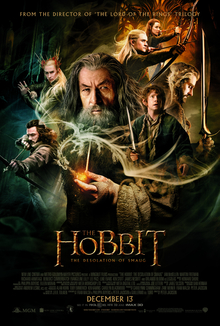
The poster doesn't break any new ground, but it lets you know it is a Lord of The Rings movie in the barrel-riding tradition of Peter Jackson's films.
The former is a title that Bilbo grants himself when addressing the dragon Smaug, and refers to an earlier segment of the book (and the movie) where the party manages to escape wood-elf custody by riding downstream in a bunch of emptied wine barrels. In the film's take on this sequence, Legolas and the new character Tauriel leap from dwarf head to dwarf head, committing stylish orc genocide via bow and elven dagger, with with excessively graceful flourishes and occasional assistance from the bobbing dwarves. The whole scene, and the whole movie, are filled with flagrant convenience.
There are two ways to look at this scene.
The first way is to happily tag along for the ride, as the sequence is like a more violent take on a Disneyland roller coaster. If you enjoy the pairing of fantasy trappings with preposterous, contrived logical leaps and elven acrobatics, you are a "Barrel-rider." A reader who appreciates rollicking adventure regardless of plausibility or depth of world building. You stand with Bilbo Baggins.
The second way is to be disgusted at the childish treatment of the most sacred work in the history of western fantasy literature. If you throw your hands up at absurdly cinematic happenstance and stylized combat, and a presentation that utterly ignores Tolkien's legacy as a folklorist, historian, and linguist, you are one of the Ainur (the predecessors to the Valar, or Middle Earth-bound angels who shepherded the races of Elves, Dwarves and Men) described in tremendous detail by Tolkien in the Simarillion (the ponderous cosmology and early history of Middle Earth).
Between these poles, you have the full experience of Tolkien's offerings. Most children will fall in the barrel-rider camp, while most Tolkien devotees can be described as Ainur. I would argue that both of these views are both flawed and virtuous for their own reasons. Barrel-riders are fundamentally childish and frustratingly prone to accept sillines, but they are also naturally predisposed to enjoy adventure in all its forms. They have the most fun. Ainur are pretentious and dry, but they will appreciate Tolkien on a much deeper intellectual level than anybody who experiences Middle Earth exclusively through the movies (or even exclusively through The Hobbit and Lord of the Rings novels). They truly understand Middle Earth.
Both Hobbit films to date, An Unexpected Journey and Desolation of Smaug, err on the side of barrel-riders, and by the numbers, it is the right call. Tolkien wrote The Hobbit for younger audiences, who are more taken with wacky hijinks like hiding in barrels, and having surprisingly detailed conversations with dragons and trolls that ought to be devouring our heroes instead of chatting them up. The problem, is that the Hobbit films must also be built and marketed as PG-13 action movies pitched towards fans of the original trilogy of Lord of the Rings movies.
The Lord of The Rings trilogy remains Tolkien's most popular work because it strikes the perfect balance between his Ainur fans and his barrel-rider fans--on paper at least. But it is undeniable that Peter Jackson's direction, in both The Hobbit films and Lord of The Rings very heavily favors fans of action. It is really hard to fault him for it though, because truth be told, most people are bored to tears by cosmologies and familial lineages. And most Ainur fans will argue that that is how it ought to be. If you cannot endure the songs, and the genealogies, and the almost biblical takes on creation mythology, then you are not worthy of the total joys of Tolkien's work--never mind the fact that The Hobbit was plotted and paced for younger readers.
The problem with The Hobbit films, is that they try to be too many things to too many people. They struggle to remain faithful to the child's story source material, while integrating the far darker-themed appendices of the Lord of the Rings (which are closer in tone to the Simarillion) and the bloody, violent, PG-13 style of that original trilogy. Perhaps the gravest flaws of Desolation, are its concessions to Hollywood focus testing. "Let's make Legolas a major character because he was so popular in The LOTR Trilogy!" and "Let's invent a love interest (Tauriel) from whole cloth because we need more female characters and people won't watch movies if there isn't romance in it." (That said, as shoe-horned romances go, it was written well, if predictably).
If I were in Peter Jackson's position, and had the benefit of hindsight, I would have made three groups of films. The first would greatly resemble the original Lord of the Rings trilogy that we already have. The second would be a much more kid-friendly, almost story-book (and possibly animated) approach to The Hobbit, and the third would be the Ainur-devoted adaptation of both The Lord of the Rings' appendices and the Simarillion, maybe with a few scraps of Unfinished Tails thrown in (maybe as DVD extra content).
I'm getting off-topic though. The question remains: is Desolation worth your holiday movie-going dollars?
If you are a barrel-rider, the answer is an unqualified "Yes!" Let it be known that Bilbo, THE barrel-rider, is the best part of The Hobbit, both in book and movie form. In fact, the preservation of his inescapable heroism may be the greatest triumph of the movie adaptations.He is a reluctant hero who quickly comes into his own as a charming trickster rogue, relying on quick wit, moments of astounding courage, and a reckless willingness to exploit the dubious powers of The One Ring. Even in the source text, he blows Frodo out of the water by actually taking initiative and using The Ring to achieve unqualified good (albeit at the expense of his own sanity in the long game), rather than moping around, relying on Gandalf and his far stronger-willed gardener to bail his ass out of every hardship. It doesn't hurt that Martin Freeman is much stronger actor than Elijah Wood.
If you are an Ainur however, chances are you already feel the series went astray as soon as it hit the silver screen, or at the very least, as soon as they started adapting The Hobbit.
Ultimately, I have to give the nod to the Barrel-riders though. The set-design, CGI, and production values are all top notch. Even without the surreal benefits of 48 frame 3D, the film is visually breathtaking, with a parade of gorgeous sets that set the imagination alight. The musical score is equal parts haunting and inspiring. And while the romantic subplot is forced and contrived, it is about as good as you could hope it would be. Even if you do not appreciate Jackson's tone and direction, the sheer amount of art present in the movie demands a viewing.
I suspect that There and Back Again will follow a similar pattern to this film... but who knows? If this trilogy does well enough, Ainur fans may finally be treated to a faithful adaptation of the Simarillion.
NOTE: My close friend and chief Ainur fan Andrew Nay asserts that any Simarillion movies will not actually be faithful. And given Jackson's barrel-rider sensibilities, that is a fair point.
Monday, December 2, 2013
Gunn & Bohemia
An embarrassing number of weeks ago, a friend of mine at Xchyler publishing gave me access to a copy of Pete Ford’s debut novel, Mr. Gunn & Dr. Bohemia. It is a good-natured steampunk adventure about Cornelius and Sophie Gunn, a British journalist and his wife who uncover a conspiracy that threatens all of Europe. In order to thwart the plot, they must team up with Dr. Bohemia, a reclusive inventor and scientist.
Despite my belated review, the book is a very quick read boasting easy prose and brisk pacing. Those finding themselves fatigued by the unrelenting grimness of most modern fantasy novels will find relief in Gunn & Bohemia, which is chipper throughout. Even in the wake of grave firefights, or on the lam from the law, our heroes are always in high spirits and rarely succumb to the take-no-prisoners tactics that have become so prevalent in modern fiction.
Unfortunately, this intrepidness and unambiguous morality comes at the expense of distinctive characterization. Most characters suffer from very scant personal histories, posses few personal ties, and the heroes all have very vague aspirations for the future, beyond halting he evil conspiracy they have discovered. They are also short on personal identifiers, and baring a few situations requiring Bohemia's scientific skills, one gets the sense that you could shuffle the characters like a deck of cards in a given situation and end up with a similar outcome. The villains fair no better. The final confrontation is straight out of a Disney flick, right down to peels of evil laughter and a conspicuously convenient refusal to kill the defenseless heroes. The plot has a couple crafty turns to keep you guessing throughout, but it too can feel a bit simple, and Ford’s language also occasionally falls prey to over-familiar metaphors, like ‘lighting bolts of pain.’
The book makes good use of steampunk staples ranging from massive airships and metal prosthetics that put our existing technology to shame, to night-vision goggles, lightning shooting rods, and primitive computers linked to telegraph wires. Even though they have the least impact on the plot, my favorite pieces of fanciful tech in the novel were the Dynamics: a series of moving sculptures wrought from clockwork. Even though the Europe is imperiled by a bunch of hyper-nationalistic bell-ends with napoleon complexes, Ford presents a vision of Europe that is ultimately optimistic, and almost Utopian in tone.
I would not recommend Gunn & Bohemia to everybody, but the mix of rollicking adventure and good humor delivered by distinctly British voice will likely endear itself to fans of Dr. Who. The book also serves as a conceptually pure introduction to the steampunk genre uncomplicated by supernatural or Lovecraftian elements. Even though it is not written as a young adult novel, there is no content more objectionable than what you would expect to find in a Harry Potter novel, lending itself to younger readers as well.
Despite my belated review, the book is a very quick read boasting easy prose and brisk pacing. Those finding themselves fatigued by the unrelenting grimness of most modern fantasy novels will find relief in Gunn & Bohemia, which is chipper throughout. Even in the wake of grave firefights, or on the lam from the law, our heroes are always in high spirits and rarely succumb to the take-no-prisoners tactics that have become so prevalent in modern fiction.
Unfortunately, this intrepidness and unambiguous morality comes at the expense of distinctive characterization. Most characters suffer from very scant personal histories, posses few personal ties, and the heroes all have very vague aspirations for the future, beyond halting he evil conspiracy they have discovered. They are also short on personal identifiers, and baring a few situations requiring Bohemia's scientific skills, one gets the sense that you could shuffle the characters like a deck of cards in a given situation and end up with a similar outcome. The villains fair no better. The final confrontation is straight out of a Disney flick, right down to peels of evil laughter and a conspicuously convenient refusal to kill the defenseless heroes. The plot has a couple crafty turns to keep you guessing throughout, but it too can feel a bit simple, and Ford’s language also occasionally falls prey to over-familiar metaphors, like ‘lighting bolts of pain.’
The book makes good use of steampunk staples ranging from massive airships and metal prosthetics that put our existing technology to shame, to night-vision goggles, lightning shooting rods, and primitive computers linked to telegraph wires. Even though they have the least impact on the plot, my favorite pieces of fanciful tech in the novel were the Dynamics: a series of moving sculptures wrought from clockwork. Even though the Europe is imperiled by a bunch of hyper-nationalistic bell-ends with napoleon complexes, Ford presents a vision of Europe that is ultimately optimistic, and almost Utopian in tone.
I would not recommend Gunn & Bohemia to everybody, but the mix of rollicking adventure and good humor delivered by distinctly British voice will likely endear itself to fans of Dr. Who. The book also serves as a conceptually pure introduction to the steampunk genre uncomplicated by supernatural or Lovecraftian elements. Even though it is not written as a young adult novel, there is no content more objectionable than what you would expect to find in a Harry Potter novel, lending itself to younger readers as well.
Subscribe to:
Posts (Atom)